Choosing the right solar controller matters more with lithium batteries than with lead-acid systems. The wrong settings can waste solar input, limit charging, or shorten battery life.
This roundup highlights lithium-compatible options across PWM and MPPT designs, from compact 10A controllers to higher-capacity smart units for larger 12V and 24V systems.
Best 10 Solar Charge Controller for Lithium Batteries Picks for 2026
Premium Bluetooth MPPT

- Bluetooth app monitoring and setup
- MPPT performs well in partial shade
- Intelligent load output included
Best For: Compact 12/24V lithium systems needing smart app control
Budget Li PWM

- 12V controller for LiFePO4 and lead-acid
- 30A PWM with multi-stage charging
- Compact with built-in protection features
Best For: Simple 12V RV, boat, or off-grid lithium charging
High-Capacity Bluetooth MPPT

- 50A output for larger systems
- Bluetooth app monitoring and setup
- MPPT improves harvest in shade
Best For: Larger 12/24V lithium systems needing higher charging capacity
Value 12V Lithium PWM

- LCD plus LED status monitoring
- Lithium-compatible 12V charging modes
- USB and Type-C output ports
Best For: Budget 12V lithium setups needing easy readout and basic charging
Portable Budget MPPT
Bateria Power SunRock 10 12V MPPT Controller

- Up to 100% MPPT tracking efficiency
- Works with LiFePO4 and other 12V batteries
- Includes LCD, LEDs, and SAE extension cables
Best For: Portable 12V lithium solar setups with easy monitoring and plug-and-play wiring
Feature-Rich MPPT Option
SUNAPEX 12V 10A MPPT Controller
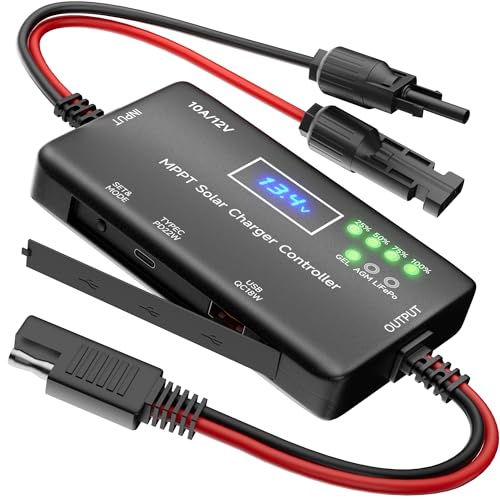
- Supports LiFePO4 and other 12V batteries
- Adds USB and Type-C device charging ports
- Zero battery drain with multiple safety protections
Best For: 12V lithium users wanting extra device-charging ports and real-time monitoring
Smart PWM 30A Option
30A 12V/24V PWM Controller for Lithium Batteries
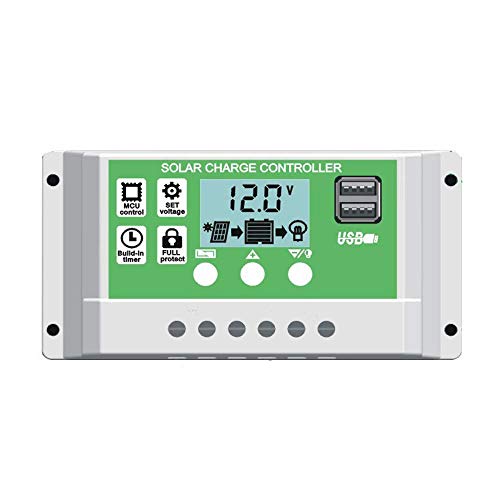
- Works with 12V/24V systems and lithium/LiFePO4 batteries
- LCD shows PV, battery, and load data
- Includes dual USB and multiple safety protections
Best For: Simple lithium-compatible charging with basic display and load control
App-Controlled Feature Pick
30A PWM Controller with Bluetooth APP
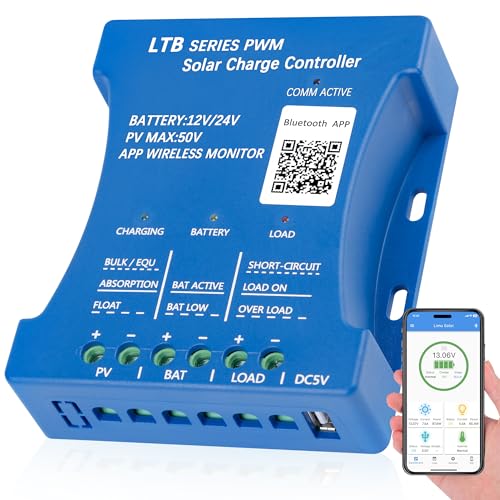
- Bluetooth app shows status and settings remotely
- Supports LiFePO4, lithium, and other battery types
- Includes 7 load modes and multiple protections
Best For: Remote monitoring and flexible load scheduling
Waterproof Slim Pick
10A Waterproof PWM Controller with LCD
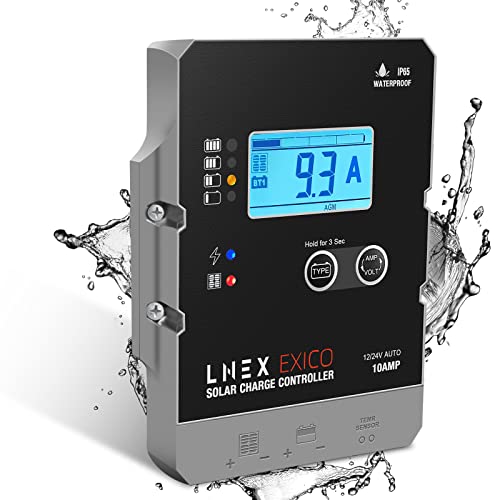
- IP65 waterproof housing for outdoor use
- Auto-detects 12V/24V and supports lithium batteries
- LCD displays current and battery voltage
Best For: Small outdoor systems needing a slim, weather-resistant controller
Premium Bluetooth MPPT – Victron SmartSolar 75V 15A
If you want a solar charge controller for lithium batteries that emphasizes efficiency and smart monitoring, this Victron SmartSolar MPPT is built for that job. Its MPPT tracking and intelligent charging are designed to make the most of available sunlight while helping optimize battery longevity, especially when your panels see mixed or partial shade.
Best For: Users who want app-based control, strong MPPT performance, and a compact controller for 12/24V systems.
Pros:
- Bluetooth connectivity with VictronConnect for real-time data, 30-day history, settings, and firmware updates.
- MPPT charging helps maximize output even when solar panels are partially shaded.
- Can synchronize with multiple SmartSolar controllers for coordinated charging.
- Includes intelligent load output for direct device power and low-voltage disconnect control.
Cons:
- Rated for 12/24V systems, so it is not a universal multi-voltage pick.
- 15A output may be limiting for larger solar arrays.
- No built-in display beyond minimal LED indicators.
Overall, this is a polished choice for lithium-focused setups where monitoring and charging efficiency matter more than raw amperage. It suits compact off-grid builds that benefit from a smarter, app-connected controller.
Budget Li PWM – Renogy Wanderer Li 30A
This solar charge controller for lithium batteries is aimed at simple 12V systems that still need chemistry-aware charging. The Renogy Wanderer Li uses smart PWM control, supports LiFePO4 along with AGM, gel, and flooded batteries, and adds basic monitoring through LED indicators and the optional Bluetooth monitoring path mentioned in the product notes.
Best For: RV, boat, and off-grid users wanting a compact 12V lithium-compatible PWM controller.
Pros:
- Supports LiFePO4 plus AGM, gel, and flooded batteries with selectable charging modes.
- 30A PWM charging with multi-stage bulk, boost, float, and auto equalization.
- Compact form factor fits tight RV or marine spaces.
- Built-in protections include reverse polarity, overcharge, overload, and short circuit.
Cons:
- Designed only for 12V systems.
- PWM design is less advanced than MPPT for harvest efficiency.
- Temperature compensation requires the BT-2 module.
For straightforward 12V lithium charging, this is a practical and space-saving option. It is best when you want compatibility and protection features without moving up to a larger MPPT controller.
High-Capacity Bluetooth MPPT – Victron SmartSolar 100V 50A
If you need a solar charge controller for lithium batteries with more headroom, this Victron SmartSolar MPPT 100/50 is the stronger-capacity sibling to smaller controllers. It keeps the same smart MPPT approach, Bluetooth monitoring, and synchronized charging features, but adds a 50A output for larger 12/24V solar setups that need more charging power.
Best For: Larger lithium battery banks and higher-output 12/24V solar systems.
Pros:
- 50A output supports larger charging loads than smaller controllers.
- MPPT tracking helps maximize solar harvest in varied or shaded conditions.
- VictronConnect app provides real-time data, 30-day history, and configuration tools.
- Load output and synchronized charging add system flexibility.
Cons:
- It is physically larger and heavier than compact controllers.
- No built-in display, relying on app connectivity and minimal indicators.
- May be more controller than needed for small solar builds.
This model makes sense when charging capacity is a priority and you still want Victron’s app-based control. It is a strong fit for bigger lithium systems that need efficient charging and load management.
Value 12V Lithium PWM – 20A LCD 12V Controller
This solar charge controller for lithium batteries is built for basic 12V setups that need easy monitoring and simple installation. It uses 20A PWM charging, supports custom modes for lithium and lead-acid battery types, and adds an LCD screen plus LED indicators so you can check system status at a glance.
Best For: Budget 12V solar setups that want an LCD display and lithium-compatible charging.
Pros:
- Supports lithium, lead-acid, and other battery types with custom charging modes.
- LCD screen and LED indicators make monitoring simple.
- Zero idle drain design helps reduce unnecessary battery loss.
- Includes dual USB and Type-C output ports for charging devices.
Cons:
- Limited to 12V systems and panels below 300W.
- PWM design is less efficient than MPPT for solar harvest.
- No polarity converter is included, so wiring must be correct.
For small 12V lithium builds, this controller offers a useful blend of display features, protection, and accessory charging ports. It is best suited to users who value simplicity and low cost over advanced MPPT performance.
Compact MPPT Pick – SOLPERK 10A 12V Waterproof Controller
If you want a solar charge controller for lithium batteries in a simple 12V setup, this SOLPERK MPPT model focuses on efficient charging and easy monitoring. It is designed for 12V batteries, including LiFePO4 lithium, and uses LED indicators to show panel and battery status at a glance.
Best For: 12V lithium battery users who want a compact, waterproof controller with straightforward plug-and-play setup.
Pros:
- MPPT charging is rated as 30% more efficient than PWM controllers.
- Compatible with LiFePO4, AGM, gel, flooded, sealed, and deep cycle 12V batteries.
- Built-in protections include under-voltage, over-voltage, overload, short circuit, and anti-back-connect.
- SAE port makes installation and connection simple.
Cons:
- Only designed for 12V battery systems.
- Status feedback is limited to indicator lights rather than a full display.
Overall, this is a practical small-format controller for basic 12V lithium solar setups where efficiency, waterproofing, and easy setup matter more than advanced controls.
Portable Budget MPPT – Bateria Power SunRock 10 12V MPPT Controller
For shoppers comparing a solar charge controller for lithium batteries, this Bateria Power SunRock 10 stands out for its 12V-only MPPT charging and portable build. It supports LiFePO4 and other common 12V batteries, while the LCD, LED indicators, and SAE plug-and-play design make it easy to monitor and connect outdoors.
Best For: Portable 12V lithium solar setups that need efficient charging, waterproofing, and an easy-to-carry controller.
Pros:
- MPPT charging claims up to 100% tracking efficiency and faster charge times.
- Compatible with LiFePO4, AGM, gel, flooded, sealed, and lead-acid 12V batteries.
- LCD display and LED lights help monitor charging status.
- Includes SAE extension cables and has waterproof construction.
Cons:
- Must be used only with 12V batteries, not higher-voltage systems.
- PV input must stay within the stated 15V to 30V Voc range.
This is a solid choice if you want a compact MPPT controller with clear usage limits and strong safety features, especially for portable solar projects and lithium battery charging.
Feature-Rich MPPT Option – SUNAPEX 12V 10A MPPT Controller
If you need a solar charge controller for lithium batteries with more monitoring and output options, the SUNAPEX 12V 10A model is built around practical everyday use. It is designed for 12V systems, supports LiFePO4 and other common battery types, and adds USB and Type-C output ports for charging devices directly.
Best For: 12V lithium users who want a compact MPPT controller with device-charging ports and detailed status feedback.
Pros:
- Compatible with LiFePO4, AGM, gel, and lead-acid 12V batteries.
- LCD screen and LED indicators make system status easy to check.
- Includes Type-C and USB output ports for direct device charging.
- Offers multiple protections, including overcharge, reverse polarity, short-circuit, and over-temperature.
Cons:
- Only suitable for 12V batteries, not 24V or 36V packs.
- Does not include a polarity converter, so wiring must be correct.
Overall, this controller is a strong fit for users who want a compact 12V MPPT unit with smart charging stages, zero battery drain, and extra convenience features for small solar systems.
Smart PWM 30A Option – 30A 12V/24V PWM Controller for Lithium Batteries
If you want a solar charge controller for lithium batteries that keeps setup simple, this 30A PWM model covers 12V and 24V systems and supports lithium-ion, LiFePO4, and lead-acid battery types. It adds an LCD display, dual USB output, and built-in protections, making it a practical fit for small off-grid or backup charging setups where basic monitoring matters.
Best For: Users who want a straightforward 30A PWM controller with lithium battery support, LCD readouts, and load timing features.
Pros:
- Supports 12V/24V systems and works with lithium-ion, LiFePO4, and lead-acid batteries.
- LCD display shows PV, battery, and load charging/discharging data.
- Dual USB output provides 5V 2.5A charging for small devices.
- Includes multiple protections such as reverse current, overheat, short-circuit, and overload protection.
Cons:
- Uses PWM charging rather than MPPT technology.
- Load output is intended for DC loads only.
- No Bluetooth or app-based monitoring.
This is a solid value-oriented controller if you need lithium compatibility without extra complexity. The feature set is focused on core control, display feedback, and battery protection rather than advanced remote management.
App-Controlled Feature Pick – 30A PWM Controller with Bluetooth APP
This solar charge controller for lithium batteries is built for buyers who want remote monitoring and flexible load control in one unit. It supports 12V/24V auto matching, works with LiFePO4 and lithium batteries, and adds Bluetooth app control so you can check system status and change settings without being at the controller.
Best For: Users who want app-based monitoring, 7 load modes, and broad battery compatibility in a 30A PWM controller.
Pros:
- Bluetooth app support lets you monitor battery type, load mode, and device status remotely.
- Compatible with Sealed, Gel, Flooded, LiFePO4, Lithium, and other battery types.
- Offers 7 load modes, including manual, dusk-to-dawn, repeat, and segmented timing.
- Includes built-in protections against overvoltage, overcurrent, short circuit, overheating, and reverse connection.
Cons:
- Uses PWM charging, not MPPT.
- USB output is limited to 5V/1.5A.
- First-time setup requires correct battery connection and proper voltage for auto पहचान.
For users who value convenience and configuration flexibility, this controller stands out with app-based control and multiple lighting/load modes. It is especially useful when you want to fine-tune behavior without relying on onboard buttons alone.
Waterproof Slim Pick – 10A Waterproof PWM Controller with LCD
If you need a compact solar charge controller for lithium batteries in a small system, this 10A LNEX unit focuses on waterproof durability and easy visual monitoring. It automatically detects 12V or 24V systems, supports LiFePO4 and lithium batteries, and is designed for outdoor use with an IP65 waterproof rating.
Best For: Small charging setups that need a slim, waterproof controller with LCD monitoring.
Pros:
- IP65 waterproof design is suitable for rain, spray, and condensation.
- Backlit LCD and LED indicators show real-time solar current and battery voltage.
- Supports 12V/24V systems and multiple battery types, including LiFePO4 and lithium.
- Built-in protections cover over temperature, over voltage, over current, over charging, over discharging, overload, and short circuit.
Cons:
- Limited to 10A output, so it suits smaller systems.
- PWM design may not fit users looking for higher-efficiency MPPT charging.
- Fewer advanced control features than Bluetooth-enabled models.
This is a strong choice when weather resistance and compact size matter more than advanced controls. It keeps the feature set practical while still offering the battery support and protection most small lithium setups need.
How We Picked the Best Solar Charge Controller for Lithium Batteries
We focused on lithium compatibility, charging control, system voltage support, current capacity, and overall practicality for real off-grid and backup power use. Priority went to controllers that clearly support LiFePO4 or lithium settings, include useful protections, and match common panel-and-battery sizes.
Quick Comparison
MPPT models are the better choice when you want more energy harvest, especially in colder weather, partial shade, or with higher-voltage panels. PWM models can still make sense for simpler, lower-cost setups where panel voltage is closely matched to the battery bank and maximum efficiency is less important.
Key Buying Factors for a Solar Charge Controller for Lithium Batteries
Battery Profile Support
Look for a true lithium or LiFePO4 charge profile, not just generic “12V” labeling. Adjustable absorption and float settings are a plus if you want to match your battery maker’s recommendations.
Controller Type and Efficiency
MPPT controllers usually outperform PWM units by converting excess panel voltage into usable charging power. That matters most with larger arrays, colder climates, or mixed sun conditions.
System Voltage and Current Headroom
Make sure the controller matches your system voltage and has enough amperage for your solar array. Leaving headroom helps prevent overheating and nuisance limiting when panels produce at peak output.
Protections and Monitoring
Reverse polarity, overcharge, short-circuit, temperature, and low-voltage protections are important for both battery safety and controller longevity. Bluetooth or LCD monitoring can also make setup and troubleshooting much easier.
Build Quality and Installation Fit
Waterproof housing, compact dimensions, and clear terminals matter if the controller will be mounted in a van, boat, shed, or outdoor enclosure. Choose a form factor that suits your available space and ventilation.
Who Should Buy Which Solar Charge Controller for Lithium Batteries?
If you have a small portable or budget setup, a 10A or 20A PWM controller may be enough, especially for a single battery and modest panel wattage. If you want better charging performance, more flexible panel placement, or a more future-proof system, an MPPT controller is the smarter long-term pick.
For larger lithium banks or expanded solar arrays, choose a higher-amp smart MPPT model with app-based monitoring and configurable charge parameters. For simple 12V LiFePO4 systems, the best Solar Charge Controller for Lithium Batteries is usually the one that balances correct charging settings, adequate current rating, and reliable protections over extra features you may never use.