Low water pressure can turn ordinary showers, appliances, and outdoor watering into frustrating chores. The right booster pump can improve flow, stabilize pressure, and make better use of an existing supply system.
This roundup compares 10 water pressure booster pumps across whole-house, shallow-well, irrigation, RV, and on-demand applications. Pay close attention to pressure ratings, flow capacity, controls, and installation requirements before choosing.
Best 10 Water Pressure Booster Pumps Picks for 2026
Best Smart Whole-House Value
1.2 HP EVO BOOST5 Booster Pump

- 26.5 GPM variable-speed flow
- Smart Life App remote control
- 50 dB operation with safety protections
Best For: Whole-house pressure boosting with wireless monitoring
Best Established Residential Option
Grundfos SCALA1 3-45 Booster Pump

- 15.8 GPM residential flow
- Dry-run, cycling, and runtime protection
- Compact stainless steel design
Best For: Moderate-demand residential pressure boosting
Best High-Flow Whole-House Pick
1.5 HP EVO BOOST8 Booster Pump
- 53 GPM variable-speed capacity
- Supports up to 12 faucets
- App control and 50 dB operation
Best For: Large homes and high simultaneous water demand
Best Versatile Transfer Pump

- 131-foot maximum lift
- Self-priming for transfer and irrigation
- Includes hose adapters and PTFE tape
Best For: Gardens, tanks, shallow wells, and water transfer
Best Whole-House Pick
PM750S Constant-Pressure Booster
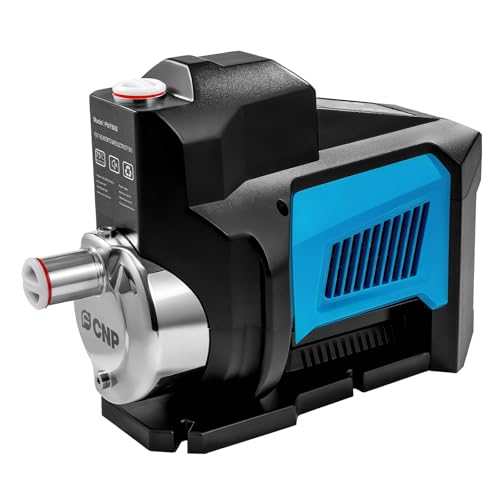
- Up to 1,532 GPH and 164-foot maximum head
- Variable-speed control supports steady pressure
- Quiet, protected stainless-steel design
Best For: Multi-floor homes and whole-house water boosting
Best Smart-Control Pick

- Up to 1,500 GPH and 170-foot maximum head
- Wireless app control with OTA updates
- Quiet, compact variable-speed design
Best For: Smart whole-house installations with limited access
Best High-Pressure Diaphragm Pump

- 5.5 GPM flow with 70 PSI pressure switch
- Self-primes to 9.8 feet and lifts to 131 feet
- Thermal overload protection and automatic operation
Best For: Garden irrigation, cleaning, hose spraying, and RV water transfer
Best for Home Water Boosting

- 1.6 HP motor with 164-foot maximum head
- Five-gallon tank with automatic 20–40 PSI cycling
- Stainless steel housing and two-year warranty
Best For: Residential supply, shallow wells, irrigation, and sprinkler systems
Best Portable RV Booster

- Automatic start/stop for tap-controlled water flow
- Dry-run, overload, and overheat protection
- Includes filter, fittings, tape, and mounting accessories
Best For: RV, marine, boat, household, and garden applications
Best Smart Whole-House Value – 1.2 HP EVO BOOST5 Booster Pump
For households seeking water pressure booster pumps with app control and steady demand-based performance, the EVO BOOST5 combines a 1.2 HP variable-frequency motor with adjustable pressure from 22 to 92 PSI. Its 26.5 GPM flow rating is designed to support up to eight faucets across three floors.
Best For: Whole-house pressure boosting, showers, shallow wells, storage tanks, and clean-water irrigation where wireless monitoring is useful.
Pros:
- Variable-speed operation automatically adjusts to water demand.
- Wireless Smart Life App control provides pressure, energy, and temperature monitoring.
- Stainless steel construction, quiet 50 dB operation, and built-in dry-run and electrical protections.
- Includes a three-year full warranty and supports 1-inch MNPT connections.
Cons:
- Its 1-inch ports and 26.5 GPM rating provide less capacity than the larger EVO BOOST8.
- The pump is relatively large at 20.7 by 10.8 by 16.3 inches.
The EVO BOOST5 is a capable choice when quiet operation, app-based control, and consistent pressure matter more than maximum flow. Confirm the 1-inch plumbing connections and available installation space before buying.
Best Established Residential Option – Grundfos SCALA1 3-45 Booster Pump
The SCALA1 3-45 is one of the more compact water pressure booster pumps for residential plumbing, offering 15.8 GPM flow from a 1 HP, 115V motor. Its protection features focus on preventing damage from dry running, frequent cycling, and extended operation.
Best For: Residential pressure boosting, groundwater intake, rainwater harvesting, and installations where a compact stainless steel pump is preferred.
Pros:
- Compact dimensions of 15.9 by 7.6 by 11.9 inches.
- Dry-running protection stops the pump when water is unavailable.
- Cycling and maximum-runtime protection help address leaks and pipe-break situations.
- Stainless steel construction and a 24-month-from-startup or 30-month-from-date-code manufacturer warranty.
Cons:
- Its 15.8 GPM flow rating is lower than the other whole-house options in this roundup.
- The supplied notes do not specify wireless app control or an adjustable pressure range.
Choose the SCALA1 when compact residential installation and layered automatic protection are priorities. Its lower flow rating makes it better suited to moderate household demand than high-flow, multi-faucet applications.
Best High-Flow Whole-House Pick – 1.5 HP EVO BOOST8 Booster Pump
The EVO BOOST8 is designed for buyers who need higher-capacity water pressure booster pumps. Its 1.5 HP permanent-magnet motor delivers up to 53 GPM, with adjustable pressure from 22 to 92 PSI and support for as many as 12 faucets across three floors.
Best For: Larger homes, high simultaneous water demand, showers, storage tanks, shallow wells, and irrigation systems requiring higher flow.
Pros:
- High 53 GPM flow rating for demanding whole-house applications.
- Variable-speed control maintains pressure according to water demand.
- Smart Life App supports remote status, pressure, energy, and temperature monitoring.
- Stainless steel body, 50 dB operation, and built-in dry-run, overcurrent, and voltage protection.
Cons:
- The 1.25-inch MNPT ports may require larger plumbing or adapters.
- Its 20.7 by 10.8 by 16.3-inch housing needs substantial installation space.
- The higher-capacity design may be more pump than a small household requires.
With its 53 GPM rating and support for up to 12 faucets, the EVO BOOST8 is the strongest fit here for high-demand homes. Verify that the plumbing system, electrical supply, and available space match its larger connection and installation requirements.
Best Versatile Transfer Pump – LEO 1.5 HP Smart-Control Pump
The LEO 1.5 HP pump is a versatile option among water pressure booster pumps, especially for transfer and irrigation tasks. It is self-priming, can lift water up to 131 feet, and can operate as a pressure booster when paired with a regulator.
Best For: Lawn and garden irrigation, shallow wells, rain barrels, pools, water tanks, ponds, lakes, and clean-water transfer.
Pros:
- Self-priming design with a stated maximum lifting height of 131 feet.
- Suitable for irrigation, tank draining, shallow wells, and rainwater transfer.
- Stainless steel casing, aluminum motor housing, and carbon-ceramic mechanical seal.
- Includes two 3/4-inch NPT garden hose adapters, PTFE tape, and a 24-month warranty.
Cons:
- The notes identify a 980 GPH transfer rate, which is lower than the EVO BOOST models’ listed flow ratings.
- It requires a regulator to function as a pressure booster.
- The supplied notes emphasize manual shutoff after use rather than fully automatic demand operation.
This LEO pump is a practical choice when one portable unit must handle irrigation and water transfer, with occasional pressure-boosting use. It is less specialized for automatic whole-house constant-pressure service than the dedicated booster pumps in this roundup.
Best Whole-House Pick – PM750S Constant-Pressure Booster
For shoppers comparing water pressure booster pumps, the PM750S stands out as a whole-house option designed for steady pressure across multiple fixtures. Its 750W variable-frequency motor can deliver up to 1,532 GPH, support pressure settings from 22 to 80 PSI, and serve up to 10 faucets across three floors.
Best For: Whole-house residential or light-commercial water boosting where quiet, automatically adjusted pressure is a priority.
Pros:
- Variable-speed control maintains consistent pressure as water demand changes.
- High 164-foot maximum head and self-priming design suit multi-floor homes.
- Quiet operation is rated as low as 25–40 dB, with energy-efficient permanent-magnet motor technology.
- Includes dry-run and power-failure protection, plus a corrosion-resistant stainless-steel pump head.
Cons:
- Its larger 16.93-by-9.06-by-13.39-inch size may require careful installation planning.
- The advanced whole-house design may be more than needed for a single faucet or occasional transfer task.
Choose this model when you want a dedicated, quiet pressure-boosting system with automatic control and enough capacity for broad household use.
Best Utility Value – 1.5HP Mechanical Booster Pump
This 1.5HP model is a straightforward choice among water pressure booster pumps for users who prefer mechanical automatic control. It provides up to 1,600 GPH and a 100-foot maximum head, making it suitable for pressure boosting, irrigation, drainage, and general water-transfer jobs.
Best For: Buyers seeking a versatile, self-priming pump for showers, irrigation, basements, pools, ponds, or emergency water transfer.
Pros:
- Strong 1.5HP motor delivers up to 1,600 GPH.
- Mechanical pressure switch automatically starts and stops the pump.
- Self-priming design supports relatively simple setup.
- Overheat and dry-run protection help protect the motor during operation.
Cons:
- The mechanical switch does not support custom pressure adjustment.
- Its 100-foot maximum head is lower than the other listed whole-house models.
- Cast-iron construction may be less appropriate for shoppers prioritizing stainless-steel water-contact components.
This is a practical, multi-purpose pump when simple automatic operation matters more than app control or finely adjustable constant pressure.
Best Smart-Control Pick – GWANZI App-Controlled Booster
The GWANZI combines whole-house water boosting with wireless monitoring and variable-speed control. Its 900W permanent-magnet motor offers up to 1,500 GPH, a 170-foot maximum head, and adjustable pressure from 15 to 90 PSI, making it one of the more feature-rich water pressure booster pumps in this group.
Best For: Homes, villas, and apartments where remote pressure adjustments, compact installation, and quiet operation are especially useful.
Pros:
- Wireless app control allows pressure adjustment, mode changes, monitoring, and OTA firmware updates.
- Variable-speed operation provides constant-pressure boosting with up to 1,500 GPH flow.
- Water cooling keeps operating noise around 30 dB.
- Compact integrated design uses aligned one-inch NPT inlet and outlet connections.
Cons:
- App connection distance is approximately 30 feet, which may limit remote access depending on installation location.
- Setup and firmware maintenance may be less straightforward than a basic mechanical-switch pump.
- Maximum pressure depends on the water-supply method; the notes specify up to 80 PSI from mains water and 58 PSI from a water tank.
Consider this model if smart monitoring and compact, quiet installation are worth prioritizing over the simplicity of a traditional mechanical control.
Best High-Pressure Diaphragm Pump – 5.5 GPM 70 PSI AC Pump
For straightforward water pressure booster pumps use around the home, garden, RV, or workshop, this ECO-WORTHY model combines a 5.5 GPM flow rate with a 70 PSI pressure switch. Its automatic start/stop operation and self-priming design make it practical for tasks that need water on demand.
Best For: Garden irrigation, hose spraying, cleaning, and residential or recreational water transfer.
Pros:
- Delivers 5.5 GPM with a factory-set 70 PSI pressure switch.
- Self-primes up to 9.8 vertical feet and lifts water up to 131 feet.
- Includes thermal overload protection that disconnects the circuit if the motor overheats.
- Can run continuously for more than one hour according to the supplied specifications.
Cons:
- Requires a 110V AC corded electrical connection.
- Its 9.8-foot self-priming height may not suit deeper water sources.
- It is a pump-only package, with no pressure tank listed among the included components.
This is a useful choice when you want strong on-demand pressure in a relatively compact diaphragm-pump format. Verify the electrical supply, hose connections, and required lift before installation.
Best for Home Water Boosting – 1.6 HP Jet Pump with Tank
This Aquastrong model is one of the more substantial water pressure booster pumps for residential supply and irrigation. It pairs a 1.6 HP motor with a five-gallon pressure tank, automatic 20-to-40 PSI cycling, and a claimed maximum head of 164 feet.
Best For: Home water boosting, shallow wells, garden irrigation, lawn sprinklers, cabins, and farms.
Pros:
- 1.6 HP motor provides strong suction up to 26 feet and a maximum head of 164 feet.
- Five-gallon pressure tank helps prolong service life and supports automatic operation.
- Stainless steel housing resists corrosion and the carbon-ceramic seal helps prevent leakage.
- Includes a pressure gauge, garden hose adapters, PTFE tape, and a two-year warranty.
Cons:
- Priming is required before startup.
- The larger 17.9-by-10.9-by-19.7-inch body needs more installation space.
- It must be protected from freezing during winter.
With its pressure tank and well-pump configuration, this unit is better suited to a more permanent installation than occasional portable use. Its pre-assembled design can simplify setup, but confirm the shallow-well depth and available space first.
Best Portable RV Booster – 5.5 GPM 75 PSI Diaphragm Pump
For portable water pressure booster pumps, the Tdrsuper 110V diaphragm pump offers automatic tap-controlled operation and a compact package aimed at RV, marine, kitchen, bathroom, and garden use. It also includes a filter, fittings, tape, and mounting hardware to help with installation.
Best For: RVs, boats, marine applications, household taps, and lawn or garden water delivery.
Pros:
- Provides up to 5.5 GPM flow with adjustable factory-set pressure around 70 PSI.
- Automatically starts when a tap opens and stops when it closes.
- Offers overload, overheat, and dry-run protection, plus a vibration-reducing mounting design.
- Package includes a filter with a 50-mesh stainless steel screen, fittings, tape, and a spanner.
Cons:
- Designed for 110V AC power rather than battery-only operation.
- The supplied details list a 102-foot maximum lift, lower than some comparable claims in this category.
- Warranty coverage is limited to 180 days.
This pump stands out for flexible installation and included accessories, especially where automatic faucet operation matters. Its dry-run and thermal protections add reassurance for RV or marine use, but check that the 110V supply and included fittings match your setup.
How We Picked These Water Pressure Booster Pumps
We selected models representing the main ways homeowners and property managers solve low-pressure problems: whole-house boosting, shallow-well supply, garden irrigation, utility use, RV systems, and compact on-demand applications. We compared advertised pressure, flow, motor size, voltage, head height, pump controls, self-priming capability, and intended use.
Specifications can vary by installation conditions, and maximum PSI or GPH figures are not the same as performance at every fixture. Use the comparison below as a screening tool, then confirm the manufacturer’s installation instructions, plumbing connections, electrical requirements, and warranty coverage.
Quick Comparison
| Best For | What to Prioritize | Models to Consider |
|---|---|---|
| Whole-house pressure boosting | Automatic control, steady pressure, adequate flow | SCALA1 3-45; 1.2 HP and 1.5 HP whole-house models |
| Shallow wells and home supply | Self-priming operation, head height, pressure switch | LEO; Aquastrong; automatic 1.5 HP model |
| Irrigation and garden use | Flow rate, lift capacity, duty cycle | Aquastrong; higher-flow 1.5 HP booster |
| RV, cabin, or compact systems | Low-voltage complexity, on-demand control, compact size | ECO-WORTHY; Tdrsuper |
Key Buying Factors for Water Pressure Booster Pumps
Pressure and Flow
PSI indicates pressure, while GPM or GPH indicates how much water the pump can move. A pump with a high maximum PSI may still provide disappointing results if its flow falls sharply at the pressure your home needs. Consider simultaneous use, such as a shower and washing machine running together, rather than choosing from the headline rating alone.
Head Height and Water Source
Maximum head is especially important for wells, elevated tanks, and irrigation. Calculate vertical lift plus friction from pipe length, elbows, filters, and valves. Self-priming designs can simplify startup, but they still require correct suction plumbing and a suitable water source.
Controls and Installation
Automatic controllers and pressure switches can start the pump when a tap opens and stop it when demand ends. Variable-speed or constant-pressure systems may provide smoother output, while simpler mechanical switches can be easier to service. Check voltage, amperage, pipe size, inlet conditions, check valves, and whether a pressure tank or dry-run protection is required.
Construction and Operating Environment
Stainless-steel housings can suit damp or outdoor locations, but weather exposure still requires proper protection. Confirm temperature limits, noise expectations, filtration needs, and whether the pump is approved for potable water. Never use a pump for drinking-water service unless its materials and certifications support that application.
Who Should Buy Which Water Pressure Booster Pumps?
Choose a dedicated whole-house booster when multiple fixtures need stronger, more consistent pressure. A variable-speed or integrated-control model is usually the better fit for households that value stable pressure and frequent demand changes. For a shallow well, prioritize self-priming capability, pressure-switch operation, and sufficient head height. Garden and irrigation users should focus on flow and lift rather than maximum PSI alone.
Compact diaphragm pumps are better suited to RVs, cabins, utility sinks, and localized water delivery than to supplying a large home. If your incoming supply is inadequate, the pump cannot create water that is not available; verify source flow and consider a storage tank or professional plumbing assessment when necessary.