The best cordless dust extractors make it easier to control fine dust without dragging a large vacuum and extension cord across the jobsite. The right model can improve cleanup, protect filters, and connect directly to compatible power tools.
We selected 10 leading options from Makita, DEWALT, Bosch, and Festool, covering compact cordless vacuums, high-capacity extractors, HEPA filtration, automatic filter cleaning, and demanding professional applications.
Best 10 Cordless Dust Extractors Picks for 2026
Best Compact Kit
Makita XCV11T 18V LXT 2-Gallon HEPA Extractor

- 10.1-pound portable design
- HEPA filtration for fine particles
- Battery, charger, hose, and nozzles included
Best For: Mobile cleanup with a complete cordless kit
Best High-Airflow Cordless Option
DEWALT FLEXVOLT 60V MAX Dust Extractor

- 125 CFM airflow
- Automatic cleaning with dual HEPA filters
- Wireless control and T-Stak compatibility
Best For: Demanding construction-site dust collection
Best Dual-Battery Runtime
Makita XCV07ZX 18V X2 HEPA Vacuum

- 74 CFM and 39 inches of water lift
- Up to 75 minutes on low
- Three-stage HEPA filtration
Best For: Makita users with two 18V LXT batteries
Best Heavy-Duty Capacity
Bosch VAC090AH 9-Gallon Dust Extractor

- 9-gallon collection capacity
- 150 CFM airflow
- Automatic filter cleaning every 15 seconds
Best For: High-capacity corded workshop and jobsite extraction
Premium Cordless Performance
- 36V turbine with two 18V batteries
- HEPA filtration for cordless applications
- Three power levels and compact mobility
Best For: Festool users needing powerful cordless extraction
Most Portable Cordless Extractor

- Lightweight 3.7-pound design
- Included HEPA filter
- Strap points and wireless tool control
Best For: Portable drilling and chipping dust collection
High-Capacity Wet/Dry Option
Makita VC4210L 11-Gallon Extractor

- 11-gallon wet/dry capacity
- 148 CFM suction with automatic filter cleaning
- HEPA filtration and tool-activated outlet
Best For: Extended workshop and jobsite extraction
Compact HEPA Pick

- HEPA filtration with AutoClean system
- 15-liter container for extended cleanup
- Compact chassis with included nozzles
Best For: Portable workshop, home, and upholstery cleanup
High-Capacity Jobsite Choice
- 8-gallon capacity with automatic filter cleaning
- 15-amp motor and 150 CFM airflow
- Power-tool actuation and 15-foot hose
Best For: Extended jobsite and workshop dust collection
Connected Compact Option

- Bluetooth remote start and stop
- HEPA filtration with automatic tool start
- Compact four-wheel chassis and tool-free changes
Best For: Indoor woodworking and construction with connected control
Best Compact Kit – Makita XCV11T 18V LXT 2-Gallon HEPA Extractor
The Makita XCV11T is a practical choice among cordless dust extractors when portability and included equipment matter. Its brushless motor delivers 57 CFM and 27 inches of water lift, while the HEPA filter supports fine-particle capture for wet or dry cleanup.
Best For: Mobile users who want a compact, ready-to-use extractor with batteries, charger, hose, and nozzles included.
Pros:
- Compact 10.1-pound design with a 2-gallon capacity
- HEPA filtration captures 99.97% of particles 0.3 microns and larger
- Up to 60 minutes of runtime with the included 5.0Ah battery
- Includes a 6.5-foot anti-static hose and multiple nozzles
Cons:
- Lower airflow than the larger extractors in this roundup
- Limited to a 2-gallon collection capacity
Choose this model when easy transport and a complete cordless kit are more important than maximum airflow or capacity. Its two power levels and filter-cleaning system add flexibility for routine cleanup.
Best High-Airflow Cordless Option – DEWALT FLEXVOLT 60V MAX Dust Extractor
The DEWALT DCV585B stands out among cordless dust extractors for higher airflow and jobsite-focused features. It produces 125 CFM, includes automatic filter cleaning and dual HEPA filters, and supports wet or dry applications.
Best For: Construction users needing strong dust collection, wireless activation, and compatibility with DEWALT T-Stak storage systems.
Pros:
- 125 CFM airflow for demanding dust-extraction applications
- Automatic filter cleaning with dual HEPA filters
- Wireless Tool Control enables remote or tool-based on/off operation
- Includes an 8-foot anti-static AIRLOCK hose
Cons:
- Battery is not listed among the included components
- Heavier and louder than the compact Makita option
- Only one power level is specified
This is a strong fit for users already invested in the FLEXVOLT or DEWALT jobsite ecosystem. Its wireless controls, hose storage, and T-Stak compatibility make it particularly suited to active construction setups.
Best Dual-Battery Runtime – Makita XCV07ZX 18V X2 HEPA Vacuum
The Makita XCV07ZX uses two 18V LXT batteries to provide 74 CFM of airflow and 39 inches of water lift. For shoppers comparing cordless dust extractors, its three-stage HEPA filtration and extended low-setting runtime make it a useful option for longer cleanup sessions.
Best For: Makita 18V LXT users who already own two batteries and want longer cordless operation.
Pros:
- 74 CFM airflow and 39 inches of water lift
- Three-stage HEPA filtration captures 99.97% of particles 0.3 microns and larger
- Up to 75 minutes of runtime on low or 40 minutes on high
- Brushless motor is electronically controlled for efficient battery use
Cons:
- Batteries and charger are not included
- Requires two 18V LXT batteries to operate
- Only a 90-day limited warranty is listed
This model makes the most sense for existing Makita users with two compatible batteries. It offers more airflow and water lift than the smaller XCV11T, though the battery requirement increases the initial setup cost.
Best Heavy-Duty Capacity – Bosch VAC090AH 9-Gallon Dust Extractor
The Bosch VAC090AH is the corded choice in this roundup of cordless dust extractors, trading battery freedom for sustained power and substantially greater capacity. Its 150 CFM airflow, 97-inch static water lift, automatic filter cleaning, and HEPA filtration suit demanding workshop and jobsite use.
Best For: Users who prioritize maximum capacity, continuous corded operation, and power-tool dust extraction over cordless portability.
Pros:
- Large 9-gallon capacity for longer work sessions
- 150 CFM airflow and 97 inches of static water lift
- Automatic filter cleaning every 15 seconds
- Power-tool activation and adjustable suction through the Power Broker dial
Cons:
- Not cordless; it requires a 120-volt power source
- Heavier at 28 pounds than the portable battery models
- Less convenient where outlet access is limited
Although it does not meet the cordless brief, the VAC090AH is worth considering when performance and capacity come first. Its wheels, automatic cleaning, and tool activation make it a capable stationary or jobsite extractor.
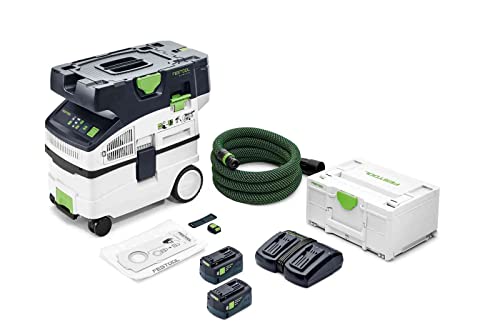
Premium Cordless Performance – Festool CTC MIDI I HEPA-Plus
Festool Cordless Mobile Dust Extractor CLEANTEC CTC MIDI I HEPA-Plus 577069+577079
Check Price On AmazonThe Festool CTC MIDI I HEPA-Plus is a full-size option for cordless dust extractors, pairing a 36V turbine with two 18V battery packs. It is designed for cordless sawing, sanding, and drilling, with three extraction-power levels and a compact mobile form.
Best For: Festool users who want cord-free extraction for demanding workshop and jobsite applications.
Pros:
- 36V turbine is designed to provide power comparable to a corded extractor.
- HEPA filtration and a SELFCLEAN filter bag support virtually dust-free applications.
- Compact, mobile design weighs about 30 lb. or less depending on battery selection.
- Three extraction-power levels provide useful adjustability.
Cons:
- Requires two compatible 18V battery packs.
- Listed runtime is 16 minutes.
- At 76 dB, it is not a particularly quiet extractor.
This is the most capable cordless-focused choice in the group, especially for users already invested in Festool batteries and tools. Its short listed runtime makes spare battery packs worth considering for extended work.
Most Portable Cordless Extractor – DEWALT DWH161B Universal
The DEWALT DWH161B is a compact pick among cordless dust extractors, weighing just 3.7 pounds and offering a HEPA filter. Its strap points, belt hook, and wireless tool-control capability make it particularly practical for drilling and chipping with SDS Plus rotary hammers.
Best For: Tradespeople who prioritize lightweight, wearable dust extraction for drilling and chipping.
Pros:
- Compact 3.7-pound design is easy to carry.
- HEPA filter is included.
- Multiple strap points and a belt hook support ergonomic positioning.
- Wireless Tool Control can link the extractor and tool for remote activation.
Cons:
- Battery and charger are not included because this is a tool-only model.
- One power level offers less adjustment than larger extractors.
- Its listed runtime is only 3 minutes.
The DWH161B favors mobility over capacity, making it a sensible choice when a full-size extractor would be cumbersome. Check battery availability and runtime expectations before relying on it for longer sessions.
High-Capacity Wet/Dry Option – Makita VC4210L 11-Gallon Extractor
The Makita VC4210L is a high-capacity alternative to compact cordless dust extractors, using an 11-gallon wet/dry design and a 12-amp motor. It delivers 148 CFM of suction, automatic filter cleaning, and tool-activated operation for workshop and jobsite cleanup.
Best For: Users who need substantial capacity and strong suction for extended wet/dry extraction tasks.
Pros:
- 11-gallon capacity reduces the need for frequent emptying.
- 12-amp motor generates 148 CFM of suction and 92 inches of water lift.
- Automatic filter cleaning helps extend filter life.
- HEPA filtration captures 99.97% of particulates 0.3 microns and larger.
Cons:
- It is corded rather than battery powered.
- Its larger wet/dry format is less portable than compact extractors.
- It may be more capacity than needed for small, quick tasks.
Choose the VC4210L when capacity and sustained extraction matter more than cordless freedom. Its tool-activated outlet and automatic filter cleaning make it well suited to longer workshop sessions.
Compact HEPA Pick – Festool CT 15
The Festool CT 15 is a compact option for shoppers comparing cordless dust extractors, although this model uses corded electric power. Its HEPA filter, adjustable high-performance turbine, automatic tool start, and 15-liter container make it suited to portable cleanup around workshops, homes, and jobsites.
Best For: Mobile indoor and outdoor cleanup, upholstery, carpets, bare floors, and users who value compact storage.
Pros:
- HEPA filtration with high-performance suction and an AutoClean system.
- Generous 3.96-gallon (15-liter) container for fewer interruptions.
- Compact, lightweight design with steel-axle chassis and integrated tool storage.
- Includes crevice and upholstery cleaning accessories.
Cons:
- It is corded rather than cordless.
- Single speed and single power level offer limited adjustment.
The CT 15 is a practical choice when portability, HEPA filtration, and included accessories matter more than battery operation. Its durable chassis and compact footprint make it easy to move and store.
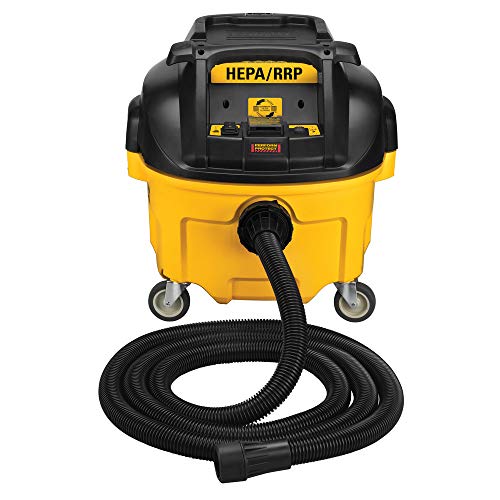
High-Capacity Jobsite Choice – DEWALT DWV010
The DEWALT DWV010 is a high-capacity dust extractor for buyers comparing cordless dust extractors, but it operates from a corded 120-volt power source. Its 15-amp motor, automatic filter cleaning, HEPA filter, and power-tool actuation support continuous jobsite use.
Best For: Jobsite dust collection, power-tool use, garage cleanup, and applications needing an 8-gallon canister.
Pros:
- Automatic filter cleaning pulses every 30 seconds to support continuous operation.
- 15-amp motor delivers 150 CFM of airflow.
- Power-tool actuation controls the extractor with a connected tool.
- Heavy-duty wheels and casters, universal swivel hose connector, and 15-foot anti-static hose.
Cons:
- It is corded and weighs 22 pounds.
- Its listed noise level is 80 dB.
- EPA RRP compliance for HEPA vacuums applies only when DWV9330 filters are used.
Choose the DWV010 when capacity and automatic filter maintenance are priorities. Its larger canister and long hose favor sustained workshop or renovation work, while the corded design limits cordless flexibility.
Connected Compact Option – Festool CT MIDI I
The Festool CT MIDI I combines a compact format with HEPA filtration, automatic tool start, and Bluetooth control. Although it is not cordless and uses corded electric power, it stands out among cordless dust extractors for users who want remote operation and flexible hose management.
Best For: Construction, woodworking, hardwood, tile, and other indoor jobs where compact mobility and remote control are useful.
Pros:
- Integrated Bluetooth lets users start and stop the extractor remotely.
- HEPA filter, automatic tool start, and manual filter cleaning help maintain suction.
- Compact, lightweight chassis with four wheels for easier movement.
- Tool-free filter changes, internal hose garage, and smooth suction hose improve convenience.
Cons:
- It is corded rather than battery powered.
- Single speed and single power level limit customization.
- The supplied notes do not specify container capacity.
The CT MIDI I is a strong fit for users who prioritize connected controls and easy handling. Bluetooth operation and tool-free maintenance add convenience, while the compact chassis suits indoor construction and woodworking tasks.
How We Picked the Best Cordless Dust Extractors
We compared these extractors by portability, dust capacity, filtration, suction control, tool compatibility, battery platform, and jobsite practicality. Because the list includes both battery-powered and corded professional extractors, we also considered whether each model is best suited to quick mobile cleanup, tool-connected dust collection, or longer high-volume work.
HEPA filtration was a priority for fine construction dust, while automatic filter cleaning and tool-start functions helped distinguish models designed for continuous sanding, cutting, grinding, or routing. We also considered the availability of batteries, chargers, hoses, adapters, and replacement filters.
Quick Comparison
Compact cordless models such as the Makita XCV11T and DEWALT DWH161B are convenient for punch-list work, drilling, and localized cleanup. Larger battery-powered units, including the DEWALT FLEXVOLT DCV585B and Makita XCV07ZX, offer more capacity and stronger support for demanding applications.
The Bosch, Festool, and larger Makita models are better choices when maximum capacity, automatic cleaning, long runtimes, or sustained tool extraction matter more than eliminating the power cord. Check the exact package contents carefully: some listings include batteries and chargers, while others are tool-only or require separate accessories.
Key Buying Factors for Cordless Dust Extractors
Battery Platform and Runtime
Choose a model that matches batteries you already own when possible. Compact units are easier to carry but may require frequent battery changes during heavy use. Dual-battery and FLEXVOLT systems generally provide more usable runtime and power, but add weight and cost.
Capacity and Portability
A small canister is ideal for mobile drilling and short jobs. Larger tanks reduce emptying interruptions and work better with saws, sanders, and grinders, though they are less convenient on ladders or in finished spaces.
Filtration and Dust Control
For silica, drywall, wood, and other fine particles, look for HEPA filtration, a sealed system, and reliable filter-cleaning features. Verify local requirements for hazardous dust and use the correct bags, filters, and pre-separators.
Tool Activation and Accessories
Automatic tool start can turn the extractor on when a connected tool runs, reducing wasted battery power and cleanup. Confirm hose diameter, adapter compatibility, airflow requirements, and whether antistatic components are included.
Who Should Buy Which Cordless Dust Extractors?
Choose a compact cordless extractor for installers, remodelers, service technicians, and anyone who values fast setup and one-handed portability. Choose a higher-capacity cordless model for crews working away from outlets or using several battery tools throughout the day. Choose a corded professional extractor for shop use, extended grinding, high-volume dust collection, and projects where continuous suction matters more than wireless mobility.
Before buying, confirm the battery system, included accessories, dust-class rating, outlet requirements, and warranty. The best Cordless Dust Extractors are not necessarily the largest or most powerful; they are the ones that match your tools, work duration, dust type, and preferred balance of capacity and portability.