Fine dust can linger long after a saw, sander, or router stops running. The right air filtration system helps capture airborne particles your primary dust collector may miss, keeping your workshop cleaner and more comfortable.
We compare 10 shop air filtration systems for woodworking, from compact 3-speed units to high-CFM hanging filters designed for larger garages and busy woodshops.
Best 10 Shop Air Filtration Systems for Woodworking Picks for 2026
Best HEPA Filtration
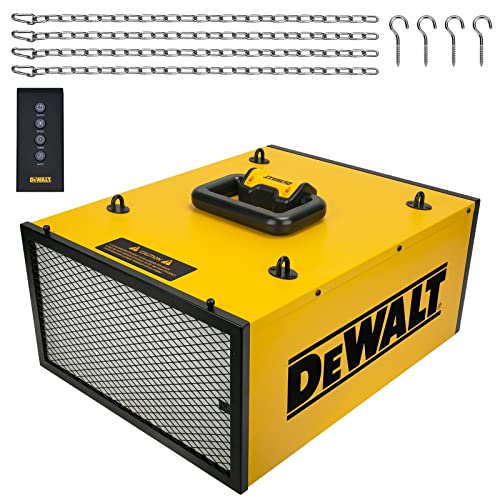
- Two-stage cotton pre-filter and H11 HEPA filtration
- Four modes with air-quality sensing and remote control
- Ceiling-hanging design with timer settings
Best For: Woodworkers seeking finer filtration and flexible controls
Best Compact Value
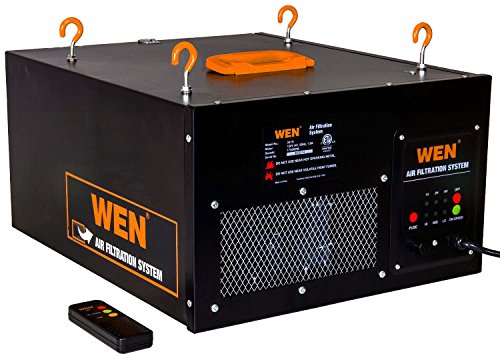
- 300/350/400 CFM three-speed airflow
- Covers workshops up to 400 square feet
- RF remote and programmable timer
Best For: Small shops wanting simple, affordable air circulation
Best High-Coverage Option

- 1,050-1,350 CFM airflow for areas up to 1,700 square feet
- 360-degree intake with built-in ionizer
- Ceiling, workbench, or direct-ceiling installation
Best For: Large workshops needing high airflow and flexible placement
Best Industrial-Strength Airflow
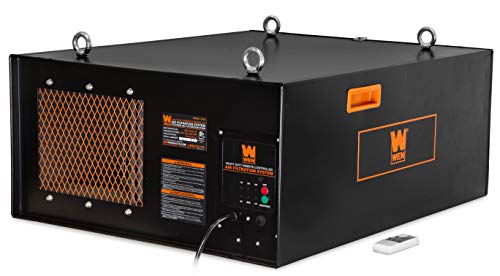
- 556/702/1,044 CFM three-speed airflow
- Covers rooms up to 1,000 square feet
- RF remote and programmable timer
Best For: Larger workshops prioritizing high air-moving capacity
Compact Coverage Pick

- 270° intake with two-speed vortex fan
- MERV-11 filtration for airborne dust
- Ceiling- or workbench-mountable design
Best For: Small woodworking shops and garages up to 800 square feet
High-Airflow Shop Pick

- 1,350 CFM airflow for spaces up to 1,700 sq. ft.
- 360° intake with two-speed fan control
- Remote, touch controls, and timer included
Best For: Larger woodshops, garages, and workshops
Odor-Control Feature Pick

- Built-in ionizer targets dust and odors
- 270° intake with two-speed vortex fan
- Remote timer and flexible mounting options
Best For: Small shops wanting added odor-control functionality
Best Overall Coverage

- 580–780 CFM airflow
- 270-degree air intake
- Below 50 dBA operation
Best For: Workshops up to 800 square feet
Best for Large Shops

- Up to 1,350 CFM
- 360-degree intake
- Covers up to 1,700 square feet
Best For: Large shops needing broad air circulation
Best Compact Option

- Three speeds up to 500 CFM
- 26-foot RF remote
- Portable benchtop design
Best For: Small shops and localized work areas
Best HEPA Filtration – DEWALT DWXAF101
If you want to shop air filtration systems for woodworking with finer particle filtration, the DEWALT DWXAF101 stands out with a two-stage setup that combines a washable cotton pre-filter and an H11 HEPA filter. Its ceiling-hanging design preserves floor space, while remote control, automatic mode, and timer settings make it practical for routine workshop use.
Best For: Woodworkers who prioritize HEPA filtration, flexible controls, and a space-saving ceiling-mounted setup.
Pros:
- Two-stage filtration captures over 95% of 0.3-micron particles, according to the supplied specifications.
- Four operating modes include high, medium, low, and automatic air-quality sensing.
- Includes 1-, 2-, 4-, and 8-hour timer settings, a remote, washable pre-filter, and a filter replacement indicator.
- Ceiling hooks and chains help keep the unit off the floor.
Cons:
- The listed noise level is 64 dB.
- It is designed for ceiling hanging, so installation requires suitable overhead mounting space.
With its HEPA filter, automatic sensing mode, and three-year warranty, the DWXAF101 is a well-equipped choice for workshops where cleaner recirculated air and convenient operation matter.
Best Compact Value – WEN 3410
For shoppers comparing air filtration systems for woodworking in a smaller shop, the WEN 3410 offers three airflow speeds from 300 to 400 CFM and coverage for rooms up to 400 square feet. Its RF remote works from any angle, even when direct line of sight is blocked.
Best For: Small workshops needing straightforward remote-controlled air filtration with programmable shutoff.
Pros:
- Three speed settings deliver 300, 350, or 400 CFM.
- Includes a 1-micron filter and a 5-micron pre-filter, both designed for replacement.
- RF remote operates from up to 26 feet and does not require direct line of sight.
- Programmable timer can automatically shut the unit off.
Cons:
- Coverage is limited to rooms up to 400 square feet.
- The listed filtration is less fine than a HEPA-based system, with a 1-micron particle-retention specification.
- Noise is rated from 50 to 60 dB.
The WEN 3410 is a practical entry-level option when compact-shop coverage, simple controls, and automatic shutoff are more important than maximum airflow or HEPA filtration.
Best High-Coverage Option – Abestorm DecDust 1350IG
When you shop air filtration systems for woodworking with a larger work area in mind, the Abestorm DecDust 1350IG provides 1,050 to 1,350 CFM airflow and listed coverage up to 1,700 square feet. It adds 360-degree intake, a built-in ionizer, and touch or remote controls for flexible placement and operation.
Best For: Larger workshops needing high airflow, multiple installation options, and odor-focused particle treatment.
Pros:
- High airflow range of 1,050-1,350 CFM with stated coverage up to 1,700 square feet.
- 360-degree intake and a built-in ionizer are designed to address dust, particles, sawdust, and odors.
- Can hang from the ceiling, sit on a workbench, or mount directly to the ceiling.
- Includes four replaceable MERV-11 filters and both touch and remote controls.
Cons:
- It cannot be shipped to California because it does not meet California air cleaner regulation requirements.
- Noise is listed from 60 to 69 dBA.
- Filters may need replacement every two to four months, depending on use.
The DecDust 1350IG is compelling for broad workshop coverage and installation flexibility, but buyers should verify regional availability and account for ongoing filter replacement.
Best Industrial-Strength Airflow – WEN 3417
WEN 3417 3-Speed Remote-Controlled Industrial-Strength Air Filtration System (556/702/1044 CFM)
Check Price On AmazonFor larger woodworking spaces, the WEN 3417 is a strong candidate when you shop air filtration systems for woodworking around airflow capacity. It offers three settings from 556 to 1,044 CFM and is rated to cover rooms up to 1,000 square feet, with remote operation and a programmable timer.
Best For: Larger workshops that need higher airflow than compact air cleaners provide.
Pros:
- Three speed settings provide 556, 702, or 1,044 CFM.
- Rated to cover rooms up to 1,000 square feet.
- RF remote works from up to 26 feet and does not require direct line of sight.
- Includes a programmable timer and replaceable 1-micron filter and 5-micron pre-filter.
Cons:
- At 55 pounds, it is substantially heavier than the listed WEN 3410.
- Its listed noise range is 63 to 68 dB.
- The supplied details specify a 1-micron filter and 5-micron pre-filter rather than HEPA filtration.
The WEN 3417 makes sense when room size and air-moving capacity take priority. Its larger body and weight favor a carefully planned installation, while the remote and timer simplify everyday use.
Compact Coverage Pick – ALORAIR Purecare 780
If you need to shop air filtration systems for woodworking in a smaller shop or garage, the ALORAIR Purecare 780 offers a compact, flexible setup. Its 270° intake, two-speed vortex fan, and MERV-11 filtration are designed for rooms up to 800 square feet.
Best For: Small woodworking shops, garages, and hobby workspaces needing ceiling or workbench placement.
Pros:
- 270° intake and strong vortex fan support circulating airflow.
- MERV-11 filter is designed to capture 90% of 3–10 micron particles and 85% of 1-micron particles.
- Remote control, 1–9 hour timer, and below-50 dBA operation add convenience.
- Can be hung from the ceiling or placed on a workbench.
Cons:
- Coverage is limited to rooms up to 800 square feet.
- It cannot be shipped to California according to the supplied product notes.
The Purecare 780 is a practical choice when space-saving installation and quieter operation matter more than maximum airflow. Its replaceable filter and timer make routine shop use straightforward.
High-Airflow Shop Pick – ABESTORM DecDust 1350
For larger workspaces, the ABESTORM DecDust 1350 is one of the more powerful options among these shop air filtration systems for woodworking. It combines a 360° intake with 1,350 CFM airflow and is rated for workshops and garages up to 1,700 square feet.
Best For: Larger woodshops, garages, and workshops that need higher airflow and broad air circulation.
Pros:
- 1,350 CFM airflow and 360° intake help circulate air throughout larger spaces.
- MERV-11 filtration is designed to capture 90% of 3–10 micron particles and 85% of 1-micron particles.
- Two-speed adjustment, IR remote, touch control, and a 1–9 hour timer provide flexible operation.
- Includes hooks and chains for ceiling installation and can also sit on a workbench.
Cons:
- Its 60–69 dB noise rating is higher than the compact ALORAIR models.
- The larger 27-pound unit may require more planning for ceiling installation.
The DecDust 1350 stands out when room coverage and airflow are top priorities. Consider its higher noise rating and installation requirements if your shop is small or noise-sensitive.
Odor-Control Feature Pick – ALORAIR Purecare 780IG
The ALORAIR Purecare 780IG adds a built-in ionizer to the compact Purecare platform, making it a feature-rich option when you shop air filtration systems for woodworking. It uses a 270° intake, two-speed vortex fan, and MERV-11 filter for workshops up to 800 square feet.
Best For: Smaller woodworking areas where odor reduction features and flexible placement are useful.
Pros:
- Built-in ionizer is designed to help remove dust and odors from drawn-in air.
- 270° intake and strong vortex fan support circulating airflow.
- MERV-11 filtration is designed to capture 90% of 3–10 micron particles and 85% of 1-micron particles.
- Remote control, 1–9 hour timer, ceiling hanging, and workbench placement offer flexibility.
Cons:
- Coverage is limited to rooms up to 800 square feet.
- It cannot be shipped to California according to the supplied product notes.
- The built-in ionizer may not be necessary if odor control is not a priority.
The Purecare 780IG is best suited to users who specifically want an ionizer alongside standard airborne-dust filtration. Its compact size and below-50 dBA rating keep it practical for smaller shops.
Best Overall Coverage – Abestorm DecDust 780
If you want to shop air filtration systems for woodworking in a medium-size shop, the Abestorm DecDust 780 combines strong airflow with a compact ceiling-mounted design. Its three-sided, 270-degree intake helps capture airborne dust from multiple directions, while remote and touch controls simplify operation.
Best For: Woodworking shops, garages, and workshops up to 800 square feet that need relatively quiet overhead air cleaning.
Pros:
- 580–780 CFM airflow supports circulation during sanding, sawing, and grinding.
- 270-degree intake design draws in dust from multiple directions.
- Operates below 50 dBA and includes remote control operation.
- Compact 18.35-by-18.35-by-8.8-inch design is suited to ceiling mounting.
Cons:
- Its stated coverage is limited to up to 800 square feet.
- The unit weighs 20 pounds, so ceiling installation requires suitable support.
The Abestorm is a practical choice when you value broad intake coverage, useful airflow, and lower operating noise without a bulky footprint.
Best for Large Shops – ALORAIR Purecare 1350
For larger spaces comparing shop air filtration systems for woodworking, the ALORAIR Purecare 1350 stands out for its 360-degree intake and coverage rated up to 1,700 square feet. Its strong vortex fan is designed to maintain airflow as the filter collects particles, and the unit can hang from the ceiling or sit on a workbench.
Best For: Large woodworking shops, garages, and work areas needing high circulating airflow and timer-based operation.
Pros:
- Offers 1,050/1,350 CFM settings for substantial air circulation.
- 360-degree intake helps collect airborne particles from around the unit.
- Timer controller supports automatic shutdown from one to nine hours.
- Hooks and chains allow hanging installation, while the unit can also be placed on a workbench.
Cons:
- Its listed noise rating of 60–69 dB is higher than quieter models.
- It cannot be shipped to California because it does not meet the stated requirements there.
- The 27-pound weight may make repositioning more demanding.
Choose the ALORAIR when room coverage and high airflow matter more than low noise or compact dimensions. The replaceable MERV 11 filter adds practical maintenance flexibility.
Best Compact Option – PURISYSTEMS PuriCare 500IG
The PURISYSTEMS PuriCare 500IG is a flexible pick for smaller spaces when you shop air filtration systems for woodworking. It provides three fan speeds up to 500 CFM, a two-filter setup with a built-in ionizer, and a portable design that can sit on a bench or work surface.
Best For: Small woodworking shops, garages, and benchtop work areas up to 500 square feet.
Pros:
- Three speed settings provide 350, 450, or 500 CFM airflow.
- Built-in timer can shut the unit off automatically after one to six hours.
- RF remote works from up to 26 feet and does not require direct line of sight.
- Handles and rubber feet make it easier to move and place on a work surface.
Cons:
- Its 500-square-foot rating is intended for smaller areas.
- The listed 61 dB noise level may be noticeable in a quiet shop.
- It cannot be shipped to California under the stated product requirements.
The PuriCare 500IG makes sense when portability, remote control, and automatic shutoff are priorities. Its smaller capacity is best matched to a compact shop or localized work area.
How We Picked the Best Shop Air Filtration Systems for Woodworking
We focused on the features that matter most in a working shop: airflow, filtration design, coverage potential, controls, installation flexibility, and practical maintenance. The lineup includes compact and industrial-strength models, so you can compare systems for hobby rooms, garages, and larger woodworking spaces.
We also considered useful differences such as remote controls, multiple fan speeds, built-in ionizers, 360-degree intake patterns, and two-stage air movement. Because listed CFM ratings are typically maximum figures, treat them as a comparison point rather than a guarantee of performance in your exact room.
Quick Comparison
- For smaller workshops: Look at lower-CFM 3-speed models such as the WEN 3410 or PuriSystems PuriCare 500IG.
- For medium-sized spaces: The WEN 3417, Abestorm 780 CFM, and ALORAIR 580/780 CFM systems offer more airflow without moving into the largest class.
- For large shops and garages: High-output 1,050- to 1,350-CFM models from Abestorm and ALORAIR are suited to spaces that need faster air turnover.
- For convenient operation: Remote controls and multiple speed settings make it easier to run filtration after a project or adjust airflow from across the room.
Key Buying Factors for Shop Air Filtration Systems for Woodworking
Airflow and Room Size
Higher CFM can move and filter more air, but the best choice depends on room volume, ceiling height, dust production, and how often the system runs. Avoid choosing solely by the biggest number; a properly placed, consistently used unit can outperform a powerful system installed poorly.
Filter Configuration
Check whether the system uses a single filter, a two-stage setup, or additional features such as an ionizer. Two-stage designs may improve particle capture and extend the life of the finer filter, while replacement-filter availability and cost should influence long-term ownership.
Controls, Noise, and Installation
Remote controls are convenient for overhead units, particularly when the filter is mounted near the ceiling. Confirm the mounting method, included hardware, clearance requirements, and noise expectations before buying. A quieter unit is more likely to be left running long enough to clean the air effectively.
Maintenance and Safety
Plan to inspect and replace filters on schedule, keep intakes unobstructed, and use a dedicated dust-collection setup for chips and heavy debris. An overhead air cleaner is not a substitute for source capture, ventilation, or appropriate respiratory protection.
Who Should Buy Which Shop Air Filtration Systems for Woodworking?
Choose a compact or midrange unit if you work in a small garage, basement shop, or hobby room and want affordable supplemental filtration. Choose a higher-CFM model for larger rooms, frequent sanding, or multiple active work areas. Choose a remote-controlled system if the unit will hang overhead or you want filtration to continue after leaving the bench. For the cleanest overall setup, pair the filter with tool-specific dust collection, regular housekeeping, and a properly fitted respirator when fine dust exposure is possible.