A cold garage can make projects uncomfortable, threaten temperature-sensitive materials, and discourage you from using the space altogether. The right electric heater can add steady warmth without requiring a full HVAC installation.
This roundup compares 10 options, including low-profile baseboard heaters, portable units, and ceiling-mounted garage heaters. Use the guide below to match wattage, voltage, controls, and installation style to your garage.
Best 10 Baseboard Heaters for Garages Picks for 2026
Reliable Wall-Mount Heat
Cadet F Series 36-Inch Baseboard Heater
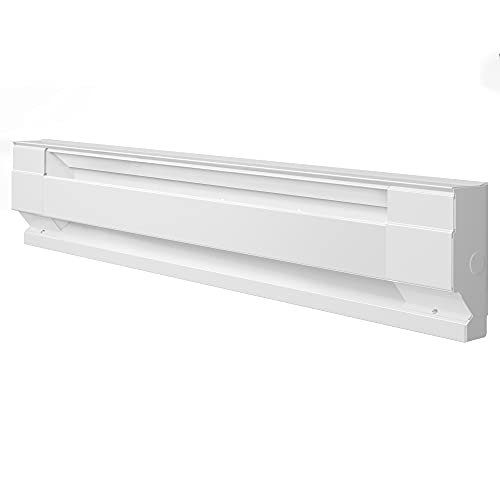
- 750/563-watt output with 240/208-volt compatibility
- 36-inch convection design for steady room heating
- Includes pre-punched knockouts and a limited lifetime warranty
Best For: Indoor garage areas up to about 125 square feet with compatible wiring
Simple Plug-In Comfort
Comfort Zone Convection Baseboard Heater

- 120-volt corded design for convenient setup
- Two heat settings with a manual thermostat
- Stay-cool housing, tip-over cutoff, and overheat protection
Best For: Compact indoor garage zones needing adjustable portable heat
Overhead Workshop Coverage
Shinic 2-Pack Radiant Garage Heaters

- Two 120-volt ceiling-mounted quartz heaters
- 90-degree adjustment with direct radiant warmth
- Five heat/light settings plus integrated halogen work lights
Best For: Garages and workshops needing overhead spot heat and lighting
Quiet Adjustable Heat
EZ-HEAT 1,500-Watt Baseboard Heater

- 1,500-watt output with two heat settings
- Adjustable thermostat and quiet operation
- Stay-cool body with tip-over and overheat protection
Best For: Medium indoor garage spaces needing quiet, controllable floor heat
Quiet 240V Pick
Stelpro Brava 1250W Baseboard Heater

- 1,250W output for up to 125 sq. ft.
- Quiet one-piece steel convection design
- Hardwired; thermostat sold separately
Best For: Small enclosed garages and workshops needing quiet supplemental heat
High-Output Garage Heater
Comfort Zone 5000W Ceiling Mount

- 5,000W fan-forced heating
- Listed coverage up to 1,000 sq. ft.
- Ceiling mount preserves floor space
Best For: Larger garages and shops needing powerful directed heat
Small-Space 120V Pick
Stelpro Brava 500W Baseboard Heater
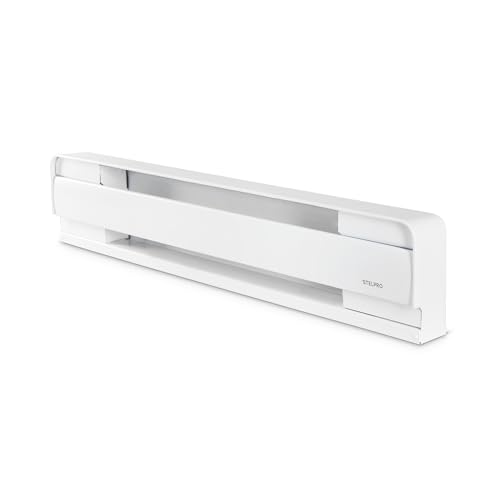
- 500W output for up to 50 sq. ft.
- Compact, quiet one-piece steel design
- Hardwired 120V; thermostat sold separately
Best For: Small enclosed garage areas or workshop nooks
Best Portable Garage Heater
Buyplus 1500W PTC Ceramic Heater

- Fast three-second heating
- Three operating modes
- Portable design with overheat protection
Best For: Portable heating in garages up to 200 square feet
Best Digital Baseboard Heater

- Digital thermostat with display
- Listed 500-square-foot coverage
- Multiple safety protections
Best For: Enclosed garages and workspaces needing precise temperature control
Best Simple Baseboard Heater

- Two heat settings and manual thermostat
- Listed 300-square-foot coverage
- Quiet operation with safety shutoffs
Best For: Smaller enclosed garages and workshops needing simple controls
Reliable Wall-Mount Heat – Cadet F Series 36-Inch Baseboard Heater
For garages with suitable indoor electrical wiring, the Cadet F Series is one of the more traditional baseboard heaters for garages. Its 36-inch convection design, 750/563-watt settings, and 240/208-volt compatibility make it a practical choice for steady, localized warmth rather than fast spot heating.
Best For: Permanently mounted indoor areas up to approximately 125 square feet where low-profile, convection heat is preferred.
Pros:
- Offers 750/563-watt output for flexible heating.
- Convection heating helps circulate warm air through the room.
- Universal wiring and pre-punched knockouts can simplify installation.
- Includes a limited lifetime warranty.
Cons:
- Designed for indoor use, so it is not intended for exposed outdoor garage conditions.
- Requires compatible 240/208-volt electrical service rather than a standard 120-volt outlet.
- Its 125-square-foot coverage may be limited for larger garages.
This Cadet is best suited to a properly wired garage room or workshop where quiet, continuous convection heat matters more than portability. Confirm voltage, mounting, and coverage requirements before installation.
Simple Plug-In Comfort – Comfort Zone Convection Baseboard Heater
If you want baseboard heaters for garages without a hardwired installation, this Comfort Zone model uses a 120-volt corded connection and provides two heat settings. Its manual thermostat and low-profile floor design make it suitable for adding adjustable warmth to a smaller indoor workspace.
Best For: Indoor garages, offices, or work areas up to approximately 150 square feet where portable, manually controlled heat is useful.
Pros:
- Uses a standard 120-volt corded power source.
- Two heat settings and a manual thermostat provide straightforward control.
- Convection heating offers even warmth across the room.
- Includes tip-over cutoff, overheat protection, and a stay-cool housing.
Cons:
- Floor-mounted rather than permanently wall-mounted.
- Its 1500-watt output may not be enough for a large or poorly insulated garage.
- Manual controls require hands-on temperature adjustment.
The Comfort Zone is a convenient choice when outlet-powered portability and basic safety features are priorities. Its listed 150-square-foot coverage is a better match for a compact garage zone than an entire large workshop.
Overhead Workshop Coverage – Shinic 2-Pack Radiant Garage Heaters
Although not a baseboard design, the Shinic two-pack is worth considering alongside baseboard heaters for garages when floor space is limited. These 120-volt ceiling-mounted quartz heaters deliver direct radiant warmth, rotate up to 90 degrees, and include halogen work lights for garages, shops, and workbenches.
Best For: Garages or workshops needing overhead spot heating, floor-space savings, and added work lighting.
Pros:
- Two ceiling-mounted heaters provide flexible placement across a workspace.
- Radiant quartz tubes warm people and objects directly.
- 90-degree adjustment helps direct heat where it is needed.
- Includes five heat-and-light settings, overheat shutoff, and grounded plugs.
Cons:
- Radiant heat is more directional than whole-room convection heating.
- Ceiling installation is required, which may be less convenient than a floor unit.
- The supplied coverage estimate of 400-600 square feet can vary with layout and insulation.
Choose this set when overhead installation and targeted warmth are more useful than a low-profile wall heater. The integrated work lights add practical value for nighttime garage or workshop projects.
Quiet Adjustable Heat – EZ-HEAT 1,500-Watt Baseboard Heater
The EZ-HEAT CZ600 is a practical option among baseboard heaters for garages when you want adjustable, quiet electric warmth from a floor-mounted unit. Its 1,500-watt convection design has two heat settings, a manual thermostat, and safety features intended for everyday indoor use.
Best For: Medium-sized indoor spaces where quiet operation, adjustable temperature control, and portable floor placement are priorities.
Pros:
- Provides 1,500 watts of heating with two settings.
- Adjustable manual thermostat supports customized comfort.
- Quiet operation is suitable for work or relaxation areas.
- Includes dent-proof end panels, tip-over protection, overheat protection, and a stay-cool body.
Cons:
- Floor-mounted and corded, rather than a permanently installed baseboard unit.
- Intended for indoor use and may not suit exposed garage conditions.
- The supplied notes do not specify a precise square-foot coverage rating.
EZ-HEAT makes the most sense for a garage room or enclosed workspace where low noise and user-controlled heat are important. As with any electric heater, use it in an appropriate indoor location with adequate clearance and compatible power.
Quiet 240V Pick – Stelpro Brava 1250W Baseboard Heater
For garages with a suitable 240V circuit, the Stelpro Brava is a quiet baseboard option that delivers 1,250 watts of convection heat for spaces up to 125 square feet. It is hardwired rather than plug-in and requires a separately sold thermostat.
Best For: Small, enclosed garages or workshop areas where silent, low-profile wall-mounted heat is preferred.
Pros:
- Provides 1,250 watts of heat and coverage up to 125 square feet on 240V.
- One-piece steel construction is designed to reduce the ticking and popping associated with two-piece baseboards.
- Includes overheat protection, rounded corners, universal wiring, and a five-year warranty with lifetime heating-element coverage.
Cons:
- Requires hardwired installation on a 240V circuit.
- Thermostat is sold separately.
- Its listed coverage is limited to 125 square feet.
This Stelpro model makes sense when quiet operation and a clean baseboard profile matter more than high-output garage heating. Confirm the circuit, coverage needs, and thermostat requirements before installation.
High-Output Garage Heater – Comfort Zone 5000W Ceiling Mount
The Comfort Zone 5,000-watt fan-forced ceiling heater is designed for garages, shops, and storage areas where stronger air circulation and preserved floor space are priorities. Its ceiling-mounted design directs heated airflow through adjustable louvers.
Best For: Larger garages and workshops that need powerful, overhead forced-air heating.
Pros:
- 5,000-watt output with listed heating coverage up to 1,000 square feet.
- Ceiling mounting keeps floor space clear and suits garage or shop environments.
- Adjustable mounting angle and louvers help direct airflow, while overheat protection adds a safety measure.
Cons:
- Requires hardwired installation.
- Fan-forced operation is less inherently quiet than a convection baseboard heater.
- Ceiling mounting may require more involved installation than a wall-mounted unit.
For a drafty or larger garage, this model’s higher output and directed airflow are more suitable than a compact baseboard. Its dual-knob thermostat and quick on/off controls also keep operation straightforward.
Small-Space 120V Pick – Stelpro Brava 500W Baseboard Heater
The Stelpro Brava 500W is a compact hardwired baseboard heater for small areas up to 50 square feet. Its 120V convection design provides quiet warmth, making it a practical choice for a small enclosed garage section, entry area, or workshop nook.
Best For: Small, insulated garage spaces with an available 120V circuit and modest heating needs.
Pros:
- 500 watts of heat for spaces up to 50 square feet.
- Compact 27.87-inch width and quiet one-piece steel construction.
- Includes overheat protection, rounded corners, and a five-year warranty with lifetime heating-element coverage.
Cons:
- Limited to 50 square feet of listed coverage.
- Requires hardwired 120V installation rather than plug-in use.
- Thermostat is sold separately.
This is a better match for targeted supplemental warmth than for heating an entire garage. Its modest output and 120V requirement make it easiest to consider for a small, reasonably insulated area where quiet operation is important.
Best Portable Garage Heater – Buyplus 1500W PTC Ceramic Heater
For shoppers comparing baseboard heaters for garages, the Buyplus is a compact portable alternative focused on fast, directional warmth. Its 1,500-watt PTC ceramic system is rated to heat spaces up to 200 square feet and offers three operating modes for seasonal flexibility.
Best For: Garage users who want portable, quick-start heat with fan-only and two heating settings.
Pros:
- Rapid three-second heating with 750W and 1,500W settings.
- Portable handle, non-slip base, and a 7.8-foot power cord.
- Overheat protection and operation quieter than 40 decibels.
Cons:
- Its stated heating coverage is limited to about 200 square feet.
- Portable countertop-style form does not provide the fixed placement of a traditional baseboard heater.
The Buyplus makes the most sense when mobility and fast warmth matter more than permanent installation. Its safety features and quiet operation add practicality for garages that also serve as workspaces.
Best Digital Baseboard Heater – Comfort Zone CZ650B 1500W
Among baseboard heaters for garages, the Comfort Zone CZ650B offers a low-profile, room-focused option with digital temperature control. Its 1,500-watt convection heating, two heat settings, and listed 500-square-foot coverage suit users who prefer steady, adjustable warmth rather than a portable ceramic heater.
Best For: Indoor garage or workspace heating where precise thermostat control and quiet operation are priorities.
Pros:
- Digital thermostat and temperature display support precise adjustments.
- Listed coverage of up to 500 square feet with two heat settings.
- Tip-over switch, overheat protection, stay-cool body, and dent-proof end panels.
Cons:
- Designed for indoor use rather than exposed outdoor areas.
- Floor-mounted design may require more deliberate placement than a compact portable heater.
The CZ650B is a strong fit for a finished or enclosed garage where quiet, targeted convection heat is useful. Its digital controls distinguish it from simpler adjustable-thermostat models.
Best Simple Baseboard Heater – Comfort Zone CZ600 1500W
The Comfort Zone CZ600 is a straightforward choice for shoppers seeking baseboard heaters for garages without a digital control panel. This 1,500-watt convection unit has two heat settings, an adjustable manual thermostat, and listed coverage of up to 300 square feet.
Best For: Enclosed garages, workshops, or rooms needing simple, quiet, adjustable electric heat.
Pros:
- Two heat settings and an adjustable thermostat provide basic control.
- Quiet operation is suitable for work, conversation, or media use.
- Stay-cool body, tip-over switch, and overheat protection improve handling safety.
Cons:
- Its listed coverage is smaller than the CZ650B at 300 square feet.
- Manual thermostat lacks the digital display offered by the CZ650B.
- Specified for indoor use.
The CZ600 is the practical, less complicated pick in this group. Choose it for a smaller enclosed garage when dependable controls and a low-profile baseboard design matter more than digital readouts or broader stated coverage.
How We Picked the Best Baseboard Heaters for Garages
We compared the selected heaters by heating output, electrical requirements, control options, mounting design, safety features, and suitability for different garage sizes. Because not every garage can support a dedicated 240-volt circuit or permanent installation, the list includes both true baseboard heaters and practical garage-heating alternatives.
We also considered whether each model is best suited to continuous, even warmth or quick spot heating. Product specifications such as wattage and voltage should always be checked against your electrical system and installation requirements before purchase.
Quick Comparison
| Type | Best For | Main Advantage | Key Consideration |
|---|---|---|---|
| Electric baseboard | Steady, quiet background heat | Low-profile design | Needs correct circuit sizing |
| Portable baseboard | Renters and flexible placement | Simple setup | Usually heats a limited area |
| Ceiling-mounted fan heater | Larger garages and workshops | Moves warm air quickly | Requires suitable mounting and wiring |
| Portable radiant or convection heater | Spot heating | Easy to reposition | May not warm the entire garage evenly |
Key Buying Factors for Baseboard Heaters for Garages
Wattage and Garage Size
Higher wattage generally provides more heat, but insulation, ceiling height, climate, doors, and air leakage matter just as much. A poorly insulated garage may need more than one heater or a higher-output ceiling unit. Avoid assuming that a compact 1,500-watt model will heat an entire workspace evenly.
Voltage and Circuit Compatibility
Many larger baseboard heaters use 240 volts, while portable models commonly run on 120 volts. Confirm the available circuit before buying. A 240-volt heater may require professional installation, and using an extension cord with a high-wattage heater can create a safety hazard.
Placement and Airflow
Baseboard heaters work best along exterior walls and below windows, with clear space around the housing. Fan-forced ceiling heaters are useful when floor space is limited or when you need heat distributed across a larger area. Keep every heater away from vehicles, combustibles, stored materials, and wet locations unless it is specifically rated for that environment.
Controls and Safety
Adjustable or digital thermostats make it easier to maintain a target temperature and reduce unnecessary runtime. Look for overheat protection, tip-over protection on portable units, durable end panels, and a design that cannot be easily blocked. Follow the manufacturer’s clearance and installation instructions exactly.
Who Should Buy Which Baseboard Heaters for Garages?
Choose a Fixed Electric Baseboard Heater If:
You want quiet, consistent background warmth and have a suitable circuit for permanent installation. These models are a strong fit for insulated garages, workshops, and rooms where floor space is limited.
Choose a Portable Baseboard or Convection Heater If:
You need flexible placement, heat only one work area, or cannot modify the electrical system. Portable models are convenient, but they require careful placement and should not be left operating unattended unless the manufacturer explicitly permits it.
Choose a Ceiling-Mounted Fan Heater If:
You have a larger garage, high ceilings, or a workspace that needs faster air circulation. These heaters can free up floor and wall space, though installation and circuit requirements are more demanding.
For the best result, pair the heater with weatherstripping, insulated garage doors, and sealed air leaks. Better insulation reduces heat loss and can make any of these Baseboard Heaters for Garages more effective and economical to operate.