Finding a blockage, leak, or damaged section of pipe is much easier when you can see inside the line. The best pipe inspection cameras for small homes combine a flexible probe, useful lighting, and a screen that makes hard-to-reach areas easier to inspect.
This roundup compares 10 home-friendly options, from compact dual-lens borescopes to longer sewer cameras. Focus on probe length, camera direction, waterproofing, and how comfortably each system fits your likely plumbing jobs.
Best 10 Pipe Inspection Cameras for Small Homes Picks for 2026
Best Compact Pick
WINWEND 16.5-Foot LCD Borescope

- 4.3-inch built-in screen
- 16.5-foot semi-rigid cable
- IP67 probe with adjustable LEDs
Best For: Routine household drain, pipe, and wall inspections
Best Battery Life
Teslong NTS300 Triple-Lens Borescope

- Up to six hours of battery life
- 234-degree combined field of view
- 5-inch IPS screen with 32GB card
Best For: Recorded home inspections and repeated DIY use
Best Phone-Compatible Value
Dual-Lens 1920P Smartphone Endoscope

- 1920P photo and video resolution
- 16.4-foot semi-rigid cable
- iOS and Android connectors included
Best For: Portable inspections viewed on a compatible smartphone
Best Multi-Angle Pick
DEPSTECH Triple-Lens Inspection Camera

- Three switchable lenses for flexible viewing
- Large 5-inch IPS screen with 1080p video
- 16.5-foot IP67 waterproof probe with 10 LEDs
Best For: Short plumbing checks and versatile home maintenance
Best Simple Viewer
T TAKMLY Dual-Lens 4.3-Inch Camera

- Front and side cameras with switchable views
- 1080p live viewing and adjustable LED lighting
- 16.4-foot IP67 waterproof cable
Best For: Basic close-up checks without photo or video recording
Best Dual-View Pick
DEPSTECH DS300 Dual-Lens Borescope
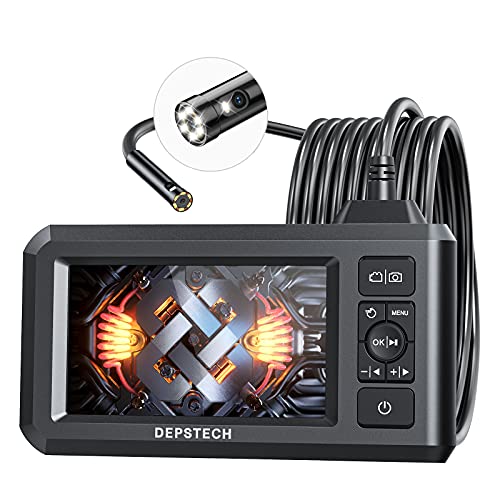
- Dual-lens and split-screen viewing options
- 16.5-foot waterproof semi-rigid cable
- Records 1080P video and 2MP photos
Best For: Homeowners needing versatile, recordable inspections
Best Large-Screen Option
TGJOR 5-Inch Dual-Lens Endoscope

- Large 5-inch screen with 170-degree view
- 16.4-foot IP67 waterproof probe
- Simple operation without apps or Wi-Fi
Best For: Live inspections where recording is not needed
Best Articulating Pick

- 210-degree two-way articulation for tight bends
- Dual-lens 1080P camera with 32GB card
- Slim 0.33-inch waterproof probe
Best For: Precise inspections around residential pipe bends
Best Compact Pick – WINWEND 16.5-Foot LCD Borescope
For small homes, this WINWEND model is a straightforward option among pipe inspection cameras for small homes. Its built-in 4.3-inch screen, 16.5-foot semi-rigid cable, adjustable lighting, and phone-free operation make it practical for checking drains, pipes, walls, appliances, and other tight spaces.
Best For: Homeowners who want a compact, self-contained inspection camera for routine plumbing and household checks.
Pros:
- Built-in 4.3-inch color LCD avoids needing a smartphone or app.
- 16.5-foot detachable, bendable cable suits many household inspection points.
- Eight adjustable LED lights and IP67 protection support dark, damp areas.
- Includes hook, magnet, and side mirror accessories.
Cons:
- The supplied notes state that it cannot capture photos or videos.
- USB charging cable is included, but the charging plug is not.
- Its shorter cable is less suitable for very long pipe runs.
The WINWEND is a sensible choice when easy setup matters more than recording or extended reach. It provides a dedicated viewing screen and useful accessories in a lightweight package suited to occasional home maintenance.
Best Long-Reach Option – DEPSTECH DS620 50-Foot Triple-Lens Camera
The DEPSTECH DS620 stands out among pipe inspection cameras for small homes when access points are far apart or difficult to reach. Its 50-foot semi-rigid cable, triple-lens design, large IPS display, and included storage make it suitable for deeper plumbing and whole-house inspection tasks.
Best For: Homeowners or DIY users who need extended reach and multiple viewing angles for drains, pipes, walls, ceilings, or other confined spaces.
Pros:
- 50-foot cable provides substantially more reach than compact home models.
- Triple lenses switch between front and side views for broader inspection coverage.
- Five-inch IPS screen, adjustable lights, and Bluart 3.0 technology support detailed viewing.
- Includes a 32GB memory card, protective case, and up to four hours of battery use.
Cons:
- The long cable may be more equipment than needed for short, accessible household drains.
- A cable puller is recommended for easier maneuvering and is not stated as included.
- The supplied notes do not specify a cable diameter beyond the 7.9mm camera.
For small homes with challenging layouts, the DS620 offers the strongest reach and documentation features in this group. It is a more substantial investment in storage space and handling, but the triple-lens view can reduce the need to reposition the probe.
Best Battery Life – Teslong NTS300 Triple-Lens Borescope
The Teslong NTS300 is a versatile choice among pipe inspection cameras for small homes, particularly when you want a large display and recorded inspection files. Its triple-lens probe, 5-inch IPS screen, 16.5-foot flexible cable, and 32GB card cover common plumbing, wall, automotive, and home-maintenance uses.
Best For: DIY homeowners who want broad viewing angles, on-device recording, and extended battery life for recurring inspections.
Pros:
- Triple-lens technology provides a combined 234-degree field of view.
- Five-inch IPS display makes the live image easier to view.
- Built-in 32GB microSD card supports JPEG images and MPEG-4 video recording.
- 5000mAh rechargeable battery is rated for up to six hours of use.
Cons:
- The 16.5-foot cable offers less reach than the DEPSTECH 50-foot model.
- The 0.31-inch probe may not suit every exceptionally narrow passage.
- Wi-Fi is listed in the specifications, but the notes emphasize transfer through the included card.
The Teslong balances inspection flexibility and runtime well for typical residential work. Its recording capability is useful for reviewing findings or sharing them, while the side-view cameras can reveal details that a front-only probe might miss.
Best Phone-Compatible Value – Dual-Lens 1920P Smartphone Endoscope
This dual-lens endoscope is a practical pick among pipe inspection cameras for small homes when you prefer viewing results on a compatible phone. The 1920P camera, 16.4-foot semi-rigid cable, adjustable LEDs, and included iOS and Android connectors make it useful for pipes, engines, wiring, and household repairs.
Best For: Smartphone users who want a portable inspection camera with front-and-side viewing and broad device compatibility.
Pros:
- 1920P resolution supports clear close-range photos and video.
- Dual-lens design helps inspect both forward and side-facing areas.
- 16.4-foot semi-rigid cable balances reach with manageable handling.
- Includes Lightning, USB-C, and Android connectors plus hook, magnet, and mirror accessories.
Cons:
- Requires the SUP-ANESOK app and a compatible iOS or Android device.
- The supplied notes warn that some Android models may show slight blurriness.
- Its stated battery life is approximately 3.5 hours.
This model is appealing for occasional inspections because it uses a phone you may already own and includes several useful adapters. Check device compatibility before buying, especially if image clarity on an Android phone is important.
Best for Easy Setup – Teslong Dual-Lens 50FT Sewer Camera
For homeowners who need pipe inspection cameras for small homes with extra reach, the Teslong combines a 50-foot semi-rigid cable with forward- and side-facing cameras. Its split-screen monitor helps you inspect straight drain sections without relying on a phone or Wi-Fi.
Best For: Inspecting longer, mostly straight PVC drains, sewer lines, and pipe walls around the home.
Pros:
- 50-foot cable reaches significantly farther than compact endoscopes.
- Dual cameras and split-screen viewing show the pipe ahead and its walls simultaneously.
- 4.3-inch adjustable IPS display, rechargeable 3000mAh battery, and included retrieval accessories.
Cons:
- The semi-rigid cable may struggle with tight 90-degree elbows and P-traps.
- Murky water can reduce visibility, so flushing the line may be necessary.
- A TF memory card is sold separately for recording.
This is the strongest choice when reach and wall visibility matter more than maneuverability in tight household bends. It is especially practical for longer, straight drain runs.
Best Multi-Angle Pick – DEPSTECH Triple-Lens Inspection Camera
The DEPSTECH DS620 is a versatile option among pipe inspection cameras for small homes, using three lenses that you can switch between at the press of a button. Its 5-inch IPS screen and 16.5-foot semi-rigid cable suit short plumbing, wall, HVAC, and automotive inspections.
Best For: Homeowners who want one inspection camera for short pipe checks and a range of household maintenance tasks.
Pros:
- Triple-lens design provides multiple viewing angles without repeatedly repositioning the probe.
- 5-inch IPS display shows 1080p video with real-time viewing.
- IP67 waterproof probe, 10 adjustable LEDs, and included magnet, hook, carrying bag, and charging cable.
Cons:
- The 16.5-foot cable offers less reach than the Teslong’s 50-foot probe.
- Continuous operation is listed at approximately 2 to 3 hours.
- A microSD card is required for saving photos and video but is not included.
Choose this model if viewing flexibility and a larger screen are more important than maximum cable length. Its triple-lens setup can reduce the need to repeatedly adjust the probe in confined areas.
Best Simple Viewer – T TAKMLY Dual-Lens 4.3-Inch Camera
For straightforward visual checks, the T TAKMLY N43 is one of the more accessible pipe inspection cameras for small homes. It provides front and side camera views, an integrated 4.3-inch display, and a 16.4-foot semi-rigid cable for short plumbing and other hard-to-reach areas.
Best For: Basic, close-up inspections of bathtub pipes, toilets, vents, walls, and other short-access locations.
Pros:
- Dual front and side cameras can be switched as needed.
- 1080p viewing, an 8-LED adjustable front light, and an IP67 waterproof probe support dark or damp areas.
- Portable design with a 2000mAh rechargeable battery and included hook, magnet, and mirror.
Cons:
- It cannot take pictures or record videos, despite the listed video-resolution specification.
- The 16.4-foot cable is intended for shorter insertions rather than long sewer runs.
- A 3-hour full charge time is specified.
This is a sensible pick when you mainly need live viewing and do not require inspection documentation. Its shorter cable and included accessories make it suitable for routine household troubleshooting.
Best Dual-View Pick – DEPSTECH DS300 Dual-Lens Borescope
For homeowners comparing pipe inspection cameras for small homes, the DEPSTECH DS300 offers useful viewing flexibility without relying on a phone. Its dual lenses, 16.5-foot semi-rigid cable, built-in screen, and waterproof probe make it practical for checking plumbing, ducts, walls, and other tight spaces.
Best For: Homeowners who want dual-angle viewing and the ability to save inspection photos and videos.
Pros:
- Dual-lens design with front, side, and wider FOV viewing modes.
- 16.5-foot semi-rigid cable reaches farther areas and holds its shape.
- 1080P video, 2MP stills, adjustable LEDs, and roughly four hours of battery life.
- IP67 waterproof construction with included hook and magnet accessories.
Cons:
- The package does not include a TF card.
- The 4.3-inch screen is smaller than some larger-screen alternatives.
The DS300 is a well-rounded choice when inspection range and recording capability matter. Its dual-camera setup can reduce the need to reposition the probe, while the long cable suits many residential inspection tasks.
Best Large-Screen Option – TGJOR 5-Inch Dual-Lens Endoscope
Among pipe inspection cameras for small homes, this TGJOR model stands out for its larger 5-inch display and simple plug-and-play operation. The dual-lens probe, 16.4-foot cable, adjustable lighting, and IP67 waterproof rating suit basic plumbing, drain, HVAC, and automotive checks.
Best For: DIY users who prefer a larger built-in screen for live viewing and do not need photo or video recording.
Pros:
- 5-inch HD screen provides a broad 170-degree viewing angle.
- Dual lenses switch between front and side views for more inspection flexibility.
- 16.4-foot semi-rigid waterproof probe with eight adjustable LEDs.
- No app or Wi-Fi is required, and the battery runs approximately three to four hours.
Cons:
- It cannot take pictures or record videos.
- Its fixed-focus design may be less flexible for varying distances.
This is a straightforward live-view inspection tool rather than a documentation-focused camera. Choose it if screen size and easy operation are more important than saving evidence of a plumbing problem.
Best Articulating Pick – Acoath 210-Degree Borescope
For tight bends and difficult access points, the Acoath is one of the more maneuverable pipe inspection cameras for small homes. Its two-way 210-degree articulation, dual lenses, slim probe, and included 32GB card help with detailed plumbing, renovation, HVAC, and mechanical inspections.
Best For: Homeowners who need precise probe control around pipe bends and want included storage for recordings.
Pros:
- Two-way 210-degree articulation provides a 420-degree range of motion.
- Dual front and side cameras offer 70-degree and 60-degree viewing angles.
- 1080P photo and video capture with an included 32GB Micro SD card.
- Slim 0.33-inch probe, IP67 waterproofing, adjustable LEDs, and protective case.
Cons:
- The 5-foot cable is considerably shorter than the longer-reach options.
- The articulating design may take more practice to control effectively.
The Acoath is the strongest fit when maneuverability matters more than maximum reach. Its articulated tip can help position the camera around bends, while the included card and accessories make it ready for documented inspections.
How We Picked the Best Pipe Inspection Cameras for Small Homes
We focused on features that matter during occasional household inspections rather than professional municipal or commercial sewer work. The selected cameras offer practical probe lengths ranging from compact models for sinks, walls, and appliances to 50-foot options for longer drain runs. We also considered screen quality, built-in lighting, lens configuration, waterproof ratings, recording capability, and the ease of handling a semi-rigid cable.
Dual- and triple-lens designs earned attention because a forward-facing view helps locate a problem while side-facing views can reveal cracks, buildup, or pipe connections. We also favored dedicated-screen systems when a phone-free setup is more convenient in a wet or dirty work area.
Quick Comparison
| Feature | Best for | What to look for |
|---|---|---|
| 16.5-foot probe | Indoor drains and short runs | Easy storage and better maneuverability |
| 32-foot probe | Broader household troubleshooting | A balance of reach and cable control |
| 50-foot probe | Longer sewer and drain lines | Strong cable handling and bright lighting |
| Dual or triple lens | Viewing pipe walls and junctions | Simple lens switching and useful side coverage |
| Dedicated IPS screen | Fast, standalone inspections | Readable display and straightforward controls |
Key Buying Factors for Pipe Inspection Cameras for Small Homes
Probe Length and Flexibility
Choose enough cable to reach the suspected problem without buying more than you can control. Shorter probes are easier to guide through traps and indoor plumbing, while 50-foot models are more appropriate for exterior cleanouts and longer sewer lines.
Camera View and Lighting
Adjustable LEDs are important because pipes can be dark, reflective, or covered with water. A dual-lens camera adds a forward or side view, and triple-lens systems can reduce the need to reposition the probe. Check whether lens switching is available at the handle or screen.
Water Resistance and Image Quality
An IP67-rated probe is a sensible minimum for wet plumbing work, but the rating generally applies to the camera and cable rather than the entire control unit. A 1080p or higher display can make cracks and obstructions easier to distinguish, although lighting and lens cleanliness matter just as much.
Screen, Recording, and Handling
A built-in 4.3- or 5-inch screen avoids phone compatibility issues and is easier to use with gloves. Look for photo and video recording if you need to share evidence with a plumber. For longer probes, a stable reel or manageable cable stiffness can be more valuable than extra resolution.
Who Should Buy Which Pipe Inspection Cameras for Small Homes?
Choose a compact 16.5-foot dual-lens model for sinks, tubs, appliance lines, wall cavities, and other short indoor inspections. A 32-foot articulating or dual-lens camera suits homeowners who want more reach while retaining good control in tight spaces. For main drains, cleanouts, and longer sewer runs, a 50-foot model is the better choice, provided you are comfortable feeding and cleaning the cable.
Buy a triple-lens camera if viewing pipe sides and junctions is a priority. Choose a dedicated-screen model for the simplest setup, or a camera with recording and expandable storage if you expect to document recurring plumbing problems. Whichever model you choose, clean and disinfect the probe after use, avoid forcing it through resistance, and treat these tools as inspection aids—not substitutes for professional repairs when structural damage is suspected.