Choosing among solar charge controllers for beginners can feel confusing fast, especially when you’re comparing MPPT, PWM, battery types, and amps. The good news: the right controller is usually the one that matches your panel size, battery chemistry, and system voltage.
This roundup focuses on easy-to-use options that help first-time buyers avoid common setup mistakes while still getting reliable charging performance. Whether you want a simple budget PWM model or a more efficient MPPT controller, these picks cover the most practical starting points.
Best 10 Solar Charge Controllers for Beginners Picks for 2026
Bluetooth MPPT Pick
Victron SmartSolar MPPT 75V 15A

- MPPT charging for better harvest in shade
- VictronConnect app shows live data and history
- Automatic load disconnect helps protect batteries
Best For: Beginners who want app monitoring and efficient MPPT charging
Simple LCD PWM Option
30A Auto Parameter Solar Controller

- Auto-adapts to 12V or 24V systems
- LCD shows status and supports manual settings
- Dual USB output and built-in protections
Best For: First-time users with lead-acid systems who want simple controls
High-Capacity Bluetooth MPPT
Victron SmartSolar MPPT 100V 50A

- 50A MPPT controller for larger 12/24V systems
- Bluetooth app shows data, history, and settings
- Supports synchronized operation with other units
Best For: Beginners building a larger solar setup who want room to expand
Easy Entry PWM Choice

- Made for 12V systems with panels below 300W
- LCD and LED indicators simplify monitoring
- USB and Type-C ports add device-charging convenience
Best For: Beginners with compact 12V setups who want simple monitoring
Beginner-Friendly All-Rounder
Renogy Wanderer 10A PWM Controller
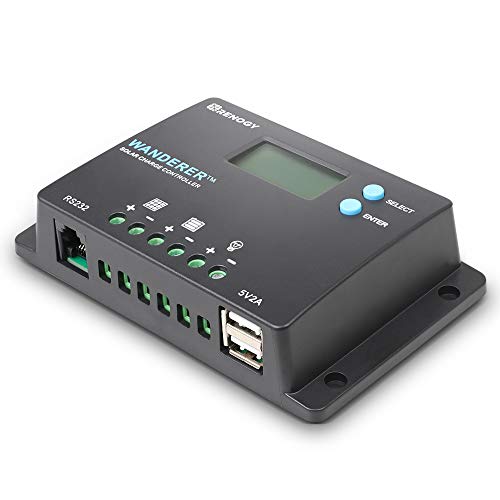
- 12V/24V PWM controller with 4-stage charging
- LCD shows voltage, current, and status
- Built-in protections for RV and marine use
Best For: Beginners who want a simple, well-rounded PWM controller
Simple MPPT Starter Pick
SUNAPEX 10A 12V MPPT Controller
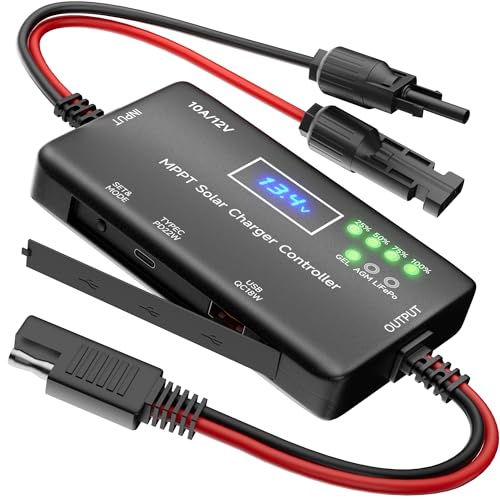
- MPPT controller for 12V battery systems
- Plug-and-play SAE connectors
- USB and Type-C charging outputs
Best For: Beginners building a small 12V system
App-Ready Budget Choice
ECO-WORTHY 30A Bluetooth PWM Controller

- 12V/24V PWM controller with Bluetooth app monitoring
- LCD display and dual USB outputs
- Multiple protection features and broad battery support
Best For: Beginners who want app monitoring and higher current capacity
Best Heavy-Duty Pick
30A Dual USB 12V/24V Regulator

- Auto-detects 12V or 24V systems
- LCD display helps with settings and monitoring
- Dual USB ports support small device charging
Best For: Beginners with lead-acid systems who want simple controls
Outdoor Ready PWM
SOLPERK 10A Waterproof 12V/24V Controller

- IP67 waterproof housing for outdoor use
- Auto-detects 12V or 24V systems
- Plug-and-play SAE port with LED monitoring
Best For: Beginners needing a weather-resistant controller for mobile setups
Bluetooth MPPT Pick – Victron SmartSolar MPPT 75V 15A
If you’re comparing solar charge controllers for beginners, this Victron SmartSolar MPPT is a strong starting point if you want app-based monitoring and better power harvesting. It uses MPPT charging, Bluetooth connectivity, and battery presets to help you configure and track a small 12/24V system with less guesswork.
Best For: Beginners who want a Bluetooth-enabled MPPT controller with easy app monitoring and flexible configuration.
Pros:
- MPPT design helps maximize available panel output, including in partial shade.
- VictronConnect app provides real-time data, 30-day history, settings, and firmware updates.
- Intelligent load output can disconnect loads automatically when battery voltage gets too low.
- Supports synchronized operation with other SmartSolar MPPT controllers.
Cons:
- More advanced than basic PWM controllers, so it may be more than some first-time users need.
- Includes minimal onboard display, so most checking is done through the app.
- Lower 15A capacity than the larger 50A model in this roundup.
This is a practical choice if you want a beginner-friendly path into a smarter solar setup and value visibility into system performance. It fits users who are ready to learn a little more in exchange for stronger control and efficiency.
Simple LCD PWM Option – 30A Auto Parameter Solar Controller
For solar charge controllers for beginners, this 30A PWM unit keeps the basics straightforward with automatic 12V/24V adaptation, an LCD, and built-in protection features. It is designed for lead-acid batteries and includes dual USB output, which makes it useful for simple home, workshop, or backup setups.
Best For: First-time users with 12V or 24V lead-acid systems who want an easy LCD controller with USB output.
Pros:
- Automatic 12V/24V adaptation reduces setup hassle.
- LCD display shows working status and data.
- Dual USB output can charge small devices at 5V/2.5A max.
- Includes multiple automatic protection features and memory for user settings.
Cons:
- Only suitable for lead-acid battery types, not lithium or NiMH.
- Requires correct connection order: battery first, then solar panel.
- Best suited to simpler systems rather than high-efficiency MPPT builds.
This is a budget-friendly, easy-to-read option for users who want basic solar management without a steep learning curve. If you are building a conventional lead-acid setup, it offers useful features without making the system feel complicated.
High-Capacity Bluetooth MPPT – Victron SmartSolar MPPT 100V 50A
If you are shopping solar charge controllers for beginners but planning a larger system, this Victron SmartSolar MPPT offers the same app-connected approach in a higher-capacity package. It is built to optimize power output, handle 12/24V charging, and provide configuration through the VictronConnect app.
Best For: Beginners who want a higher-capacity MPPT controller with Bluetooth app control for bigger solar setups.
Pros:
- MPPT charging helps maximize power output, including with partial shade.
- VictronConnect app provides real-time information, 30-day history, and firmware updates.
- Can synchronize with other SmartSolar MPPT controllers for system-wide optimization.
- Has intelligent load output for direct device power and low-voltage disconnect.
Cons:
- More controller than many beginners need for a small starter system.
- No display on the unit itself, so app access is more important.
- Higher 50A capacity may be unnecessary for basic panels and batteries.
This model makes sense when a beginner knows the system will grow and wants room to expand. It is not the simplest or smallest option, but it does combine strong features with a user-friendly Bluetooth setup.
Easy Entry PWM Choice – 12V 20A PWM Controller
Among solar charge controllers for beginners, this 12V 20A PWM model is a straightforward pick for small systems that need simple monitoring and basic device charging. It is designed only for 12V batteries, supports multiple battery types, and adds LCD status information plus USB and Type-C output ports.
Best For: Beginners with small 12V setups who want an easy PWM controller with useful device charging ports.
Pros:
- Clear LCD and LED indicators make system status easy to check.
- Supports lead-acid, lithium, and other battery types according to the notes.
- Zero idle drain and reverse current protection help avoid unnecessary battery loss.
- USB and Type-C outputs add convenience for charging small electronics.
Cons:
- Only compatible with 12V systems, not 24V or 36V packs.
- Limited to solar panels below 300W.
- PWM design is simpler than MPPT if your priority is maximum energy harvest.
This controller is a practical small-system option when you want simple monitoring and easy plug-in features instead of more advanced setup tools. It is best for compact beginner builds where 12V compatibility is the main requirement.
Beginner-Friendly All-Rounder – Renogy Wanderer 10A PWM Controller
If you’re comparing solar charge controllers for beginners, the Renogy Wanderer 10A is a practical place to start because it keeps setup and system checks straightforward while still offering more control than a basic regulator. It supports 12V/24V systems, uses 4-stage charging, and includes an LCD so you can see voltage, current, and system status at a glance.
Best For: New RV, marine, and DIY off-grid users who want a simple PWM controller with built-in display and protection features.
Pros:
- 4-stage charging helps optimize AGM, Gel, Flooded, and Lithium batteries.
- LCD display shows voltage, current, and system status clearly.
- Multiple protections include overcharge, overload, short-circuit, and reverse polarity.
- Compact, negative-ground design suits RV and marine installs.
Cons:
- PWM design is less advanced than MPPT options.
- 10A output is better for smaller systems.
- Bluetooth monitoring requires a separate BT-1 module.
Overall, this is a solid beginner controller if you want easy visibility, broad battery compatibility, and a compact footprint without moving into a more complex system.
Simple MPPT Starter Pick – SUNAPEX 10A 12V MPPT Controller
For shoppers researching solar charge controllers for beginners, the SUNAPEX MPPT 10A keeps the basics approachable with plug-and-play SAE connectors, clear LCD/LED status, and a compact footprint. It is built specifically for 12V batteries, supports several common battery types, and adds USB plus Type-C outputs for charging small devices.
Best For: First-time users who want an easy 12V controller with MPPT charging, battery-type selection, and device charging ports.
Pros:
- MPPT charging with smart 4-stage battery management.
- Plug-and-play SAE connectors simplify installation.
- LCD and LED indicators make system status easy to read.
- USB and Type-C outputs add convenient device charging.
Cons:
- Only suitable for 12V batteries.
- Must be wired with correct polarity.
- Not compatible with panels that already have built-in controllers.
This is a good beginner-friendly MPPT option if your system is clearly 12V and you want easy setup plus extra output ports without overcomplicating the install.
App-Ready Budget Choice – ECO-WORTHY 30A Bluetooth PWM Controller
If you want solar charge controllers for beginners with app-based monitoring, the ECO-WORTHY 30A stands out for its Bluetooth connectivity, LCD display, and automatic 12V/24V support. It manages solar and battery operation with a built-in microcontroller and adds dual USB output for basic device charging.
Best For: Beginners who want a higher-current PWM controller with Bluetooth monitoring and easy mode switching.
Pros:
- Supports 12V and 24V systems.
- Built-in Bluetooth enables app monitoring within about 98 feet in open field conditions.
- LCD display makes status and parameter checks simple.
- Multiple protections include short-circuit, open-circuit, reverse, and overload.
Cons:
- PWM design is less efficient than MPPT alternatives.
- Physical size is larger than compact 10A units.
- Install order matters: battery first, then panel, then load.
This model is a strong fit if you want a beginner-friendly controller with more capacity, app visibility, and broad battery compatibility, but don’t mind sticking with PWM.
Easy Start MPPT – SOLPERK 10A Waterproof 12V Controller
If you want one of the more beginner-friendly solar charge controllers for beginners, this SOLPERK MPPT unit keeps setup simple while still offering smarter charging than basic PWM models. It is built for 12V systems, gives clear LED status feedback, and works with common battery types including AGM, lead acid, gel, deep cycle, sealed, flooded, and LiFePO4 lithium batteries.
Best For: New users who want a compact 12V MPPT controller with easy status checks and broad battery compatibility.
Pros:
- MPPT charging is described as 30% more efficient than PWM models.
- LED indicators make battery and panel status easy to monitor.
- Supports a wide range of 12V battery types, including LiFePO4.
- SAE port design supports simple plug-and-play installation.
Cons:
- Designed for 12V systems only.
- Limited to 10A output.
- Best suited to users who can work within the included manual guidance.
For beginners focused on a straightforward 12V solar setup, this controller offers a practical mix of easy monitoring, built-in protection features, and more efficient MPPT charging. It is a solid pick if you want a compact controller that stays simple without giving up useful battery support.
Best Heavy-Duty Pick – 30A Dual USB 12V/24V Regulator
This PWM model is a practical choice for buyers comparing solar charge controllers for beginners who want clear readouts and easy parameter control. It automatically works with 12V or 24V systems, uses an LCD display for status and mode changes, and adds dual USB ports for charging small devices.
Best For: First-time users with lead-acid solar setups who want adjustable settings and USB output.
Pros:
- Automatically supports 12V and 24V systems.
- LCD display makes data and mode changes easy to read.
- Dual USB 5V/3A output adds device-charging convenience.
- Includes protections like overcurrent, short circuit, and reverse connection.
Cons:
- Not suitable for lithium batteries.
- Only compatible with lead-acid battery types like AGM and GEL.
- PWM design is less advanced than MPPT options.
If you are building a basic lead-acid system and want a controller with clear controls, this one makes the process approachable. The auto voltage recognition and LCD-based adjustments are especially useful when you want a simple setup with a few extra features.
Outdoor Ready PWM – SOLPERK 10A Waterproof 12V/24V Controller
For shoppers looking at solar charge controllers for beginners, this SOLPERK PWM controller stands out for its waterproof housing, automatic voltage detection, and simple LED monitoring. It supports 12V and 24V systems, works with common deep-cycle batteries, and uses an SAE port for plug-and-play installation.
Best For: Beginners who need a weather-resistant controller for RV, boat, or car setups.
Pros:
- IP67 waterproof design suits outdoor use.
- Automatically identifies 12V or 24V voltage.
- Supports AGM, GEL, and flooded deep-cycle batteries.
- SAE port and pre-drilled holes make installation easier.
Cons:
- Limited to 10A maximum current.
- PWM charging is less advanced than MPPT.
- Battery support is focused on deep-cycle lead-acid types.
This is a sensible entry-level option if your setup will live outdoors or travel in an RV, boat, or vehicle. The waterproof build and simple indicator lights reduce guesswork, which is helpful when you want a controller that feels easy to manage.
How We Picked These Solar Charge Controllers for Beginners
We prioritized models that are straightforward to set up, clearly labeled, and suited to small- to mid-size starter systems. We also weighed battery compatibility, charging efficiency, display usefulness, and how well each controller fits common beginner use cases like RVs, cabins, boats, and basic off-grid kits.
Quick Comparison: What Beginners Should Expect
PWM controllers are usually cheaper and simpler, making them a solid entry point for basic 12V systems with modest solar input. MPPT controllers cost more, but they generally extract more power from panels and can be a better long-term choice if you plan to expand your system or want better performance in colder weather or less-than-ideal sunlight.
Key Buying Factors for Solar Charge Controllers for Beginners
Battery Type Support
Make sure the controller supports your battery chemistry, whether that’s LiFePO4, AGM, Gel, or lead-acid. A mismatch can reduce charging performance or shorten battery life.
System Voltage and Amperage
Check whether your setup is 12V, 24V, or auto-detecting, and confirm the controller’s amp rating can handle your panel array. Oversizing slightly is often safer than running at the limit.
PWM Vs. MPPT
If you want simplicity and lower cost, PWM is often enough for small starter systems. If efficiency matters more, or your panel voltage is higher than battery voltage, MPPT is usually the smarter upgrade.
Display and Setup Tools
LCD screens, auto-parameter detection, and Bluetooth monitoring can make first-time setup much easier. These features are especially helpful for Solar Charge Controllers for Beginners who want to verify charging status without guesswork.
Who Should Buy Which Solar Charge Controllers for Beginners?
If you’re building a small budget system for lights, phones, or a basic RV setup, a 10A to 20A PWM controller is often the simplest choice. If you’re planning a larger battery bank, want better charging efficiency, or expect to expand later, an MPPT model is the better fit. For those who value convenience, look for units with clear LCDs, automatic voltage detection, and battery-chemistry presets.
In short, choose the controller that matches your present system first, then leave room for a little growth. That approach keeps your first solar setup safer, easier, and more cost-effective.