Choosing the right thermal camera can make inspections faster, diagnostics clearer, and hidden problems easier to find. From home energy checks to HVAC troubleshooting, today’s models vary widely in resolution, image quality, and ease of use.
In this roundup, we focus on practical picks that balance performance, portability, and value so you can match the right camera to your job.
Best 10 Thermal Camera Picks for 2026
Compact Home Inspector
TOPDON TC004 Mini Thermal Imaging Camera

- 128x128 thermal imaging enhanced to 240x240 with TISR
- 40° x 30° FOV, 25Hz refresh rate, and 15-hour runtime
- Auto alerts with photo capture and IP54 mini design
Best For: Homeowners and DIY inspections
PC Analysis Pro
FOXWELL RT280 Thermal Imaging Camera

- 320x240 LCD with TISR-enhanced 240x180 effective resolution
- Windows software offers 2D/3D analysis and reports
- 8GB storage, 9 palettes, laser targeting, and rugged build
Best For: Inspections that need PC analysis and reporting
High-Resolution Powerhouse
Thermal Master Thor002 Handheld Thermal Camera

- 512x384 thermal resolution with X³ IR enhancement
- 3.5-inch IPS display, 25Hz refresh, and 40mK sensitivity
- Wireless transfer, 32GB storage, and voice notes
Best For: Professional users who want top-tier image detail
Ultra-Light Dual-Mode Pick

- 240g lightweight design with non-slip grip
- Thermal imaging plus thermometer mode
- NETD < 50mK and up to 14-hour battery life
Best For: Portable inspections at home, in HVAC, automotive, or kitchen settings
Phone-Friendly High-Resolution Choice
Thermal Master P1 USB-C Thermal Camera

- 320x240 X³ IR resolution with 25Hz refresh rate
- USB-C support for iOS, Android, and Windows
- Pocket-size 17g body with 5–8 hour battery life
Best For: Portable phone-based inspections where size, compatibility, and image clarity matter
Pro-Level AI Inspection Upgrade
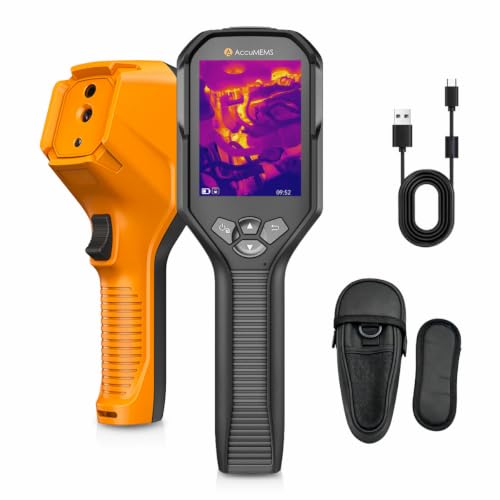
- Enhanced 640x480 output from a 256x192 detector
- Thermal and visible modes with AI inspection presets
- Wi-Fi sharing, 4GB storage, and tripod support
Best For: Professional-grade inspections that benefit from image fusion and AI-guided modes
Universal Compatible Thermal Camera
RISION Magic Thermal Camera, 320x240 QuadIR

- USB-C thermal camera for iOS, Android, and Windows.
- 320x240 QuadIR with 25Hz refresh and 52° x 39° view.
- App tools include PIP, graphs, spot/line/area analysis.
Best For: mobile-friendly inspections, HVAC work, and electrical diagnostics
Rugged Home Inspection Thermal Camera
Thermal Camera, 240 x 240 TISR Resolution

- 240x240 super-resolution imaging with 25Hz refresh.
- Temperature alarm with highest, lowest, and center readings.
- Drop-resistant to 6.6 feet and IP54 dust/water resistance.
Best For: home inspections and rugged everyday troubleshooting
Professional Analysis Thermal Camera
Firecore Thermal Imaging Camera, 320x240

- 320x240 Super Resolution from 160x120 IR clarity.
- 32GB storage plus Windows analysis software.
- Four image modes: Thermal, Visible Light, PIP, and Thermal Mix.
Best For: inspection work that needs storage, analysis, and reporting
Compact Home Inspector – TOPDON TC004 Mini Thermal Imaging Camera
If you want a thermal camera that’s easy to carry but still useful for everyday diagnostics, the TOPDON TC004 Mini is built for practical home and light-duty inspection work. It starts with 128×128 thermal imaging and uses TISR to enhance detail to 240×240, while the 40° x 30° field of view and 25Hz refresh rate help keep scans smooth.
Best For: Homeowners and DIY users checking leaks, underfloor heating, or basic electrical and machinery issues.
Pros:
- TISR-enhanced thermal imaging up to 240×240 for better detail.
- Measures from -4°F to 842°F with auto hot, cold, and center spot detection.
- Instant over-temperature warnings can auto-capture photos for faster documentation.
- Portable mini design with 15-hour runtime and IP54 protection.
Cons:
- Built-in storage is 512MB, so it is not the largest option here.
- No charging head is included with the cable.
Overall, this is a straightforward thermal imaging camera for users who value portability, long battery life, and simple alerts over advanced analysis features.
AI Fault Finder – HF96 Thermal Camera with AI Scene Detection
The HF96 is a versatile thermal camera for users who want automated scene help without giving up manual control. Its IntellFault AI scene recognition is designed to identify water leaks and insulation gaps, while live super resolution boosts thermal images to 240×240 clarity at 25Hz for smoother inspection work.
Best For: Technicians and homeowners who want AI-assisted thermal scans for leaks, insulation, and electrical hotspots.
Pros:
- IntellFault AI scene recognition helps detect leaks and insulation gaps.
- Live super resolution enhances images to 240×240 with 50mK sensitivity.
- 3-in-1 tool combines thermometer, thermal camera, and laser pointer.
- 4GB storage, 11-hour battery life, and IP54 protection support field use.
Cons:
- No moisture readings are provided.
- AI scene features require downloading the latest firmware.
If you want a thermal imaging camera with smart detection and broad inspection flexibility, the HF96 offers a strong mix of automation, measurement range, and rugged portability.
PC Analysis Pro – FOXWELL RT280 Thermal Imaging Camera
The FOXWELL RT280 is a thermal camera built for users who want both clear handheld imaging and deeper PC-based analysis. It uses a 320×240 LCD, TISR-enhanced effective resolution up to 240×180, and a 50° x 38° field of view to support detailed inspections across homes, electrical systems, HVAC, and mechanical equipment.
Best For: Users who want thermal imaging plus Windows software for reporting and analysis.
Pros:
- 320×240 LCD and TISR-enhanced 240×180 effective thermal resolution.
- Windows PC software supports 2D/3D analysis and report generation.
- 8GB eMMC storage holds over 20,000 images and videos.
- Laser pointer, LED light, 9 palettes, and IP54/6.6-foot drop durability.
Cons:
- PC analysis is not compatible with Mac.
- It is larger than the mini-style options in this roundup.
This is a strong pick if you need an infrared camera that does more than capture images, especially when documentation and analysis matter after the inspection.
High-Resolution Powerhouse – Thermal Master Thor002 Handheld Thermal Camera
If image detail is the priority, the Thermal Master Thor002 is the most advanced thermal camera in this group. It upgrades thermal resolution from 256×192 to 512×384 with X³ IR technology, pairs that with a 3.5-inch 640×480 IPS display, and keeps scans smooth at 25Hz with 40mK sensitivity.
Best For: Professionals who want higher-resolution thermal imaging and flexible wireless workflow options.
Pros:
- 512×384 thermal resolution with X³ IR enhancement.
- 3.5-inch 640×480 IPS display and 25Hz refresh rate.
- Wireless transfer via USB, WiFi, smartphone, or iPad support.
- Large 32GB storage, voice notes, QR file management, and 10.5-hour battery life.
Cons:
- It is the heaviest product in this roundup at 3.12 pounds.
- Likely more camera than casual users need for simple checks.
For buyers who want the sharpest thermal imaging and the most flexible data handling, the Thor002 stands out as the premium choice here.
Ultra-Light Dual-Mode Pick – GT14S Thermal Imaging Camera
If you want a thermal camera that is easy to carry and quick to use, the GT14S is built around simple dual-mode inspection. Its full-screen thermal view helps you watch moving animals, machinery, automotive parts, or HVAC systems in real time, while thermometer mode gives you point-and-shoot readings when you need exact numbers.
Best For: Users who want a lightweight thermal camera for flexible home, HVAC, automotive, and kitchen checks.
Pros:
- Lightweight 240g body with a non-slip grip for comfortable handling.
- Dual-mode design combines thermal imaging and thermometer mode.
- NETD under 50mK with 0.05°C sensitivity for subtle temperature differences.
- Up to 14 hours of battery life for longer inspection sessions.
Cons:
- Resolution is not stated in the supplied notes.
- More advanced workflow features are not as extensive as higher-end models.
Overall, the GT14S focuses on portability and practical everyday inspection rather than maximum feature depth. It makes sense if you want a straightforward thermal camera for quick diagnostics across multiple common use cases.
Phone-Friendly High-Resolution Choice – Thermal Master P1 USB-C Thermal Camera
The Thermal Master P1 is a compact thermal camera made for users who want smartphone and computer compatibility without giving up image detail. With 320×240 X³ IR resolution and a 25Hz refresh rate, it aims to deliver smoother visuals and sharper thermal imaging for inspections where clarity matters.
Best For: Smartphone and computer users who need a compact thermal camera for home, HVAC, electrical, automotive, and industrial checks.
Pros:
- Works with USB-C smartphones, iOS, Android, and Windows devices.
- 320×240 X³ IR resolution for clearer thermal images.
- Detects temperature differences as small as 0.04°C.
- Very compact at 17g with 5–8 hours of continuous use.
Cons:
- iPhones with Lightning ports need a separate Type-C to Lightning adapter.
- Requires the Thermal Master app for control.
The P1 stands out as a highly portable thermal camera that trades bulk for convenience and phone-based control. If you want a pocketable inspection tool with better-than-basic thermal detail, it is a strong practical option.
Pro-Level AI Inspection Upgrade – GT27D WiFi Thermal Camera
The GT27D is a more advanced thermal camera for users who want higher-resolution scanning and easier fault identification. It combines a native 256×192 detector with UIRA-IR enhancement to output real-time 640×480 thermal images, plus visible-light support to help confirm exactly where a problem is located.
Best For: Professional inspectors, HVAC technicians, and DIY users who want AI-assisted thermal scanning with visual confirmation.
Pros:
- Enhanced 640×480 output from a native 256×192 detector.
- Dual-spectrum thermal and visible imaging with Thermal, Visual, Fusion, and PIP modes.
- Five inspection presets for moisture, insulation, floor heating, electrical, and solar panel work.
- Wi-Fi sharing, 4GB storage, and tripod mount for practical field use.
Cons:
- More advanced than basic handheld models, so it may be more than casual users need.
- Relies on app-based workflow for exporting and reporting.
For buyers who want a thermal camera that goes beyond simple spot checks, the GT27D offers a strong mix of AI-assisted modes, visible verification, and field-ready convenience. It is built to speed up inspection work without sacrificing useful detail.
Universal Compatible Thermal Camera – RISION Magic Thermal Camera, 320×240 QuadIR
If you want a thermal camera that works across common mobile and desktop workflows, this RISION model is built around USB-C connectivity and real-time thermal/visible-light fusion. It emphasizes quick hotspot identification, a wide temperature span, and app-based analysis for practical inspection work.
Best For: HVAC checks, electrical troubleshooting, automotive diagnostics, and home energy audits on supported iOS, Android, and Windows devices.
Pros:
- 320×240 QuadIR upscaled from 160×120 for clearer thermal detail.
- 25Hz refresh rate with a 52° x 39° field of view for smooth scanning.
- Broad temperature range from -4°F to 1112°F with ±3.6°F accuracy and 40mK sensitivity.
- RISION View app supports PIP, spot, line, area analysis, graphs, and 12 color palettes.
Cons:
- Mac devices are not supported.
- Some advanced diagnostic features depend on the app workflow.
- Best suited to users who need a phone-connected thermal camera rather than a standalone unit.
Overall, this is a flexible thermal imaging option if you value app-based analysis, live spotting, and broad compatibility with supported devices. The combination of QuadIR resolution and thermal fusion makes it especially useful when you need to narrow down issues quickly.
Rugged Home Inspection Thermal Camera – Thermal Camera, 240 x 240 TISR Resolution
This thermal camera is aimed at practical home and field inspections, with super-resolution imaging, temperature alarms, and a durable handheld design. It offers a straightforward way to spot abnormal heat sources while keeping the image readable during routine scanning.
Best For: Home water-leak checks, car inspections, circuit troubleshooting, and use in tougher work environments.
Pros:
- 240×240 super-resolution imaging with a 25Hz refresh rate.
- Temperature alarm plus highest, lowest, and center temperature readouts.
- Measures from -4°F to 1022°F with adjustable distance and emissivity settings.
- Drop-resistant to 6.6 feet and rated IP54 for dust and water resistance.
Cons:
- 6 color palettes is fewer than some higher-end alternatives.
- Field of view is 50°, which may be less flexible for some wide-area scans.
- Product details focus on inspection use rather than advanced reporting features.
For buyers who want a durable thermal imager with simple, useful alerts and a broad temperature range, this model keeps the workflow practical. It looks especially appealing for users who need dependable performance in home and job-site inspection scenarios.
Professional Analysis Thermal Camera – Firecore Thermal Imaging Camera, 320×240
If you want a thermal camera with stronger documentation and analysis features, this Firecore model stands out for its built-in storage, Windows software, and multiple image modes. It is designed to make inspection work easier to capture, compare, and report.
Best For: Electrical inspections, HVAC diagnostics, and home inspection tasks that benefit from on-device storage and PC analysis.
Pros:
- 160×120 IR resolution enhanced to 320×240 Super Resolution clarity.
- 32GB eMMC storage can hold over 30,000 thermal images.
- Includes Thermal, Visible Light, Picture-in-Picture, and Thermal Mix modes.
- Windows PC software supports image analysis and professional report generation.
Cons:
- PC analysis software is not compatible with Mac.
- Only a 40° x 30° field of view, which is narrower than some rivals.
- More geared toward documentation workflows than ultra-simple point-and-shoot use.
Overall, this is a strong pick if your thermal camera needs include storage, reporting, and image comparison after the inspection. The added laser, LED light, and smart alerts further support detailed work in confined or dark areas.
How We Picked the Best Thermal Camera Options
We prioritized image clarity, temperature range, portability, display quality, and overall usefulness for common real-world tasks. We also looked at whether each Thermal Camera is better suited to inspections, electrical work, automotive diagnostics, or general troubleshooting.
Because buyers often need different strengths, we favored a mix of compact budget-friendly models and higher-resolution options for more detailed viewing.
Quick Comparison: What Matters Most
If you want the simplest choice, start with resolution and intended use. A 240 x 240 or 320 x 240 Thermal Camera is often enough for home maintenance and basic leak detection, while higher-resolution options are better when you need finer detail or want to inspect at a greater distance. If you’ll use it on the go, weight, battery life, and one-handed operation matter just as much as raw imaging specs.
Key Buying Factors for a Thermal Camera
Resolution and Image Detail
Higher resolution helps separate small temperature differences and makes edges easier to read. If you inspect wiring, HVAC components, or building envelopes, a sharper screen can save time and reduce guesswork.
Temperature Range and Sensitivity
Check both the measurable temperature range and the smallest detectable differences. A wider range is useful for industrial or automotive work, while strong sensitivity helps spot subtle hot and cold patterns.
Display, Focus, and Controls
A bright screen, intuitive menu layout, and easy focus controls can matter more than extra features. For fast field use, a Thermal Camera with simple operation is usually the better long-term choice.
Special Features
Helpful extras include visual overlays, hotspot tracking, laser pointers, app connectivity, and thermometer mode. These features can speed up diagnosis, but they should complement—not replace—good core image quality.
Who Should Buy Which Thermal Camera?
Homeowners and property inspectors should look for a balanced Thermal Camera with solid resolution and easy operation. HVAC technicians and electricians may want stronger temperature range, better detail, and hotspot tracking. If you need mobility or frequent smartphone use, a compact USB-C or lightweight model can be the most practical fit. For buyers who want the clearest image possible, prioritize the highest-resolution option within budget.
Ultimately, the best choice is the Thermal Camera that matches your workload, not just the one with the longest spec sheet.