A weak shower can result from low municipal pressure, an elevated tank, undersized plumbing, or flow restrictions—not just a problem with the showerhead. The right booster pump can improve pressure and make hot-water delivery feel more consistent.
These 10 options cover whole-house systems, automatic household pumps, and compact diaphragm models. Compare pressure, flow, controls, connection size, noise, and installation requirements before choosing.
Best 10 Water Pressure Booster Pumps for Showers Picks for 2026
Best Whole-Home Control

- Adjustable 22–80 PSI pressure
- 1500 GPH maximum flow
- Quiet variable-speed operation
Best For: Whole-house and apartment pressure boosting
Best Compact Shower Booster

- Up to 7.93 GPM flow
- Automatic start and stop
- Compact stainless steel housing
Best For: One or two indoor fixtures
Best Adjustable Diaphragm Option
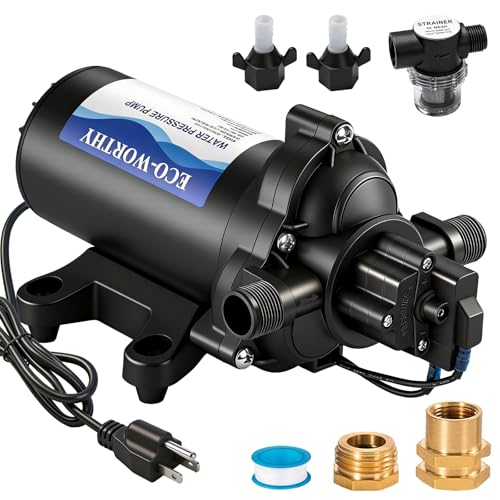
- 4.0 GPM flow capacity
- Adjustable 45–70 PSI switch
- Self-priming and thermal protection
Best For: RV, marine, irrigation, and smaller systems
Best High-Capacity Smart Pump

- 26.5 GPM rated flow
- 22–92 PSI adjustable range
- App control and smart protections
Best For: Large multi-floor homes with multiple fixtures
High-Pressure Utility Pick
ECO-WORTHY 5.5 GPM Diaphragm Pump

- Up to 5.5 GPM and 70 PSI
- Automatic faucet-controlled operation
- Thermal overload protection
Best For: High-pressure household, RV, irrigation, and cleaning tasks
Indoor Fixture Booster
Residential 32.5 PSI Stainless Steel Pump

- Designed for targeted household fixtures
- Automatic demand-based pressure control
- Stainless steel housing with IP67 protection
Best For: Indoor shower, sink, and residential water outlets
Versatile RV-Ready Choice
Tdrsuper 5.5 GPM Diaphragm Pump

- 5.5 GPM flow with 70 PSI factory setting
- Automatic start/stop and dry-run support
- Includes filter, fittings, tape, and tools
Best For: Shower, RV, marine, bathroom, and garden use
Best Low-Flow Pick

- Zero-pressure mode supports very weak flow
- Three speeds and three operating modes
- Quiet operation under 45dB in testing
Best For: Showers and fixtures with weak or inconsistent flow
Best Quiet Local Booster

- Up to 9.2 GPM and 26.1 PSI
- Manual and automatic operating modes
- Quiet design rated at up to 40dB
Best For: Quiet, localized boosting for showers and individual fixtures
Best Whole-Home Control – Aquastrong Smart 45
For shoppers comparing water pressure booster pumps for showers and broader household use, the Aquastrong Smart 45 stands out for its adjustable, constant-pressure operation. It can be set from 22 to 80 PSI, automatically responds to demand, and supports city mains, tanks, shallow wells, and garden applications.
Best For: Homes or apartments needing quiet, whole-house pressure control across multiple fixtures.
Pros:
- Variable-speed control maintains pressure from 22 to 80 PSI.
- Supports up to 1500 GPH flow and a 150-foot maximum head.
- Quiet 55 dB operation with claimed energy savings over standard pumps.
- Includes dry-run, overheating, blockage, leakage, and sensor protections.
Cons:
- Its 17.2-inch length and integrated design require more installation space than compact boosters.
- Professional installation guidance may be useful for complex plumbing systems.
The Smart 45 is a strong choice when shower pressure is only one part of the problem. Its broad pressure range, self-priming capability, and protection features make it a versatile whole-home solution.
Best Compact Shower Booster – Variable-Speed 100W Pump
This compact option is designed for targeted residential boosting, making it one of the more practical water pressure booster pumps for showers, sinks, and water heaters. Its variable-speed motor adjusts to demand, while automatic start and stop operation helps simplify everyday use.
Best For: Indoor systems serving one or two fixtures where a small, responsive booster is preferred.
Pros:
- Provides up to 7.93 GPM and 32.5 PSI maximum pressure.
- Compact 4.1-by-3.71-by-5.3-inch design suits space-limited installations.
- Automatic operation responds to water demand.
- Stainless steel housing and IP67 waterproof protection support indoor residential use.
Cons:
- Its 32.5 PSI maximum is less than that of the higher-powered whole-house models.
- It is intended for one or two fixtures rather than a large, simultaneous household demand.
Choose this pump when the main goal is improving pressure at a shower or a small number of fixtures without installing a larger whole-house unit. Actual results will depend on piping, elevation, and demand.
Best Adjustable Diaphragm Option – ECO-WORTHY 33-Series
The ECO-WORTHY 33-Series is a diaphragm-style pump for buyers who want adjustable on-demand boosting at a moderate 4.0 GPM. It can turn on when a faucet opens, shut off when demand stops, and support applications ranging from faucets and irrigation to select shower setups.
Best For: RV, marine, irrigation, or single-fixture systems needing adjustable 45–70 PSI operation.
Pros:
- Adjustable pressure switch range of 45–70 PSI.
- On-demand operation shuts the pump off when faucets close.
- Self-primes up to 9.8 vertical feet and lifts up to 131 feet.
- Built-in thermal overload protection helps protect the motor.
Cons:
- Its 4.0 GPM flow is lower than the whole-house variable-speed models.
- It is a diaphragm pump, so buyers seeking constant-pressure inverter control may prefer another design.
- The supplied notes describe support for continuous operation for more than one hour, not unrestricted 24/7 use.
This model makes sense for smaller or specialized water systems where pressure-switch control and flexible mounting matter more than high household flow. Its included garden-hose adapters also broaden its utility beyond shower plumbing.
Best High-Capacity Smart Pump – AIDPATH EVO BOOST5
For large homes needing stronger shower and whole-house performance, the AIDPATH EVO BOOST5 combines a 1.2 HP permanent-magnet motor with variable-frequency control. It is rated for 26.5 GPM, offers adjustable pressure up to 92 PSI, and is designed to maintain steady pressure for as many as eight faucets across three floors.
Best For: Larger homes with multiple floors and simultaneous fixture demand.
Pros:
- High 26.5 GPM flow and 197-foot head rating support demanding installations.
- Adjustable 22–92 PSI range and automatic response to water demand.
- Wireless Smart Life App control provides monitoring and parameter adjustment.
- Runs at a stated 50 dB and includes dry-run, overcurrent, and voltage protection.
Cons:
- At 20.4 pounds and 20.7 inches long, it needs substantially more installation space.
- Its higher capacity may be unnecessary for a single shower or small apartment.
- The supplied specifications list a 26-foot maximum lifting height in the details, while the product notes separately state a 197-foot head; verify the installation requirements before purchase.
The EVO BOOST5 is the most capable option here for broad household demand, especially when app-based monitoring is valuable. Its size, capacity, and installation requirements make it better suited to a planned whole-house system than a simple shower-only upgrade.
High-Pressure Utility Pick – ECO-WORTHY 5.5 GPM Diaphragm Pump
If you need water pressure booster pumps for showers or other household and outdoor tasks, the ECO-WORTHY offers strong on-demand performance. Its 110V diaphragm design delivers up to 5.5 GPM, with a factory pressure setting of 70 PSI and adjustable pressure for different needs.
Best For: Buyers who want a high-pressure pump for showers, hose work, irrigation, cleaning, RV use, or other residential and outdoor applications.
Pros:
- Provides up to 5.5 GPM flow and 70 PSI pressure.
- Self-primes up to 9.8 vertical feet and lifts water up to 131 feet.
- Automatic start/stop responds when a faucet opens or closes.
- Thermal overload protection helps protect the motor from overheating.
Cons:
- Requires a 110V AC power connection.
- Its high-pressure, utility-focused design may be more than needed for a single indoor fixture.
- The supplied specifications list a 9.8-foot maximum lifting height while also citing a 131-foot lift figure, so installation conditions should be checked carefully.
The ECO-WORTHY stands out when pressure and versatility matter more than compact indoor installation. It is a capable option for boosting water flow across shower, hose, garden, RV, and cleaning applications, provided the electrical and plumbing setup matches its requirements.
Indoor Fixture Booster – Residential 32.5 PSI Stainless Steel Pump
For shoppers comparing water pressure booster pumps for showers, this compact residential model is designed to improve flow at selected fixtures rather than pressurize an entire home. It combines automatic pressure control with a stainless steel housing for targeted indoor use.
Best For: Indoor residential installations supporting showers, sinks, and other individual water outlets where steady pressure is needed.
Pros:
- Designed specifically for targeted fixture-level pressure boosting.
- Offers up to 7.93 GPM flow, 32.5 PSI pressure, and 75 feet of maximum head under different operating conditions.
- Automatic control adjusts to demand and stops the pump when water use ends.
- Includes IP67 protection, 3/4-inch NPT connections, and 1/2-inch adapters.
Cons:
- Maximum flow, pressure, and head ratings are not achieved simultaneously.
- Its 32.5 PSI maximum pressure is lower than the diaphragm pumps in this roundup.
- Intended for indoor residential use rather than broad outdoor or RV applications.
This pump is the most focused choice for a household fixture that needs steadier water pressure. Its automatic operation, compact size, and connection options make it a practical fit when you want targeted shower or sink support instead of whole-home pressurization.
Versatile RV-Ready Choice – Tdrsuper 5.5 GPM Diaphragm Pump
The Tdrsuper is a flexible option among water pressure booster pumps for showers, especially for buyers who also need support in an RV, boat, kitchen, garden, or bathroom. Its 110V AC diaphragm pump provides up to 5.5 GPM, automatic start/stop, and a factory pressure setting of 70 PSI.
Best For: Households and mobile users needing one pump for shower, bathroom, RV, marine, irrigation, and garden-hose applications.
Pros:
- Offers up to 5.5 GPM flow with adjustable pressure and a 70 PSI factory setting.
- Self-primes up to 9.8 vertical feet and lists lifting capacity up to 164 feet.
- Includes automatic start/stop, overload and overheat protection, and dry-run support.
- Package includes a filter, hose fittings, Teflon tape, spanner, and mounting-related components.
Cons:
- Requires 110V AC power.
- Noise-reduction features are included, but a diaphragm pump may still be less discreet than a small fixture-specific booster.
- The supplied details cite different lift figures, so buyers should verify the applicable rating for their installation.
With its included accessories and broad application range, the Tdrsuper is a strong all-purpose pick for users moving between home, RV, marine, and outdoor settings. It offers useful protection features and automatic operation, while its 70 PSI setting provides substantial pressure headroom for shower use.
Best Low-Flow Pick – CrestWave 85W Smart Booster
For shoppers comparing water pressure booster pumps for showers, the CrestWave stands out for its zero-pressure starting mode, adjustable output, and low operating noise. Its 85W motor reaches up to 550 GPH, 25.6 PSI, and 59 feet of head.
Best For: Showers and household fixtures affected by weak flow, especially installations needing automatic starting at very low flow rates.
Pros:
- Zero-Pressure Auto mode can start and stop below 1.2 L/min.
- Three speed levels and Auto, Manual, and Zero-Pressure Auto modes offer flexible control.
- Runs at less than 45dB under the stated test conditions.
- Includes G 3/4-inch ports, adapters, seals, mounting plugs, screws, and a 24V power adapter.
Cons:
- Standard Auto mode requires at least 1.2 L/min inlet flow to start automatically.
- The included adapters may require checking compatibility with existing plumbing.
The CrestWave is a versatile choice when shower flow is inconsistent or too weak to trigger a conventional automatic pump. Its low-voltage output and included installation hardware add convenience, while the multiple modes help accommodate different water conditions.
Best Traditional Household Option – H15GR-15 120W Booster Pump
The H15GR-15 is a conventional automatic option among water pressure booster pumps for showers, kitchen fixtures, water heaters, and irrigation. Its 120W motor provides up to 396 GPH, 21.7 PSI, and 49.2 feet of head through 1/2-inch NPT connections.
Best For: Household water-heater and shower lines that need automatic pressure support from a flow-switch pump.
Pros:
- Automatic flow switch adjusts operation as water demand changes.
- Suitable for household pressurization, water heaters, solar water heaters, and irrigation.
- Full brass fittings and a 120W motor are included in the all-in-one unit.
- Rated for liquid temperatures from 0°F to 212°F.
Cons:
- Its maximum pressure and flow ratings are lower than some higher-output options.
- Uses 1/2-inch NPT connections, so plumbing compatibility should be confirmed.
- The notes describe a 30-day return period and three months of fittings-part replacement rather than a longer stated warranty.
This pump makes sense for buyers who want a straightforward automatic booster for a specific household line. The flow switch and brass fittings support practical installation, particularly where a water heater or shower supply needs steadier pressure.
Best Quiet Local Booster – BT80 Smart Shower Pump
The BT80 is designed for local shower and fixture boosting rather than whole-house use. It delivers up to 9.2 GPM and 26.1 PSI, uses a 24V working voltage, and offers manual and automatic modes for maintaining a steadier flow.
Best For: Showers, sinks, toilets, or washing machines needing localized pressure improvement in a hard-piped installation.
Pros:
- High listed capacity of 9.2 GPM and 26.1 PSI.
- Manual and automatic modes provide flexible operation and adaptive flow control.
- Designed for quiet operation at up to 40dB, with 20dB stated at 3 feet.
- 24V operation is intended as a safer low-voltage design, and an adapter is included for the stated connection variation.
Cons:
- Not suitable for whole-house water pressure boosting.
- Must be installed through hard pipes and cannot be used with flexible pipe.
- High-rise installations are advised to use a check valve before the pump inlet.
The BT80 is a strong fit when the goal is improving pressure at one shower or fixture without attempting to pressurize an entire home. Its quiet design and dual controls are useful, but the hard-pipe requirement and local-use limitation should be confirmed before purchase.
How We Picked the Best Water Pressure Booster Pumps for Showers
We organized this roundup around the specifications that matter most for shower performance: maximum pressure, gallons per minute, activation method, voltage, connection size, construction, and intended application. We also considered whether each pump is better suited to a single fixture, an RV or auxiliary water system, or multiple fixtures throughout a home.
Maximum PSI is only part of the picture. A pump must maintain useful pressure while water is flowing, and its flow rating should match the shower and any other fixtures it may serve. Automatic pressure or flow switches can simplify daily use, while variable-speed and constant-pressure designs may provide smoother results but usually require more involved installation.
Quick Comparison
| Best For | What to Prioritize | Typical Options in This Roundup |
|---|---|---|
| One shower or fixture | Automatic operation, compact size, suitable flow | Compact household and smart shower pumps |
| Several fixtures | Higher flow, stronger motor, pressure stability | Whole-house booster pumps |
| RV or auxiliary supply | Self-priming operation, diaphragm design, adapters | 12V/110V-style transfer and diaphragm pumps |
| Low-pressure homes | Higher usable PSI and proper plumbing integration | High-pressure automatic or variable-speed models |
Key Buying Factors for Water Pressure Booster Pumps for Showers
Pressure and Flow
Look for a pressure rating that addresses your current shortfall, but do not select solely by the highest advertised PSI. Shower comfort depends on pressure under load and adequate GPM. A pump that is too small may struggle when another tap or toilet is running; an oversized pump can create noise, cycling, or plumbing stress.
Automatic Controls and Compatibility
Flow switches and pressure switches let the pump start when a fixture opens and stop when it closes. Confirm the activation threshold, shutoff behavior, and whether the pump is compatible with your plumbing layout. Check inlet and outlet sizes—many products use 1/2-inch connections, while whole-house systems may require larger fittings or bypass arrangements.
Power, Installation, and Noise
Verify that the pump’s voltage matches the available circuit and that a suitably protected electrical connection is possible. Installation may require isolation valves, a bypass, filters, check valves, or a pressure tank. Place the pump on a stable surface and use flexible connectors where recommended to reduce vibration. If the pump will run near bedrooms or a bathroom, noise and cycling behavior deserve extra attention.
Water Source and Use Case
Some diaphragm pumps are designed for fresh-water transfer, RV systems, or intermittent duty rather than permanent whole-house service. Confirm duty cycle, self-priming capability, water temperature limits, and whether the manufacturer permits potable-water use before installation.
Who Should Buy Which Water Pressure Booster Pumps for Showers?
Choose a whole-house or variable-speed booster when multiple bathrooms need better pressure or household demand changes throughout the day. Choose a compact automatic pump when one shower, kitchen, or low-flow branch is the main problem and installation space is limited. RV-style diaphragm pumps make sense for mobile, tank-fed, or auxiliary systems, provided their duty rating and fittings suit the application. For a simple shower upgrade, prioritize automatic operation, moderate energy use, compatible connections, and enough real-world flow rather than the maximum headline PSI.