Choosing a whole-house water filter on a budget means balancing filtration performance, flow rate, installation requirements, and replacement costs. The right system can improve water at every tap without committing to an expensive treatment setup.
This roundup compares 10 options, including sediment prefilters, clear housings, carbon systems, multi-stage units, and well-water-focused packages. Use the guide below to match the filter type and maintenance demands to your home’s water conditions.
Best 10 Whole House Water Filters Under 100 Picks for 2026
Best Value Two-Stage Filtration
Compact 2-Stage Whole House Filter

- Includes two extra cartridge sets
- 3/4-inch ports and compact 10-inch design
- Up to 10 gpm flow rate
Best For: Households wanting a compact system with replacement filters included
Best Sediment Prefilter
iSpring WSP-50 Spin-Down Filter

- Reusable 50-micron stainless screen
- Flushable housing with visual monitoring
- Protects downstream filters and plumbing
Best For: Indoor whole-house sediment prefiltration, especially for well water
Best High-Flow Housing
SimPure DB10C Clear Filter Housing

- Large 4.5-by-10-inch cartridge format
- Listed flow rate up to 20 gpm
- Clear housing with 1-inch brass ports
Best For: DIY users who want to choose a compatible cartridge
Best Complete Multi-Stage Kit
3-Stage 15 GPM Home Filter System
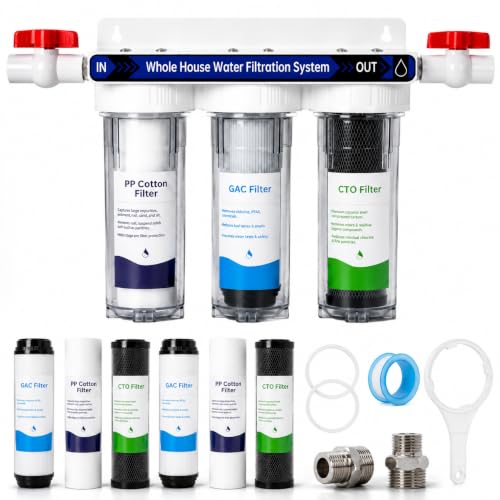
- Combines PP, GAC, and CTO filtration
- Rated for flow rates up to 15 GPM
- Includes three complete filter sets
Best For: Whole-home chlorine, odor, taste, and sediment reduction
Best Replacement Cartridge Value
PUREPLUS 5-Micron Carbon Filter

- Two-pack for standard 10-by-4.5-inch housings
- Targets sediment, chlorine, rust, and color
- Up to 30,000 gallons depending on conditions
Best For: Tap-water filtration in compatible heavy-duty housings
Best All-In-One Value

- Filters sediment, chlorine, odors, iron, scale, and lead-related impurities
- Includes three cartridge sets for 1.5–2 years of stated use
- 15 GPM flow rate with 3/4-inch plumbing compatibility
Best For: Families wanting included replacement filters and broad everyday filtration
Best for Well or City Water
3-Stage Filter with 2-Year Supply

- Designed for well and municipal water supplies
- Includes nine cartridges for 1.5–2 years of stated coverage
- Two shut-off valves and up to 15 GPM flow
Best For: Homes wanting compact filtration with replacement cartridges included
Best Appliance-Protection Pick

- Targets scale, chlorine, heavy metals, sediment, taste, and odors
- Includes two spare cartridge sets for 12–24 months of stated coverage
- Clear housings and separate shut-offs simplify maintenance
Best For: Homes prioritizing scale reduction and appliance protection
Best Value Two-Stage Filtration – Compact 2-Stage Whole House Filter
For shoppers comparing whole house water filters under 100, this two-stage system offers a compact setup with included replacement cartridges. It is designed to reduce sediment, rust, chlorine odor and taste, and some heavy metals while supporting household water flow up to 10 gallons per minute.
Best For: Families and apartment residents looking for a compact filter with extra cartridges for routine household use.
Pros:
- Includes two additional cartridge sets for longer-term maintenance.
- Universal 3/4-inch ports fit standard household plumbing.
- Clear housing and two valves support easier monitoring and servicing.
- Rated for flow up to 10 gpm.
Cons:
- Replacement cartridges are expected about every 6–12 months, depending on use.
- The notes do not specify removal of all dissolved contaminants.
This is a practical value-oriented option when included filter replacements and a compact footprint matter. Verify your plumbing layout and water conditions before installation.
Best Sediment Prefilter – iSpring WSP-50 Spin-Down Filter
Among whole house water filters under 100, the iSpring WSP-50 stands out as a reusable prefilter for larger particles. Its 50-micron stainless steel screen is intended to reduce sediment, rust, dirt and sand before water reaches finer filters or household plumbing.
Best For: Well-water users and homes that need a flushable first-stage sediment filter.
Pros:
- Flushable and reusable stainless steel mesh screen.
- See-through housing makes sediment buildup easy to monitor.
- Lead-free brass head and dual-thread connections support installation flexibility.
- Screen typically lasts one to two years, according to the supplied notes.
Cons:
- A 50-micron screen may clog quickly in water with heavy sediment.
- It is a sediment prefilter, not a complete solution for chlorine, taste or dissolved contaminants.
- Designed for indoor use within the stated temperature and pressure ranges.
This filter is best viewed as a protective first stage rather than a standalone whole-home purifier. Homes with substantial sediment may need a larger unit or a different micron rating.
Best Complete Starter System – Pentair OMNIFilter U25
The Pentair OMNIFilter U25 is a straightforward choice among whole house water filters under 100, combining a clear housing, included carbon cartridge and valve-in-head design. It reduces sediment, chlorine taste and odor from water supplied through the home while supporting flow up to 5 gallons per minute.
Best For: Homes on chlorinated municipal water that want a complete starter kit with a standard replacement cartridge.
Pros:
- Includes the housing, TO1 carbon cartridge, wrench and mounting bracket.
- Valve-in-head shutoff simplifies cartridge changes without shutting off the main supply.
- Accepts standard 10-inch by 2.5-inch replacement cartridges.
- Included cartridge is rated for up to 15,000 gallons.
Cons:
- Maximum flow is 5 gpm, lower than some larger systems.
- The included cartridge is generally replaced about every three months.
- The TO1 cartridge is designed for chlorinated water supplies.
Its included components and accessible cartridge format make the U25 easy to evaluate and maintain. Consider your household flow needs and water source before choosing this smaller-capacity system.
Best High-Flow Housing – SimPure DB10C Clear Filter Housing
For buyers seeking whole house water filters under 100 with higher flow potential, the SimPure DB10C provides a large clear housing that accepts standard 4.5-by-10-inch cartridges. It is a housing-only setup, so you will need to purchase a compatible filter cartridge separately.
Best For: DIY installers who want a reusable large-format housing for city or well water and prefer choosing their own cartridge.
Pros:
- Supports a listed maximum flow rate of up to 20 gpm.
- Standard 1-inch NPT brass inlet and outlet ports.
- Clear housing allows quick visual inspection of cartridge condition.
- Includes a wrench, mounting bracket and installation screws.
Cons:
- No filter cartridge is included.
- The larger housing requires adequate installation and replacement space.
- Cartridges and push fittings may need to be purchased separately.
This is a flexible foundation rather than an out-of-the-box filtration system. It makes the most sense for shoppers comfortable selecting a cartridge based on their sediment, carbon or other filtration requirements.
Best Budget Sediment Defense – MewMore WHC40 Spin-Down Filter
For shoppers comparing whole house water filters under 100, the MewMore WHC40 is a practical pre-filtration option for capturing visible sediment before it reaches household plumbing and equipment. Its reusable design and interchangeable mesh filters make it adaptable to changing water conditions.
Best For: Homes using city or well water that primarily need sediment, sand, rust, and debris reduction.
Pros:
- Includes 40-, 100-, and 200-micron stainless steel mesh filters.
- Flushable and reusable, reducing the need for frequent cartridge replacements.
- Transparent housing allows visual monitoring, while the brass valve head adds durability.
- Includes connectors for several 1-inch and 3/4-inch threaded configurations.
Cons:
- Designed mainly for sediment and debris, not chlorine, taste, or odor reduction.
- Requires regular flushing, especially with poor-quality or well water.
- Installation still requires compatible threaded plumbing connections.
The WHC40 is a cost-conscious choice when sediment protection is the priority. Its reusable filter elements can help control ongoing maintenance costs, but households seeking broader contaminant reduction may need a multi-stage system or additional filtration.
Best Complete Multi-Stage Kit – 3-Stage 15 GPM Home Filter System
Among whole house water filters under 100, this three-stage system stands out for combining sediment filtration with activated carbon and carbon block treatment. It is designed to improve water quality at multiple fixtures while maintaining a stated flow rate of up to 15 GPM.
Best For: Small to medium households wanting chlorine, odor, taste, rust, and sediment reduction for city or well water.
Pros:
- Uses 0.5-micron PP, GAC, and CTO filter stages.
- Supports flow rates up to 15 GPM through reinforced 3/4-inch NPT brass ports.
- Includes three complete cartridge sets, or nine filters total.
- Clear housings, shutoff valves, a wrench, connectors, plumber’s tape, and a manual are included.
Cons:
- Does not reduce TDS or remove dissolved minerals.
- Filter life varies with water quality and household usage.
- As a multi-stage system, installation and cartridge changes may be more involved than with a single filter.
This system offers strong value for buyers who want a fuller filtration setup rather than sediment-only protection. The included replacement sets reduce near-term maintenance purchases, while the clear housings make filter condition easier to inspect.
Best Replacement Cartridge Value – PUREPLUS 5-Micron Carbon Filter
For shoppers seeking whole house water filters under 100, the PUREPLUS PP10BB-CC is a two-pack replacement cartridge for standard 10-by-4.5-inch heavy-duty housings. Its layered polypropylene and coconut-shell activated carbon construction targets sediment, chlorine, rust, color, and some VOCs in tap water.
Best For: Homes with compatible standard housings that need affordable tap-water sediment and carbon filtration replacement cartridges.
Pros:
- Uses three PP layers plus a coconut-shell activated carbon layer.
- Designed to reduce chlorine, sand, rust, sediment, color, and some VOCs.
- Two-pack format and stated capacity of up to 30,000 gallons, depending on water quality.
- Compatible with many standard 10-by-4.5-inch heavy-duty housings and listed models.
Cons:
- Not recommended by the supplied notes for well-water filtration.
- Requires a compatible housing; it is not a complete whole-house system.
- Replacement is suggested every three to six months, depending on use and water conditions.
The PUREPLUS two-pack is a sensible maintenance purchase when you already own a compatible heavy-duty housing. It keeps beneficial minerals and does not lower TDS, so buyers seeking dissolved-solids reduction will need a different type of treatment.
Best All-In-One Value – 3-Stage Whole House Filter
For shoppers comparing whole house water filters under 100, this three-stage system offers broad everyday filtration for well or city water. It targets sediment, chlorine, odors, iron, scale, and some heavy metals while preserving natural minerals, and includes three complete cartridge sets for an advertised 1.5–2 years of use.
Best For: Families wanting an all-in-one system with replacement filters included for kitchen, bathroom, or main-line installation.
Pros:
- Three-stage filtration addresses sediment, chlorine, odors, iron, scale, and lead-related concerns.
- Includes nine replacement cartridges, plus two built-in shut-off valves and a bypass valve head.
- Rated for up to 15 GPM and fits standard 3/4-inch plumbing.
Cons:
- Does not reduce TDS; natural minerals remain in the water.
- Cartridges should be replaced about every six months.
- Installation requires removing the factory plastic wrap from each cartridge.
This is a practical value pick when included replacement filters matter as much as initial filtration. Its compact housing and high stated flow rate make it versatile, but buyers seeking TDS reduction will need a different type of system.
Best for Well or City Water – 3-Stage Filter with 2-Year Supply
This system is a strong option among whole house water filters under 100 for households that want simple three-stage treatment without removing naturally occurring minerals. It is designed for well or municipal water and comes with three sets of cartridges covering sediment, chlorine, and odors.
Best For: Households seeking a compact, easy-maintenance filter with a substantial supply of replacement cartridges.
Pros:
- Three-stage design uses PP, GAC, and CTO cartridges for sediment, chlorine, and odor reduction.
- Includes nine filters, advertised to provide 1.5–2 years of coverage.
- Two integrated shut-off valves simplify filter changes, and the system supports up to 15 GPM.
Cons:
- Does not lower TDS levels.
- Replacement timing is approximately every six months.
- Although marketed for whole-home use, the listed installation type is under-sink.
The included cartridge supply helps lower ongoing maintenance hassle, while the 0.5-micron product highlight and 15 GPM rating add appeal. Confirm the plumbing layout and installation location before buying, especially if you plan to connect it to a main household line.
Best Appliance-Protection Pick – 3-Stage Anti-Scale Filter
For buyers evaluating whole house water filters under 100, this three-stage model emphasizes taste, odor, scale, and heavy-metal reduction while maintaining a strong stated 15 GPM flow. It includes two spare cartridge sets, making it suited to households that want filtration and replacement coverage in one package.
Best For: Families looking to reduce scale and protect appliances, pipes, coffee makers, and laundry equipment from incoming impurities.
Pros:
- PP, GAC/KDF, and softener cartridges target sediment, chlorine, limescale, heavy metals, taste, and odors.
- Includes two spare sets, providing stated coverage for 12–24 months.
- Individual shut-offs, double O-rings, and clear housings support maintenance and leak monitoring.
Cons:
- Preserves beneficial minerals, so it does not reduce TDS.
- Filter life is listed at about five months, depending on water conditions.
- The listed maximum supported TDS level is 300 ppm.
This model stands out for its anti-scale positioning and visible housings, which make it easier to see accumulated debris. It is a sensible choice for households prioritizing appliance protection, provided their water conditions fall within the stated specifications.
How We Picked the Best Whole House Water Filters Under 100
We focused on systems and replacement-filter options priced for budget-conscious shoppers while comparing the features that matter most in whole-house filtration. The selection includes single-housing systems, spin-down sediment filters, two- and three-stage designs, and packages with extra cartridges. We considered stated micron ratings, port sizes, flow-rate claims, included filters, housing dimensions, and whether each product is better suited to municipal or well water.
Because water quality varies widely, product claims should be treated as starting points rather than a substitute for testing. Check the manufacturer’s specifications and confirm that the system addresses your specific contaminants.
Quick Comparison
- Best for basic sediment: Spin-down filters and 5-micron cartridges capture sand, rust, and larger particles.
- Best for chlorine and taste: Carbon cartridges or multi-stage systems are generally the more relevant choice.
- Best for customization: Clear filter housings let you choose compatible cartridges and monitor buildup.
- Best for well-water setups: Look for sediment protection, appropriate flow capacity, and a filter supply sized for frequent maintenance.
Key Buying Factors for Whole House Water Filters Under 100
Filtration Type and Micron Rating
Lower micron ratings can capture finer particles, but they may clog sooner and reduce flow if the incoming water is dirty. Spin-down filters are useful as washable prefilters, while sediment, carbon, and specialty cartridges serve different purposes. A carbon filter can help with chlorine and taste, but it is not a universal solution for dissolved minerals, hardness, or every contaminant.
Flow Rate and Port Size
Compare the system’s rated gallons per minute with your household’s peak demand. A filter that is too restrictive may cause weak showers or slow appliance filling. Also verify whether your plumbing uses 3/4-inch or 1-inch connections and budget for adapters, shutoff valves, or a bypass if they are not included.
Installation and Maintenance
Confirm that you have enough wall clearance to remove the housing and replace cartridges. Transparent housings make sediment buildup easier to inspect, while opaque housings can offer a cleaner appearance. Replacement frequency depends on water quality and usage, so calculate ongoing cartridge costs instead of judging the purchase price alone.
What the System Does Not Remove
Do not assume a low-cost whole-house filter softens water or removes lead, iron, bacteria, or other dissolved contaminants simply because the listing mentions them. Review independent testing or certification when available, and test your water before choosing a treatment method for a specific health or plumbing concern.
Who Should Buy Which Whole House Water Filters Under 100?
Choose a spin-down or basic sediment model if your main problem is visible sand, grit, or rust and you want a washable first line of defense. A standard cartridge housing is a better fit if you want flexibility to use sediment, carbon, or specialty filters over time. Select a two- or three-stage system if you want combined sediment and taste or odor reduction and have adequate installation space.
For well water, prioritize a system with a suitable sediment stage and enough replacement capacity for your household. If chlorine, hardness, iron, or heavy metals are significant concerns, use water testing to determine whether a filter under $100 is sufficient or whether you need dedicated softening or treatment equipment.