Whole-house filtration can improve water quality at every tap, shower, and appliance—but the right system depends on your source water, contaminant concerns, flow needs, and maintenance preferences.
We’ve gathered 10 multi-stage whole-house water filters spanning city-water, well-water, heavy-metal, iron, chlorine, PFAS, and fine-particle filtration needs. Use the guide below to narrow your choices before comparing individual systems.
Best 10 Multi Stage Whole House Water Filters Picks for 2026
High-Flow Chlorine Defense

- Up to 15 GPM flow
- Three-stage sediment and carbon filtration
- 100,000-gallon capacity
Best For: High-flow chlorine, sediment, taste, and odor reduction
Monitored City & Well Water

- Three-stage contaminant reduction
- Pressure gauges for maintenance tracking
- Up to 15 GPM flow
Best For: Small to medium homes using city or well water
Iron & Manganese Specialist

- Targets iron and manganese
- 5-micron sediment plus carbon stages
- Up to 15 GPM and 100,000 gallons
Best For: Homes with tested iron or manganese concerns
Maintenance-Friendly Heavy Metal Reduction
WF3-01 3-Stage Whole House Filter

- GAC+KDF heavy-metal reduction stage
- 180-day filter timers and pressure gauges
- Includes valves, brush, and flexible fittings
Best For: Maintenance-conscious buyers targeting heavy metals and odors
Heavy-Duty Protection
Express Water Ultimate Protection 3-Stage

- Reduces chlorine and multiple heavy metals
- Adds polyphosphate anti-scale protection
- Includes stainless frame, gauges, and pressure-release buttons
Best For: Homes needing broad contaminant and scale protection
Everyday Whole-Home Filtration
Aquaboon 3-Stage Whole House System

- Combines sediment, carbon, and polyphosphate stages
- Targets rust, silt, chlorine, tastes, and odors
- Includes brackets, wrench, housings, and manual
Best For: Routine whole-home sediment and chlorine filtration
UV-Enhanced Filtration
Geekpure 5-Stage Whole House System

- Adds 6 GPM UV treatment to sediment and carbon stages
- Nano antiscale carbon targets chlorine, odors, and scale
- Retains minerals but does not reduce hardness or heavy metals
Best For: Homes wanting UV treatment with multi-stage filtration
PFAS-Focused Protection
3-Stage PFAS Whole House Filter
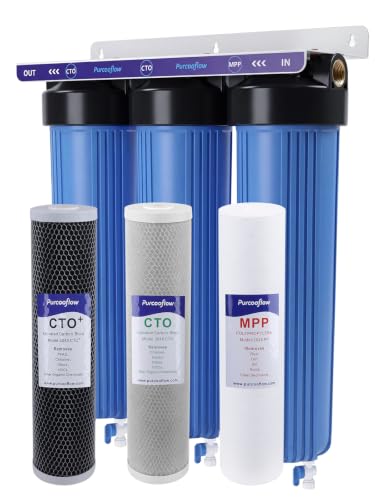
- Targets PFOA and PFOS with a dedicated carbon-block stage
- Uses standard 20 x 4.5-inch replacement cartridges
- Offers 15 GPM flow and built-in drain valves
Best For: Households prioritizing PFAS reduction and easy maintenance
Low-Maintenance Value
0.5-Micron 3-Stage Home Filter

- Includes two spare sets of replacement cartridges
- Filters sediment, chlorine, tastes, and odors
- Provides clear housings and individual shut-offs
Best For: Buyers seeking included replacement filters and straightforward upkeep
Heavy-Duty Plumbing Defense

- Combines sediment, KDF, and CTO filtration
- Uses a framed design with a pressure gauge
- Supports 1-inch connections and 15 GPM flow
Best For: Homes needing a robust, monitorable system for sediment and selected metals
High-Flow Chlorine Defense – iSpring WGB32B
For shoppers comparing multi stage whole house water filters, the iSpring WGB32B emphasizes high flow and broad everyday filtration. Its three 20-by-4.5-inch cartridges use sediment and coconut-shell carbon filtration to reduce chlorine, rust, tastes, odors, herbicides, and other impurities.
Best For: Homes seeking a high-capacity, high-flow filter for chlorine, sediment, taste, and odor reduction.
Pros:
- Rated for flow rates up to 15 GPM with 1-inch inlet and outlet connections.
- Three-stage design includes a 5-micron sediment filter and two CTO carbon block filters.
- 100,000-gallon capacity and an expected filter life of up to one year.
- DIY-oriented setup, individually wrapped cartridges, and included housing wrench.
Cons:
- Does not reduce TDS or remove healthy minerals like a reverse osmosis system.
- Its large 20-inch cartridges require adequate installation space.
The WGB32B is a practical choice when maintaining water flow and reducing chlorine-related taste and odor matter more than TDS removal. Its long cartridge capacity may also help limit maintenance for a typical household.
Monitored City & Well Water – Pro+Aqua Elite GEN2 PRO-100-E
The Pro+Aqua Elite GEN2 PRO-100-E is a monitored option among multi stage whole house water filters, with three filter stages and pressure gauges. It is designed for small to medium homes with one to three bathrooms and can be used with city or well water.
Best For: Small to medium households wanting visible pressure monitoring and broad contaminant reduction without electricity, backwashing, or regeneration.
Pros:
- Three stages target sediment, dissolved metals, hydrogen sulfide odors, chlorine, VOCs, pesticides, and other chemicals.
- Stainless steel pressure gauges help track system performance and filter replacement timing.
- Supports flow rates up to 15 GPM and uses 1-inch ports.
- Includes a five-year manufacturer warranty and lifetime U.S. technical support after activation.
Cons:
- Replacement filters are recommended every six months for best filtration and flow rate.
- The supplied specifications list professional installation, which may add setup cost.
- Designed specifically for smaller homes with one to three bathrooms.
This system stands out for homeowners who want broad three-stage treatment and an easy way to watch pressure changes. The shorter six-month replacement interval is the main maintenance consideration.
Iron & Manganese Specialist – iSpring WGB32BM
The iSpring WGB32BM is one of the more targeted multi stage whole house water filters, adding an iron and manganese-focused third stage to sediment and carbon filtration. Its FM25B catalytic media is specified to reduce iron up to 3.0 ppm and manganese up to 1.0 ppm, while also addressing chlorine, rust, tastes, and odors.
Best For: Homes with tested iron or manganese concerns that also need whole-house sediment, chlorine, and odor reduction.
Pros:
- Third-stage filter targets iron up to 3.0 ppm and manganese up to 1.0 ppm.
- First-stage sediment filtration reaches 5 microns, followed by coconut-shell carbon filtration.
- Up to 15 GPM flow with 1-inch NPT connections.
- 100,000-gallon capacity and filter life of up to one year.
Cons:
- Iron and manganese reduction depends on staying within the stated maximum concentrations.
- Does not reduce TDS, so it is not a substitute for reverse osmosis when TDS removal is required.
- The three-cartridge system is relatively large and weighs about 55 pounds.
Choose the WGB32BM when iron and manganese are central to your water-quality problem rather than incidental concerns. Its long stated service life and 15-GPM flow make it suitable for whole-home installation, provided your test results fit its limits.
Maintenance-Friendly Heavy Metal Reduction – WF3-01 3-Stage Whole House Filter
The WF3-01 combines three large-format filters with pressure monitoring and service reminders, making it a maintenance-conscious pick among multi stage whole house water filters. Its sediment, carbon block, and GAC+KDF stages are intended to reduce sediment, chlorine, VOCs, odors, and several heavy metals.
Best For: Homeowners who want heavy-metal and taste improvement features with built-in maintenance reminders and flexible fittings.
Pros:
- GAC+KDF stage is specified for lead, mercury, arsenic, cadmium, chromium, chlorine, and other chemicals.
- Multiple pressure gauges and 180-day timers help identify clogging and replacement timing.
- Includes pressure-relief and drain valves, a housing brush, maintenance card, and adaptable fittings.
- Supports up to 15 GPM and accepts 3/4-inch or 1-inch NPT conversions.
Cons:
- The supplied details list under-sink installation, so confirm the intended installation location before buying.
- Its 180-day timers imply more frequent cartridge attention than systems rated for one year.
- The overall assembly is about 31 inches high and 23 inches wide, requiring substantial space.
The WF3-01 is appealing if cartridge maintenance is easy to forget or if you value service accessories. Its heavy-metal reduction claims and flexible fittings should be matched to your water test and plumbing layout.
Heavy-Duty Protection – Express Water Ultimate Protection 3-Stage
For homeowners seeking multi stage whole house water filters with broad contaminant coverage, the Express Water Ultimate Protection system combines sediment, activated carbon, KDF, and polyphosphate treatment. Its freestanding stainless steel frame, gauges, and pressure-release buttons make monitoring and filter changes more convenient.
Best For: Homes prioritizing heavy-metal reduction, chlorine reduction, and anti-scale protection across the whole water supply.
Pros:
- Designed to reduce lead, arsenic, chromium, mercury, cadmium, chlorine, and other heavy metals.
- Polyphosphate stage helps protect pipes and appliances from scale buildup.
- Heavy-duty stainless steel bracket and freestanding frame support installation flexibility.
- Three pressure gauges and pressure-release buttons simplify system monitoring and maintenance.
Cons:
- At 63 pounds and roughly 29 by 8.5 by 30 inches, it requires substantial installation space.
- Filter life is listed at approximately six months, so ongoing replacements are part of ownership.
- Manual operation means the system does not have an independent power source.
With a stated maximum flow rate of 17 GPM and 100,000-gallon capacity, this is a substantial option for larger household water supplies. It is especially compelling when scale and heavy metals are higher priorities than a compact footprint.
Everyday Whole-Home Filtration – Aquaboon 3-Stage Whole House System
The Aquaboon is a practical choice among multi stage whole house water filters, using sediment, carbon, and polyphosphate filtration in a conventional whole-house setup. It is built to address common concerns such as rust, silt, dirt, chlorine, unpleasant odors, and scale.
Best For: Households wanting straightforward whole-home sediment, chlorine, taste, odor, and scale filtration with included installation accessories.
Pros:
- Three filtration stages combine sediment protection, carbon filtration, and polyphosphate scale control.
- Pleated polyester sediment filter helps capture dust, sand, rust, and silt.
- Activated carbon filter is specified to reduce up to 99% of chlorine along with tastes, odors, and chemicals.
- Includes housings, brackets, a wrench, and manual for installation and maintenance.
Cons:
- The listed upper temperature rating is 70°F, limiting suitability for warmer water conditions.
- Filter replacement is listed at six-month intervals.
- It does not list dedicated heavy-metal or UV treatment.
With a stated 15 GPM maximum flow rate and 100,000-gallon capacity, the Aquaboon balances useful flow with a familiar three-stage design. Its feature set is best matched to routine whole-home water-quality improvements rather than specialized purification needs.
UV-Enhanced Filtration – Geekpure 5-Stage Whole House System
The Geekpure stands out among multi stage whole house water filters by combining PP sediment filtration, two carbon filters, a UV stage, and nano antiscale carbon. It is designed for homeowners who want expanded treatment in a wall-mounted system while retaining minerals and avoiding changes to water chemistry from the UV stage.
Best For: Homes seeking UV treatment plus sediment, chlorine, taste, odor, and scale reduction, provided an electrical connection is available.
Pros:
- Five-stage configuration includes sediment, two carbon filters, 6 GPM UV, and nano antiscale carbon filtration.
- UV stage adds treatment without chemicals or changes to taste, color, odor, pH, conductivity, or general water chemistry.
- Two pressure gauges and a built-in pressure-release valve support monitoring and safer filter replacement.
- Retains healthy minerals and offers listed filter life of six to 12 months, with the UV filter lasting one year.
Cons:
- The system requires corded electricity for its UV stage.
- It will not reduce hardness, heavy metals, or total dissolved solids.
- The UV filter is rated for 6 GPM, which may be more limiting than the system’s stated 15 GPM maximum flow.
This wall-mounted system offers the most extensive stage count of the three options, but its benefits come with electrical and maintenance requirements. It is a strong fit when UV treatment is important and heavy-metal or hardness reduction is not required.
PFAS-Focused Protection – 3-Stage PFAS Whole House Filter
This three-stage option stands out among multi stage whole house water filters for households prioritizing PFAS reduction alongside everyday sediment, chlorine, and odor filtration. It uses standard 20 x 4.5-inch cartridges, 1-inch brass ports, and a 15 GPM maximum flow rate.
Best For: Homes seeking targeted PFAS reduction with a high-flow, standard-cartridge system.
Pros:
- Third-stage carbon block is tested to reduce PFOA and PFOS, with listed reduction rates of 98.57% and 97.05%.
- Three-stage design combines sediment, chlorine-and-odor, and PFAS-focused filtration.
- Built-in drain valves, brass ports, mounting hardware, wrench, and Teflon tape simplify maintenance and installation.
- 100,000-gallon capacity and a listed 12-month filter life support less-frequent replacement.
Cons:
- The system is relatively large, measuring about 21.85 inches wide and 25.2 inches high.
- PFAS performance is specifically documented for PFOA and PFOS rather than every possible contaminant.
This is a strong choice when PFAS is a central concern rather than an incidental feature. Its standard filter size and drain valves also make ongoing ownership more convenient.
Low-Maintenance Value – 0.5-Micron 3-Stage Home Filter
For shoppers comparing multi stage whole house water filters on operating cost, this system includes two spare sets of PP, GAC, and CTO cartridges. It is designed to reduce chlorine, rust, odors, and off-flavors while maintaining a listed 15 GPM flow rate.
Best For: Budget-conscious households wanting replacement filters included with the initial purchase.
Pros:
- Includes two extra sets of PP, GAC, and CTO cartridges, with replacement intervals listed at four to six months.
- Three-stage filtration addresses sediment, chlorine, taste, and odor concerns.
- Individual shut-offs, double O-rings, and clear housings support easier maintenance and inspection.
- Can be used with well water or city tap water according to the supplied product information.
Cons:
- The system preserves beneficial minerals, so it does not reduce TDS.
- The listed capacity is 10,000 gallons, lower than some larger whole-house systems.
- Its included connectors are 3/4-inch, so plumbing compatibility should be checked before installation.
The extra cartridges give this model practical value for buyers who want supplies on hand. It is best viewed as a chlorine-and-sediment solution, not a TDS-reduction system.
Heavy-Duty Plumbing Defense – VEVOR 3-Stage KDF Filter
This VEVOR system takes a heavy-duty approach to multi stage whole house water filters, pairing sediment, KDF, and CTO stages. It is designed to reduce rust, sand, chlorine, odors, and selected heavy metals while supporting 1-inch plumbing connections and up to 15 GPM.
Best For: Larger homes wanting a framed, high-capacity system with pressure monitoring.
Pros:
- Three stages target sediment, chlorine, H2S, odors, and listed heavy metals including lead, arsenic, and chromium.
- Painted iron frame supports either floor-standing or wall-mounted installation.
- Pressure gauge helps monitor system pressure and filter condition.
- 100,000-gallon capacity, 1-inch NPT connection, and 15 GPM flow support whole-home use.
Cons:
- At 48.9 pounds and up to 31.5 inches high, it is heavier and larger than many compact systems.
- The listed filter life is six months, so replacement planning is necessary.
- Its supported maximum TDS level is listed as 300 ppm.
With its sturdy frame and pressure gauge, this model suits installations where durability and monitoring matter. Confirm available space and mounting requirements before choosing it.
How We Picked the Best Multi Stage Whole House Water Filters
We selected systems based on filtration-stage design, stated contaminant-reduction goals, housing and port sizes, compatibility with municipal and well water, replacement-filter availability, and practical installation considerations. The lineup includes three-stage systems, larger-capacity housings, fine-micron options, and models aimed at specific concerns such as iron, manganese, heavy metals, chlorine, and PFAS.
Product claims can vary by cartridge, flow rate, and testing conditions. Always verify the manufacturer’s performance data and confirm that a system addresses the contaminants found in your water report.
Quick Comparison
| Best For | Look For | Why It Matters |
|---|---|---|
| City water | Sediment and carbon stages | Helps reduce particles, chlorine, and taste or odor issues. |
| Well water | Iron, manganese, sediment, and higher-capacity housings | Well water may need more targeted treatment and frequent prefiltration. |
| Heavy metals | Certified or clearly documented reduction claims | Not every carbon cartridge is designed for every metal. |
| Very fine filtration | Submicron or 0.5-micron cartridges | May capture smaller particles but can reduce flow faster. |
| High household demand | Large 20-inch housings and suitable port sizes | Higher capacity can help maintain flow between filter changes. |
Key Buying Factors for Multi-Stage Whole-House Water Filters
Match the Stages to Your Water Problem
A sediment cartridge is useful for sand, rust, and suspended particles. Carbon commonly targets chlorine, taste, and odor. KDF or specialized media may support reduction of certain metals, while iron and manganese concerns often require a purpose-built cartridge or a separate treatment step. Do not assume that a three-stage label means the same treatment across brands.
Check Flow Rate, Port Size, and Pressure Limits
Compare the system’s rated gallons-per-minute flow with your home’s simultaneous demand. A filter that is too restrictive may cause weak showers or appliance issues. Also confirm whether the connections match your plumbing and whether pressure gauges, shutoff valves, a bypass, and mounting hardware are included.
Calculate Maintenance Cost
Replacement intervals depend on incoming water quality and household usage. Larger cartridges may last longer, but they can cost more initially. Check replacement availability, cartridge dimensions, micron ratings, and whether changing filters requires a housing wrench or special tools.
Consider Installation and Testing
Most systems install on the main water line and need adequate clearance for cartridge removal. A licensed plumber may be worthwhile, especially for tight utility spaces, high-pressure plumbing, or well-water setups. Test your water before and after installation when contaminant reduction is important.
Who Should Buy Which Multi Stage Whole House Water Filters?
Choose a straightforward carbon-and-sediment system if your main concerns are chlorine, odors, and visible particles in treated city water. For well water, prioritize a model with appropriate sediment capacity and documented support for iron or manganese rather than relying on a generic cartridge.
Households concerned about lead, mercury, arsenic, chromium, or PFAS should select a system with specific, verifiable reduction claims and use independent water testing to confirm performance. If your home has high water demand, look for larger housings, generous flow ratings, and readily available replacement cartridges. Finally, choose a fine-micron system only when its added filtration is worth the possible pressure and maintenance trade-offs.