Finding problems inside engines, walls, pipes, and HVAC systems is easier when a camera can steer around bends instead of relying on a fixed probe. The best articulating inspection borescopes combine directional control, useful lighting, a clear display, and a slim enough shaft for restricted access.
These 10 options include two-way and four-way probes, dual-lens cameras, long cables, and ultra-slim designs. Use the guide below to match probe movement, image coverage, durability, and accessories to the work you actually perform.
Best 10 Articulating Inspection Borescopes Picks for 2026
Best Balanced Pick
Teslong Articulating Borescope

- Two-way 210° articulation with a 5-foot semi-rigid cable
- 4.5-inch IPS display with adjustable LED lighting
- 1080p video, 32GB storage, and up to 5-hour battery life
Best For: Automotive, HVAC, and household inspections
Best Slim-Probe Option
FOXWELL Y400 Articulating Borescope

- 6.2mm probe reaches narrow openings
- 220° two-way steering with thumb-wheel control
- HD IPS screen, 4X zoom, and IP67 protection
Best For: Spark plug holes, HVAC vents, valves, and industrial diagnostics
Best for Long-Reach Work
DEPSTECH DS650 Articulating Borescope

- 10-foot semi-rigid cable for extended reach
- Dual lenses with split-screen viewing and 210° articulation
- 1080p imaging, IP67 construction, and manual focus
Best For: Deep automotive, HVAC, plumbing, and industrial inspections
Best All-Direction Control
Ralcam 360° Articulating Borescope

- Four-way 360° steering with lockable angles
- Slim 6.2mm probe with six adjustable LEDs
- Standalone operation with 32GB storage
Best For: Complex automotive, plumbing, HVAC, electrical, and DIY inspections
Best Overall
FOXWELL 220° Dual-Lens Articulating Borescope
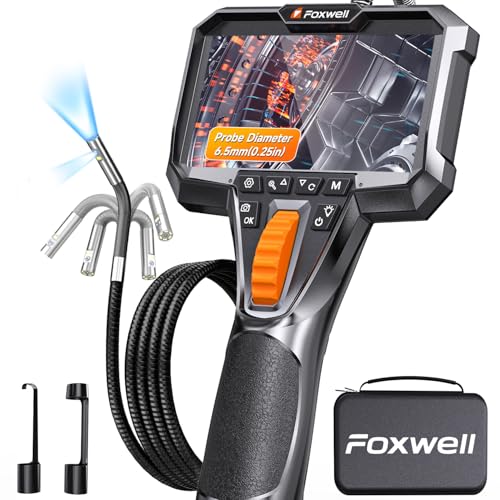
- 220° articulation with front- and side-view cameras
- Slim 0.25-inch probe for tight access points
- HD IPS display with IP67 protection and 32GB storage
Best For: Detailed automotive, HVAC, plumbing, and retrieval work
Best Slim-Probe Value
Anykit 210° Articulating Borescope

- Extra-slim 0.22-inch probe for difficult access
- 1920×1080P display with zoom and image flip
- 3000mAh battery supports up to five hours
Best For: Engine, HVAC, plumbing, and wall-cavity inspections
Best for Comfortable Handling
Teslong Dual-Lens Articulating Borescope

- Front- and side-view cameras reduce probe repositioning
- 4.5-inch IPS screen with adjustable LED lighting
- 5-foot semi-rigid cable and ambidextrous joystick
Best For: Comfortable automotive, HVAC, and household inspections
Best Articulation Control

- 220° two-way steering for navigating turns
- 1080p viewing with 4.3-inch IPS monitor
- IP67 probe with accessories and 32GB card
Best For: Automotive, HVAC, plumbing, and mechanical inspections
Best Multi-Angle Viewing
Teslong TF550 4-Way Dual-Lens Borescope

- Four-way control with 360° rotation
- Front and side cameras reduce repositioning
- 5-inch 1080p display with audio recording
Best For: Professional multi-angle equipment and automotive inspections
Best Compact Engine Inspection
210° Two-Way Articulating Borescope

- Lockable 210° articulation for engine access
- 1080p display with three-level lighting
- IP67 waterproof and oil-resistant probe
Best For: Portable automotive engine and wet-area inspections
Best Balanced Pick – Teslong Articulating Borescope
For buyers comparing articulating inspection borescopes, the Teslong offers a practical balance of maneuverability, viewing comfort, and straightforward operation. Its two-way articulating probe, 5-foot semi-rigid cable, and built-in display make it suitable for inspecting automotive, HVAC, and household spaces without relying on a phone app.
Best For: Automotive maintenance, HVAC work, and general household inspections where a flexible but shape-retaining probe is useful.
Pros:
- Two-way 210° articulation and a semi-rigid 5-foot gooseneck help navigate tight spaces.
- 4.5-inch IPS screen provides sharp viewing in bright or dim conditions.
- Adjustable LED illumination, 1080p video, and included 32GB storage support documentation.
- Central joystick and rear photo button enable convenient one-handed operation.
Cons:
- Two-way articulation offers less directional control than four-way designs.
- The 5-foot cable may be limiting for especially deep or extended inspection areas.
- Still images are listed at 2MP, so this is primarily an inspection-viewing tool rather than a high-resolution camera.
The Teslong is a well-rounded choice when you want an independent screen, useful lighting, and manageable probe control in a compact inspection tool. Its semi-rigid cable and five-hour battery rating add practicality for routine field use.
Best Slim-Probe Option – FOXWELL Y400 Articulating Borescope
The FOXWELL Y400 stands out among articulating inspection borescopes for its 0.24-inch probe and responsive 220° two-way steering. That combination is designed for narrow access points such as spark plug holes, HVAC vents, pipes, valves, and industrial equipment, while the built-in display avoids app or Wi-Fi setup.
Best For: Mechanics and technicians who need to reach very narrow openings and examine components with adjustable lighting and zoom.
Pros:
- Ultra-slim 6.2mm probe can access openings where larger scopes may not fit.
- 220° two-way articulation with a thumb wheel supports precise tip control.
- HD IPS display, six adjustable LEDs, and 2X/4X zoom help reveal details in dark areas.
- IP67 waterproof, dustproof, and oil-resistant probe with overheat protection.
Cons:
- Two-way articulation does not provide the all-direction steering of a four-way scope.
- The narrow probe prioritizes access, so buyers needing a broader probe or larger camera may prefer another design.
- Automatic shutdown at 158°F may interrupt work in particularly hot inspection environments.
Choose the Y400 when access is the main challenge. Its slim probe, direct steering, zoom, and job-site protection make it especially compelling for detailed automotive and industrial diagnostics.
Best for Long-Reach Work – DEPSTECH DS650 Articulating Borescope
For buyers needing extra reach, the DEPSTECH DS650 is one of the more versatile articulating inspection borescopes in this group. Its 10-foot semi-rigid cable, dual-lens design, split-screen viewing, and 210° bidirectional articulation are suited to complex inspections in automotive, HVAC, plumbing, and industrial settings.
Best For: Long-reach inspections that benefit from dual-lens visibility, a shape-retaining cable, and a built-in screen.
Pros:
- 10-foot semi-rigid gooseneck provides greater reach while retaining controlled positioning.
- Dual lenses, 78° fields of view, and split-screen viewing broaden situational awareness.
- 1080p imaging, adjustable LEDs, manual focus, and 1.5X zoom support close inspection.
- IP67 construction, high-temperature warning, 8GB storage, and a 2,200mAh battery add practical job-site features.
Cons:
- The longer cable may be less convenient to manage in compact work areas.
- Battery life is listed at 4+ hours, shorter than some alternatives in this roundup.
- The 0.33-inch probe is not as slim as the 0.24-inch options listed elsewhere.
The DS650 is a strong fit when inspection depth and surrounding visibility matter more than maximum compactness. Its dual-lens setup and long semi-rigid cable can reduce repositioning during larger or harder-to-reach jobs.
Best All-Direction Control – Ralcam 360° Articulating Borescope
The Ralcam offers the broadest steering range among these articulating inspection borescopes, with four-way 360° articulation and a lockable probe. Its slim 6.2mm camera, 1080p imaging, adjustable LEDs, and standalone monitor make it useful for examining automotive, plumbing, electrical, HVAC, and household spaces.
Best For: Users who want all-direction probe control for positioning the camera precisely around bends and inside confined areas.
Pros:
- Four-way 360° articulation allows the probe to bend and rotate for broad directional control.
- Probe can lock at a selected angle for steadier detailed inspection.
- 6.2mm slim camera, 1080p imaging, and six adjustable LEDs support access and visibility.
- No phone, Wi-Fi, or app is required; a 32GB Micro SD card supports JPG and AVI capture.
Cons:
- The listed video capture resolution is 720p, despite the notes describing 1080p camera imaging.
- The 4.3-inch screen is slightly smaller than the 4.5-inch displays on several alternatives.
- Supplied details do not specify a battery runtime.
The Ralcam is the logical pick when probe positioning is the priority. Four-way steering and angle locking can make complex visual access easier, while the slim camera and onboard storage keep the workflow self-contained.
Best Overall – FOXWELL 220° Dual-Lens Articulating Borescope
For buyers comparing articulating inspection borescopes, the FOXWELL stands out with a slim 6.5mm probe, 220° two-way articulation, and dual front- and side-view cameras. Its standalone HD display and built-in storage make it practical for automotive, HVAC, plumbing, and other detailed inspections without a phone or app.
Best For: Professionals who want broad viewing coverage, clear imaging, and a compact probe for demanding inspection and retrieval tasks.
Pros:
- 220° articulation and dual lenses provide front- and side-view coverage.
- Ultra-slim 0.25-inch probe fits spark plug holes, vents, and narrow pipes.
- HD IPS display, adjustable LEDs, IP67 probe, and 32GB built-in storage.
- Magnetic and hook tips can help retrieve lost screws or parts.
Cons:
- At 2.44 pounds, it is heavier than some competing handheld models.
- The probe automatically shuts down above 70°C, which may limit very hot inspections.
The FOXWELL is a strong all-around choice when inspection coverage and imaging quality matter most. Its narrow probe and retrieval accessories add useful versatility, while the integrated display and storage keep the workflow simple.
Best Slim-Probe Value – Anykit 210° Articulating Borescope
The Anykit is a practical option among articulating inspection borescopes for users who need a very narrow probe and straightforward controls. Its 0.22-inch probe, 210° two-way articulation, 4.3-inch IPS screen, and semi-rigid 4-foot cable suit engine, HVAC, plumbing, wall-cavity, and industrial checks.
Best For: Mechanics, technicians, and DIY users who prioritize a slim probe, long battery runtime, and easy plug-and-play operation.
Pros:
- 0.22-inch probe reaches especially tight spaces.
- 210° two-way articulation and a thumb slider support controlled positioning.
- 1920×1080P imaging, adjustable LEDs, three zoom levels, and 180° image flip.
- 3000mAh battery provides up to five hours of continuous inspection.
Cons:
- Its included TF card has 8GB of storage, less than some alternatives.
- The display is smaller than the 4.5-inch screen offered by the Teslong model.
Choose the Anykit when access size and operating endurance are more important than extra camera coverage. The tiny probe, semi-rigid cable, temperature alert, and no-app design create a capable kit for routine field diagnostics.
Best for Comfortable Handling – Teslong Dual-Lens Articulating Borescope
The Teslong combines two-way articulation with front- and side-view lenses, making it a convenient choice among articulating inspection borescopes for areas where repositioning is difficult. Its 4.5-inch IPS screen, 5-foot semi-rigid gooseneck, adjustable probe lighting, and centrally placed joystick support controlled one-handed inspections.
Best For: Users who want an ergonomic borescope for automotive, HVAC, household, and general confined-space inspections.
Pros:
- Dual cameras provide front and side views without constantly repositioning the probe.
- 4.5-inch IPS LCD screen offers a clear viewing surface.
- Five-foot semi-rigid cable balances reach, flexibility, and stability.
- Central joystick and dedicated controls support ambidextrous, one-handed use.
Cons:
- The supplied specifications list 720p video capture and 1MP still resolution.
- At 1.44kg, it is relatively heavy for prolonged handheld use.
- Its listed digital zoom is limited to 1.5×.
The Teslong is a good fit for inspections where handling comfort, cable reach, and quick lens switching are priorities. It offers useful visibility and illumination, though buyers seeking the highest stated image resolution may prefer another model.
Best Articulation Control – DXZtoz 220° Two-Way Borescope
For buyers comparing articulating inspection borescopes, the DXZtoz AGC430N emphasizes controlled steering, close-up imaging, and a self-contained monitor. Its 220° two-way articulation and flexible gooseneck probe are designed to help navigate turns and inspect confined automotive, HVAC, plumbing, and mechanical spaces without requiring an app.
Best For: Automotive and maintenance inspections requiring two-way steering, close focusing, and portable documentation.
Pros:
- 220° two-way articulation helps guide the camera around obstacles.
- 1080p output, a 4.3-inch IPS display, and 8 adjustable LED lights support clear viewing.
- IP67 waterproof, oil-resistant probe includes hook, magnet, side mirror, case, and 32GB memory card.
- 3000mAh battery is rated for up to four hours of operation.
Cons:
- Two-way articulation offers less directional control than a four-way design.
- The 8.5mm probe may not fit every very narrow access point.
The DXZtoz is a practical choice when steering control matters more than maximum articulation range. Its accessories and built-in screen also make it a ready-to-use option for routine field inspections.
Best Multi-Angle Viewing – Teslong TF550 4-Way Dual-Lens Borescope
The Teslong TF550 stands out among articulating inspection borescopes for its four-way joystick control and dual-camera setup. The probe bends up to 210° with 360° rotation, while front and side lenses let you inspect multiple views without repeatedly repositioning the cable.
Best For: Professional automotive, machinery, wall, pipe, and equipment inspections where directional flexibility and side viewing are useful.
Pros:
- Four-way articulation provides 360° rotation and up to 210° bending.
- Dual 1.0MP cameras offer front and side views with separate LED illumination.
- 5-inch IPS display supports 1080p photos and videos.
- Audio recording, 32GB microSD card, carrying case, hook, and magnet support documentation and retrieval tasks.
Cons:
- At 1.69kg, the kit is heavier than some compact inspection cameras.
- Its 1MP cameras may provide less still-image detail than higher-resolution models.
Choose the Teslong when viewing angle and maneuverability are priorities. The dual-lens design can reduce repositioning, while recording with audio makes it useful for maintenance reports and troubleshooting notes.
Best Compact Engine Inspection – 210° Two-Way Articulating Borescope
This 210° two-way model is a straightforward option for shoppers seeking articulating inspection borescopes for engine and other tight-space work. Its 5.3-foot cable, lockable articulation, 4.3-inch IPS screen, and integrated lighting are aimed at one-person inspections without apps or external viewing devices.
Best For: Automotive engine checks and wet or oil-prone inspection areas where a portable, easy-to-operate kit is helpful.
Pros:
- 210° articulation can be locked at a chosen angle for closer inspection.
- 1080p camera, 4.3-inch IPS display, and three-level LED lighting support viewing in dark spaces.
- IP67 waterproof probe includes oil resistance and a high-temperature warning system.
- Built-in 32GB TF card, 3000mAh battery, and carrying case support mobile use.
Cons:
- Two-way articulation is less versatile than four-way steering.
- The 0.24-inch probe specification may limit access compared with slimmer scopes.
This model makes sense for users who want controlled two-way movement, simple operation, and engine-focused durability. The lockable head and included storage are especially useful when documenting repeatable repair inspections.
How We Picked the Best Articulating Inspection Borescopes
We focused on the features that make a steerable inspection camera practical in real working conditions: articulation range, probe diameter, camera coverage, lighting, cable length, image quality, and overall versatility. The selection includes models for automotive repair, HVAC servicing, wall and cavity inspection, plumbing, and general industrial troubleshooting.
Dual-lens designs can show forward and side views, while a broader articulation range helps the probe navigate corners. We also considered whether each model appears suited to occasional household use or more frequent professional inspection work.
Quick Comparison
| Best for | Features to prioritize | Recommended type |
|---|---|---|
| Engine and automotive work | Slim probe, strong lighting, flexible articulation | Two-way or four-way camera |
| HVAC and wall cavities | Long cable, side-view coverage, durable probe | Dual-lens articulating borescope |
| Tight access points | Probe diameter around 0.22 to 0.24 inches | Ultra-slim two-way model |
| Broader cavity inspection | Wide articulation and adjustable illumination | 360-degree or four-way model |
Key Buying Factors for Articulating Inspection Borescopes
Articulation and Probe Diameter
Two-way control is usually sufficient for engine bays and straight access routes. Four-way or 360-degree articulation offers more precise positioning around obstructions, but may add cost and complexity. Check the stated probe diameter before buying; even a small difference matters when entering spark-plug holes, tubing, wall gaps, or narrow mechanical passages.
Camera Views and Image Quality
A forward-facing camera is the standard choice for locating defects. Dual-lens models add a side-facing view that can reveal corrosion, cracks, or leaks along the wall of a cavity without repeatedly repositioning the probe. Resolution specifications are useful, but lighting and lens cleanliness often have just as much impact on usable detail.
Lighting, Cable, and Handling
Adjustable LEDs help prevent washed-out images on reflective metal and improve visibility in dark cavities. Choose cable length based on the inspection area, not simply the longest available option. A longer probe reaches farther but can be harder to control. A comfortable handle, responsive steering control, and a screen that remains readable at an angle can make extended inspections less tiring.
Durability and Accessories
Look for a probe suited to the environment, especially if it may encounter oil, dust, moisture, or heat. Confirm the product’s water-resistance limits rather than assuming every articulating camera is waterproof. Useful accessories may include mirrors, hooks, magnets, carrying cases, spare cables, and recording or photo-storage functions.
Who Should Buy Which Articulating Inspection Borescopes?
Choose a slim two-way model if your priority is reaching tight automotive or household spaces at the lowest practical cost. A dual-lens borescope is a better fit for HVAC, wall, and pipe inspections where side visibility can save time. Pick a four-way or wide-angle articulating design when accurate positioning around several obstacles matters more than compact simplicity. For frequent professional use, prioritize steering control, probe construction, lighting adjustment, and warranty support over headline resolution alone.