Hard water can leave scale on fixtures, dull laundry, and shorten the life of water-using appliances. The best compact water softeners address those problems without demanding excessive space or complicated operation.
This roundup compares portable and whole-house systems across grain capacity, regeneration controls, household coverage, and installation requirements so you can choose a practical fit for your home, RV, or water-use demands.
Best 10 Compact Water Softeners Picks for 2026
Best RV Pick
On The Go OTG4-VM-DBLSOFT Portable Softener

- 16,000-grain capacity
- Drinking-water-safe brass fittings
- Designed for RV use
Best For: RV owners needing portable water treatment
Best DIY Home Option
WaterBoss 74011 Water Softener

- Quiet, efficient operation
- Built-in iron and sediment filters
- Designed for DIY installation
Best For: Homeowners wanting integrated filtration and simpler setup
Best for 3-4 Bathrooms
Aquasure Harmony 40,000-Grain System

- 40,000-grain whole-house capacity
- Automatic digital metered control
- Includes multi-purpose pre-filter
Best For: Three- to four-bathroom homes needing whole-house coverage
Best Space-Saving Home System

- Designed for 2-3 bathroom homes
- Metered regeneration
- 10-year limited tank warranty
Best For: Smaller homes with limited utility-area space
High-Capacity Choice
Aquasure Harmony 48,000-Grain Softener

- 48,000-grain capacity for three to four bathrooms
- Programmable metered digital control head
- Pre-filter targets sediment, chlorine, odors, and more
Best For: Three- to four-bathroom homes needing high capacity and customizable regeneration
Smart Salt Saver

- 40,000-grain capacity for one to five people
- Learns usage patterns for demand-based regeneration
- Reduces hardness, clear-water iron, and sediment
Best For: Families and well-water households prioritizing salt efficiency
Efficient Whole-House Pick

- 40,000-grain capacity for up to five people
- 15.5 gpm flow rate and NSF/ANSI 44 certification
- Metered mode targets lower salt and water use
Best For: Families wanting certified, high-flow softening with efficiency features
Best with Extra Features
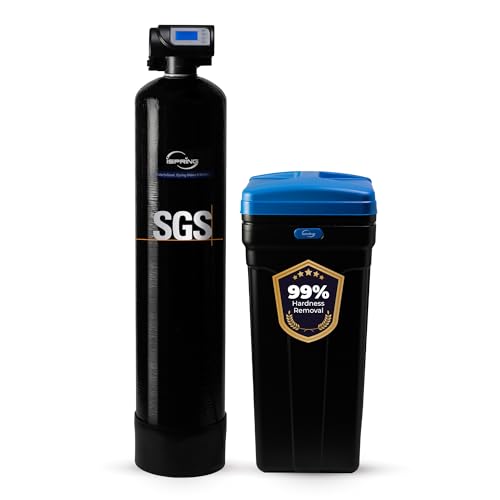
- 45,000-grain whole-house capacity
- Automatic backwash and regeneration
- Digital controls with support coverage
Best For: Larger homes and light commercial use
All-in-One Choice

- 2-in-1 softening and filtration
- AutoSense AI can reduce salt use
- Sized for households up to five people
Best For: Homes wanting soft and better-tasting water from one cabinet
Small-Household Pick

- 32,000-grain capacity for 1–4 people
- Compact footprint with 7.2-gpm flow
- Smart regeneration learns water use
Best For: Smaller homes with limited installation space
Best RV Pick – On The Go OTG4-VM-DBLSOFT Portable Softener
If you need compact water softeners for an RV, the On The Go OTG4-VM-DBLSOFT is designed specifically for mobile use. Its 16,000-grain capacity, portable format, and drinking-water-safe brass fittings make it a practical choice for RV hookups.
Best For: RV owners who need a portable water softener.
Pros:
- Portable design made for RV use
- 16,000-grain softening capacity
- Drinking-water-safe brass fittings
- Assembled by U.S. workers in Indiana
Cons:
- Not intended for apartment, condo, or house showers
- Will not fit under a kitchen sink
- Weighs 33.7 pounds
This is a focused RV solution rather than a residential whole-house system. Its 10 x 10 x 24-inch dimensions are portable, but buyers should plan for an external installation location instead of under-sink placement.
Best DIY Home Option – WaterBoss 74011 Water Softener
Among compact water softeners for homeowners who prefer a do-it-yourself installation, the WaterBoss 74011 emphasizes quiet operation and efficiency. It includes built-in iron and sediment filters and is identified as an easy DIY installation.
Best For: Homeowners seeking a quiet, efficient softener with built-in filtration.
Pros:
- Quiet operation
- High-efficiency design
- Built-in iron and sediment filters
- Easy do-it-yourself installation
Cons:
- Requires corded electric power
- Weighs 39.9 pounds
- Product details do not specify a grain-capacity rating
The WaterBoss 74011 is a sensible choice when installation simplicity and integrated filtration matter more than portability. Its electric, boxed design is better suited to a dedicated installation area than a temporary or travel setup.
Best for 3-4 Bathrooms – Aquasure Harmony 40,000-Grain System
For households needing compact water softeners with whole-house coverage, the Aquasure Harmony Series provides a 40,000-grain capacity for homes with three to four bathrooms. Its metered digital control head supports programmable operation, while the included pre-filter targets sediment and several listed contaminants.
Best For: Homes with three to four bathrooms seeking whole-house softening and automated metering.
Pros:
- 40,000-grain capacity for 3-4 bathrooms
- Automatic digital metered control valve
- Triple-purpose sediment, GAC, and zinc pre-filter
- Includes a corrosion-resistant stainless steel bypass valve
Cons:
- 55-inch height may require careful placement planning
- Not as portable as an RV-focused softener
- Listed for water temperatures up to 100°F
With a 9 x 9 x 55-inch footprint, this system saves floor width but requires substantial vertical clearance. Its digital metering and whole-house design make it a stronger fit for a permanent utility-area installation.
Best Space-Saving Home System – Tier1 24,000-Grain Softener
The Tier1 24,000 Grain Water Softener is a compact water softener system for two- to three-bathroom homes. Its space-saving tanks, metered regeneration, ceramic valve technology, and preloaded cation resin make it suited to basements, garages, or utility areas.
Best For: Two- to three-bathroom homes with limited installation space.
Pros:
- Compact 8 x 39-inch mineral tank and 13.5 x 32-inch brine tank
- Metered regeneration tracks household demand
- Ceramic valve technology resists abrasion and corrosion
- Includes a 10-year limited tank warranty
Cons:
- Installation is listed as professional
- Weighs 60 pounds
- 24,000-grain capacity is intended for smaller homes than the Aquasure system
This Tier1 model balances a relatively small footprint with a 0.75-cubic-foot resin capacity and an 18-gpm maximum flow rate. It is worth considering when long-term tank coverage and space efficiency are priorities, provided professional installation is acceptable.
High-Capacity Choice – Aquasure Harmony 48,000-Grain Softener
For households seeking compact water softeners for three to four bathrooms, the Aquasure Harmony combines a 48,000-grain capacity with metered digital regeneration. Its ion-exchange design targets hardness minerals throughout the home, while the included pre-filter addresses several common water contaminants.
Best For: Homes with three to four bathrooms that want high capacity, programmable controls, and broad whole-house water treatment.
Pros:
- 48,000-grain capacity and a rated maximum flow of 12 gpm.
- Backlit digital control head supports programmable auto-flush intervals.
- Triple-purpose pre-filter targets chlorine, odors, sediment, rust, and other listed contaminants.
- Includes a corrosion-resistant tank, premium-grade resin, and five-year extended manufacturer warranty when activated as specified.
Cons:
- At 120 pounds and 62 inches tall, it may require careful placement and installation planning.
- The freestanding system requires an adapter for power.
The Harmony is a strong fit when capacity and customizable metering matter more than the smallest footprint. Confirm the available vertical space and installation requirements before choosing it for a compact utility area.
Smart Salt Saver – Kenmore 420 Water Softener
The Kenmore 420 is one of the more compact water softeners for households of one to five people, offering a 40,000-grain capacity in a 48-inch-tall cabinet. Its IntelliSoft technology learns water-use patterns and regenerates when needed, while the system also targets clear-water iron and common well-water sediment.
Best For: Families of up to five people, especially those using well water and seeking salt-saving, demand-based operation.
Pros:
- IntelliSoft technology is designed to regenerate based on household water-use patterns.
- Reduces hardness minerals and clear-water iron to help limit scale, rust, and soap scum.
- Built-in sediment screen adds protection for plumbing and appliances.
- Includes an installation kit and offers a 10-year tank warranty.
Cons:
- Its 7.7 gpm maximum flow rate is lower than the other listed systems.
- At 102 pounds and 20.5 by 15 inches, it still needs a dedicated installation area.
- The warranty coverage varies by component, with one year for the full system and three years for electronics.
The Kenmore 420 stands out for households that value automated salt management and well-water support. Its lower flow rating makes it especially important to compare household demand before installation.
Efficient Whole-House Pick – Aquasana SimplySoft 40K
The Aquasana SimplySoft 40K is a practical option among compact water softeners for homes with up to five people and four bathrooms. It uses metered ion exchange, a 40,000-grain capacity, and an LCD control system designed to reduce salt and water use compared with standard time-based regeneration.
Best For: Homes with up to five people that want certified hardness reduction, high flow, and a cabinet-style whole-house system.
Pros:
- 15.5 gpm maximum flow rate supports whole-house water use.
- IAPMO certified to NSF/ANSI Standard 44 and CSA B483.1.
- Metered operation is designed to use 50% less salt and 28% less water than standard time-based regeneration.
- Works with city or well water and includes a softener tank, control valve, and brine cabinet.
Cons:
- The optional pre-filter is sold separately.
- Its 30-inch length may be challenging in especially tight utility spaces.
- The listed warranty is limited and varies between five and ten years.
SimplySoft is a compelling choice when certification, flow rate, and resource efficiency are key priorities. Measure the installation area carefully, and consider the optional pre-filter if incoming water contains sediment.
Best with Extra Features – iSpring WCSTB45KG
For households seeking compact water softeners with whole-house capacity, the iSpring WCSTB45KG offers a 45,000-grain ion-exchange system with automatic regeneration and a digital control valve. It is designed for residential, school, business, and light commercial use with city or well water.
Best For: Larger homes and light commercial settings that need high-capacity whole-house softening and programmable operation.
Pros:
- 45,000-grain capacity supplies softened water throughout the property.
- Programmable control valve calculates regeneration based on water quality and usage.
- Automatic backwash and regeneration help support consistent performance and resin life.
- Includes a 30-day money-back guarantee, one-year warranty, and lifetime free technical support.
Cons:
- At 75.6 pounds, it is not the lightest option to position or install.
- Requires a corded electrical connection and a separate brine tank footprint.
The iSpring is a strong choice when capacity and automated maintenance matter more than the smallest possible installation footprint. Its digital controls and durable materials make it a practical whole-house option.
All-in-One Choice – EcoPure EPH130
The EcoPure EPH130 stands out among compact water softeners with its cabinet-style 2-in-1 design. It combines ion-exchange softening with integrated filtration to provide soft water throughout the home and better-tasting drinking water at the tap.
Best For: Households of up to five people that want softening and filtration in a single installation footprint.
Pros:
- Combines water softening and filtration in one cabinet.
- AutoSense AI technology adapts to usage patterns and can use up to 40% less salt than traditional systems.
- Designed for larger households and multiple bathrooms.
- Integrated media reduces the footprint compared with multi-tank arrangements.
Cons:
- Its 42.75-inch height may limit placement in low-clearance spaces.
- The supplied notes specify a one-year parts-and-labor warranty, shorter than some tank warranties.
Choose the EPH130 if you want to consolidate softening and filtration rather than install separate equipment. Its cabinet format is space-conscious while still targeting higher household demand.
Small-Household Pick – Kenmore 350
The Kenmore 350 is a practical option for shoppers comparing compact water softeners for a smaller household. Its 32,000-grain capacity is sized for one to four people, while IntelliSoft technology learns usage patterns and regenerates only when needed.
Best For: One- to four-person households with hard water and limited installation space.
Pros:
- Compact 20.5-by-15-inch footprint suits tighter utility areas.
- IntelliSoft technology adapts regeneration to household water use.
- 7.2-gpm maximum flow rate and a 3/4-inch valve help maintain water pressure.
- Includes a sediment shield, installation kit, and long tank warranty coverage.
Cons:
- Its 32,000-grain capacity is intended for smaller households rather than high-demand homes.
- The 48-inch height may still require substantial vertical clearance.
- It is listed as manual/gravity-fed rather than corded electric.
The Kenmore 350 balances a smaller footprint with smart regeneration and household-focused capacity. It is a sensible fit when space and efficient operation are priorities for a smaller family.
How We Picked the Best Compact Water Softeners
We compared these Compact Water Softeners on the specifications that matter most in real homes: grain capacity, rated household size, regeneration controls, salt efficiency, footprint, included components, and intended installation. The selection includes portable units for RVs and occasional use, as well as whole-house systems designed for apartments, smaller homes, and families.
We also considered whether each model focuses primarily on water softening or adds filtration and taste-improvement features. Because water hardness, iron levels, plumbing layouts, and local installation requirements vary, product specifications should be confirmed before purchase.
Quick Comparison
- Portable use: The On The Go model is designed for mobility, making it a practical choice for RVs, cabins, and temporary setups.
- Smaller homes: Lower-capacity systems such as 24,000- and 32,000-grain models can suit modest water demand when regeneration frequency is acceptable.
- Family homes: Systems in the 40,000- to 48,000-grain range generally provide more reserve capacity for several bathrooms and higher daily consumption.
- Filtration plus softening: Combination systems can reduce the need for separate equipment when improving drinking-water taste is also a priority.
- Metered control: Digital demand-initiated controls typically regenerate according to water use rather than relying only on a fixed schedule.
Key Buying Factors for Compact Water Softeners
Capacity and Household Size
Grain capacity indicates how much hardness a system can remove between regeneration cycles. A small household may need only 24,000 to 32,000 grains, while larger households or homes with very hard water may benefit from 40,000 grains or more. Oversizing can provide useful reserve capacity, but it may increase cost and space requirements.
Water Hardness, Iron, and Flow Rate
Test your water before choosing a system. Hardness and iron affect capacity calculations, while peak flow rate affects whether multiple showers or appliances can operate without pressure problems. Municipal water and private wells may require different pretreatment or filtration.
Controls, Salt Use, and Maintenance
Metered controls can help limit unnecessary regeneration and salt consumption. Check how the system handles power interruptions, whether settings are easy to adjust, and how often you will need to add salt or clean the brine tank. Combination units may simplify equipment management but can have more components to maintain.
Footprint and Installation
Measure the available floor space, door clearance, drain access, electrical outlet, and distance to the main water line. Portable softeners usually need a suitable connection and regeneration location, while whole-house systems may require bypass valves, plumbing modifications, and professional installation.
Who Should Buy Which Compact Water Softeners?
Choose a portable unit if you need soft water for an RV, vacation property, or temporary location. Choose a lower-capacity whole-house model for a smaller household with limited installation space. Choose a 40,000- to 48,000-grain system if several people use water daily or your hardness level is high. Choose a softener-and-filtration combination when better-tasting drinking water is as important as scale reduction. Before ordering, verify grain capacity, dimensions, warranty terms, replacement requirements, and compatibility with your plumbing and water chemistry.