Choosing the right wall scanner can make mounting shelves, TVs, cabinets, and fixtures faster—and help you avoid hidden wiring or plumbing risks. The best wall scanner stud finders combine dependable detection with clear indicators and simple operation.
Our roundup compares 10 options ranging from straightforward stud locators to multifunction scanners with deep detection, metal sensing, live-wire alerts, and rechargeable power.
Best 10 Wall Scanner Stud Finders Picks for 2026
Most Intuitive
Franklin Sensors ProSensor M210

- 13 sensors show full stud width
- No calibration required
- Detects wood, metal, and live wires
Best For: Easy everyday stud scanning
Most Versatile
FNIRSI WD-01 6-in-1 Wall Scanner

- Six modes detect studs, metals, and wires
- Rechargeable with LCD and audio alarm
- Locates studs up to 1.5 inches deep
Best For: Multi-material home scanning
Best for Deep Scanning
Franklin Sensors ProSensor MAX

- Scans up to 2.5 inches deep
- Handles thick and layered surfaces
- Two modes show stud width and centers
Best For: Deep scanning through challenging walls
Best for Jobsite Use
BOSCH GMS120-27 Professional Wall Scanner

- Detects studs, metal, pipes, and live wires
- IP54-rated with shock-absorbing casing
- Includes AA batteries and protective pouch
Best For: Professional multi-material scanning
Best All-Around Wall Scanner

- Shows stud width and edges with LED indicators
- Detects wood, ferrous metal, and live AC wires
- Automatic calibration with wall-safe backing
Best For: DIYers and professionals needing versatile everyday scans
Best for Guided Scanning

- Three modes cover studs, deeper scans, and metal
- WireWarning Detection helps flag hot AC wires
- LCD, audio, and SpotLite guidance aid marking
Best For: Mounting projects where visual scanning guidance matters
Best Slim Center-Finder

- Center-find technology locates stud centers
- LED arrows and audible alerts guide scanning
- Detects wood, metal, and live wires to 3/4 inch
Best For: Routine stud locating on compatible wall surfaces
Versatile Home Scanner
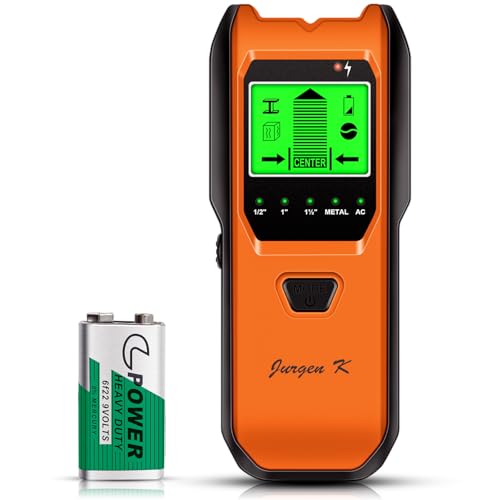
- Five scan modes for studs, metal, and AC wires
- LCD display with audio detection alarm
- Includes a 9V battery and ergonomic grip
Best For: DIY projects requiring varied detection modes
Simple Budget Pick

- Straightforward wood and metal detection
- Works up to 3/4 inch deep
- LED lights and beeping indicate stud edges
Best For: Basic wall-mounting tasks on a budget
Deep-Scan Safety Choice

- Metal detection reaches up to 2.36 inches
- WireWarning detects live AC wires up to 2 inches
- HD LCD and audio alerts show scan results
Best For: Deeper scans and added live-wire awareness
Most Intuitive – Franklin Sensors ProSensor M210
The Franklin Sensors ProSensor M210 is a practical choice among wall scanner stud finders when you want quick, uncomplicated stud detection. Its 13-sensor design displays the full width of wood or metal studs, while the center LED turns green to help identify the middle.
Best For: Homeowners who want no-calibration scanning with full-width stud visibility.
Pros:
- 13 sensors display stud width and centers.
- Starts scanning anywhere without calibration.
- Detects wood and metal studs up to 1.7 inches deep.
- Includes live-wire detection, a bubble level, and pencil caddy.
Cons:
- Requires two AA batteries, which are not included.
- Its 1.7-inch depth is less than some deeper-scanning models.
The M210 emphasizes ease of use and clear LED feedback rather than multiple scan modes. It is a strong everyday option for drywall projects where straightforward stud-center identification matters.
Most Versatile – FNIRSI WD-01 6-in-1 Wall Scanner
The FNIRSI WD-01 stands out among wall scanner stud finders for its broad detection range and six scanning functions. It can locate wood and metal studs, ferrous and non-ferrous metals, live AC wiring, and copper wire, with readings shown on an LCD and supported by an audio alarm.
Best For: DIY users who need one rechargeable scanner for studs, pipes, metals, and wiring.
Pros:
- Offers six detection modes for varied wall materials.
- Detects studs up to 1.5 inches deep in depth mode.
- Scans copper, iron, live AC wires, and copper wires at specified depths.
- Rechargeable design includes automatic calibration and LCD feedback.
Cons:
- Maximum stud depth is lower than the deepest model in this roundup.
- The many scan modes may require more setup than a basic stud finder.
With rechargeable power, automatic calibration, and dedicated metal and wire modes, the WD-01 is geared toward users who want more than simple stud locating. Its positioning hole also helps mark detected edges and centers.
Best for Deep Scanning – Franklin Sensors ProSensor MAX
The Franklin Sensors ProSensor MAX is designed for deeper wall scanning than many wall scanner stud finders. Its 13 larger sensors can detect studs through up to 2.5 inches of drywall, plaster, OSB, plywood, MDF, or large tile, with a display that shows stud width and center.
Best For: Remodelers and DIYers scanning thick, layered, or difficult wall surfaces.
Pros:
- Provides up to 2.5 inches of detection depth.
- Two modes support standard and deep scanning.
- Shows single or double studs and identifies centers.
- Requires no calibration before scanning.
Cons:
- It is larger and heavier than the compact M210.
- The supplied notes do not list live-wire detection.
- Battery power is required.
The MAX is the most specialized choice here for depth and tough surfaces. Its two-mode design lets you use standard scanning for routine work and switch to deep scanning when wall layers interfere.
Best for Jobsite Use – BOSCH GMS120-27 Professional Wall Scanner
The BOSCH GMS120-27 is a professional-oriented option among wall scanner stud finders, combining detection for wood studs, metal framing, copper pipes, and live AC wiring. Its graphical display and color-coded marking ring provide center guidance and a visual red warning when live wire is detected.
Best For: Electricians, plumbers, contractors, and installers who need a rugged multi-material scanner.
Pros:
- Detects wood, metal, copper pipes, and live AC wiring.
- Graphical display and marking ring support center finding.
- IP54-rated body and shock-absorbing rubber casing suit jobsite use.
- Includes AA batteries, soft pouch, and flexible battery options.
Cons:
- The Bosch 3.7V Li-Ion battery is sold separately.
- Its professional features may be more than casual users need.
- The supplied notes do not specify maximum detection depths.
The GMS120-27 prioritizes durability, material versatility, and clear safety feedback. It is a sensible investment when a wall scanner will see regular use in garages, workshops, or construction environments.
Best All-Around Wall Scanner – Klein Tools ESF200
The Klein Tools ESF200 is a practical choice among wall scanner stud finders when you want to locate stud centers and edges while also checking for wood, metal, and live AC wires. Its automatic calibration and wall-safe design help simplify repeated scans during installation projects.
Best For: DIYers and professionals who want one scanner for common stud, metal, and live-wire detection tasks.
Pros:
- LED indicators show the full width and edges of studs.
- Automatically calibrates as you move between walls.
- Detects wood up to 3/4 inch, ferrous metal up to 1-1/2 inches, and AC voltage up to 2 inches deep.
- Finger guard and protective felt backing help protect walls from marks.
Cons:
- Battery powered, so replacement batteries may be needed over time.
- The listed wood detection depth is limited to 3/4 inch.
The ESF200 stands out for combining automatic calibration, multi-material scanning, and clear LED guidance in a compact tool. It is a strong fit when versatility and wall protection matter more than specialized scanning features.
Best for Guided Scanning – Zircon MultiScanner A200
The Zircon MultiScanner A200 is one of the more guided wall scanner stud finders, pairing multiple scan modes with an LCD display, audio tone, and SpotLite Pointer. It can help identify stud edges and centers, scan deeper areas, locate metal, and provide a warning for hot wires before drilling.
Best For: Users who prefer on-screen and visual guidance for mounting shelves, TVs, cabinets, mirrors, and fixtures.
Pros:
- StudScan detects wood or metal stud edges and centers up to 3/4 inch deep.
- DeepScan reaches up to 1-1/2 inches for deeper scanning needs.
- WireWarning Detection alerts users to hot electrical wires behind the wall.
- LCD display, audio tone, and SpotLite Pointer support marking and alignment.
Cons:
- Requires careful calibration: it must remain flat and still until the calibration beep.
- Uses a 9V alkaline battery that must be replaced when power is low.
The A200 offers the clearest feedback of these options, with several modes and multiple forms of guidance. Its calibration procedure requires attention, but the added display and deeper scanning mode can be useful for more deliberate mounting work.
Best Slim Center-Finder – DEWALT DW0100 Stud Finder
The DEWALT DW0100 is a straightforward option among wall scanner stud finders, using center-find technology, directional LED arrows, and an audible alert to locate wood and metal framing. Constant auto-calibration and a slim profile make it convenient for routine indoor mounting jobs.
Best For: Users who want a compact, easy-to-store scanner for locating wood or metal studs up to 3/4 inch deep.
Pros:
- Center-find technology helps locate the center of a stud.
- Detects wood and metal to a depth of 3/4 inch.
- AC and live-wire detection adds a safety check before drilling.
- AAA batteries are included, and the slim profile is easy to store.
Cons:
- Does not detect objects in concrete, mortar, block, brickwork, plaster, carpeting, foil-faced materials, metallic surfaces, or ceramic tile.
- Not designed to locate non-ferrous or plastic objects such as pipes.
- Its stated detection depth is limited to 3/4 inch.
The DW0100 keeps the process simple with center marking, arrows, an audible alert, and automatic calibration. It is a sensible choice for standard wood- and metal-framed walls, provided the surface falls within its listed limitations.
Versatile Home Scanner – 5-in-1 Smart Stud Finder
For shoppers comparing wall scanner stud finders, this 5-in-1 model offers several detection depths for locating studs, metal, pipes, and live AC wires. Its LCD screen, audio alarm, and included 9V battery make it practical for common mounting and renovation tasks.
Best For: Homeowners and DIY users who want multiple scan modes and visible readings.
Pros:
- Five modes cover stud depths from 1/2 inch to 1.5 inches, plus metal and AC scanning.
- Detects the edges and centers of studs, metal, pipes, and live AC wires.
- Backlit LCD, continuous beeping, calibration, and an ergonomic non-slip grip support easier scanning.
Cons:
- The product has several modes to learn compared with a basic stud finder.
- Detection performance depends on correct calibration and scanning technique.
With broad detection coverage and straightforward visual and audible feedback, this is a flexible choice for installing TVs, cabinets, shelves, and garage storage.
Simple Budget Pick – eOUTIL 3/4-Inch Stud Finder
Stud Finder Wall Scanner Wood and Metal Detector Sensor for 1-inch Thickness Wall (Yellow)
Check Price On AmazonIf you prefer wall scanner stud finders without complicated settings, this eOUTIL model uses a straightforward button-operated scan for wood and metal behind walls. LED indicators and beeping help signal when you reach a stud edge.
Best For: Budget-conscious users handling basic picture, shelf, cabinet, or TV-mounting jobs.
Pros:
- Simple operation avoids multiple scan modes.
- Detects wood and metal up to 3/4 inch deep.
- Four-level light indicator and audio alarm provide two detection cues.
Cons:
- The 9V battery is required but not included.
- It offers less detection depth and fewer functions than the 5-in-1 models.
This compact, uncomplicated scanner is a sensible option when you mainly need to locate standard wood or metal studs rather than identify pipes or AC wiring.
Deep-Scan Safety Choice – Upgraded 5-in-1 Wall Scanner
Among wall scanner stud finders, this upgraded 5-in-1 model stands out for deeper metal and AC-wire detection. It combines dedicated scan modes, WireWarning, an HD LCD display, and an audible alarm for users working on walls, floors, and ceilings.
Best For: DIYers and professionals who want deeper scanning and live-wire awareness.
Pros:
- Detects studs up to 1.5 inches, metal up to 2.36 inches, and live AC wires up to 2 inches.
- WireWarning remains active in several scan modes to help flag live AC wiring.
- LCD display and audio alerts help identify stud centers and edges.
Cons:
- Its broader capabilities may be more than needed for simple stud locating.
- Battery-powered operation requires the included AA battery to be monitored.
The deeper scan range and always-on WireWarning feature make this a strong fit for mounting and renovation work where locating potential obstructions matters.
How We Picked These Wall Scanner Stud Finders
We focused on the features that matter during real installation work: detection accuracy, sensing depth, stud-centering ability, live-wire and metal detection, display readability, power source, and ease of calibration. We also included both established professional-tool brands and multifunction scanners aimed at occasional DIY use.
No electronic scanner should be treated as a guaranteed safety device. Use the tool according to its instructions, scan from multiple directions, and confirm important findings with measurements or a second method before drilling.
Quick Comparison
| Best For | Look For |
|---|---|
| Fast stud locating | Wide sensing area, center indication, and simple LED or audio alerts |
| Deep or difficult walls | Greater detection depth and selectable scan modes |
| Electrical safety | Dedicated live-wire detection and clear warning indicators |
| Professional projects | Reliable calibration, durable construction, and readable results |
| Occasional DIY work | Simple controls, included batteries, and an affordable design |
Key Buying Factors for Wall Scanner Stud Finders
Detection Modes and Materials
Basic models locate wood or metal framing, while multifunction wall scanners may identify live AC wiring, metal objects, and different wall depths. Selectable modes are useful when working through drywall, plaster, tile, or thicker surfaces.
Center Finding and Accuracy
A center-finding mode is usually more useful than a simple edge alert when installing heavy shelves or brackets. Wider sensor arrays can speed up scanning by showing more of a stud at once, but correct calibration and a steady pass remain essential.
Depth and Wall Construction
Check the advertised sensing depth against your wall type. Moisture, dense plaster, foil-backed insulation, pipes, fasteners, and uneven surfaces can affect readings. Deeper detection is helpful, but it does not eliminate the need to verify a target.
Alerts, Display, and Power
LED arrows, audio alarms, LCD screens, and vibration alerts each suit different conditions. A bright display helps in dim rooms, while audible alerts are convenient when you are watching the tool’s position. Rechargeable models reduce battery waste; replaceable batteries are convenient for longer jobs.
Who Should Buy Which Wall Scanner Stud Finders?
Choose a straightforward center-finding scanner if your main task is hanging frames, shelves, or light fixtures. Pick a model with live-wire and metal detection for renovation work or walls with uncertain construction. A deeper-sensing professional scanner is the better choice for thick, layered, or older walls and frequent projects. Multifunction LCD scanners can offer strong versatility for budget-conscious DIYers, provided you verify readings before drilling.
For the safest results, mark a suspected stud at several points, scan horizontally and vertically, and avoid drilling directly where a live-wire warning appears. If the reading is inconsistent or the project involves plumbing, electrical work, or structural framing, stop and investigate further.