Hard water can leave scale on fixtures, shorten appliance life, and make cleaning more difficult—especially in smaller homes where space and water usage are limited. The right softener should match your household size, plumbing setup, regeneration needs, and installation space.
These 10 options include compact whole-house systems, portable RV-friendly softeners, and a salt-free descaler for shoppers who want a lower-maintenance approach. Use the guide below to narrow the list by capacity, technology, operating cost, and installation requirements.
Best 10 Water Softeners for Small Homes Picks for 2026
Best Metered Softener

- Sized for one to two bathrooms
- Programmable metered digital control
- Helps reduce scale and appliance wear
Best For: Small homes wanting whole-house softening with customizable regeneration
Best Portable RV Option
On The Go 16,000-Grain Double Standard

- Portable 16,000-grain RV softener
- Regenerates with table salt in under 30 minutes
- Needs no electricity or tools
Best For: RV and marine setups, not residential showers or sinks
Best Space-Saving Efficiency
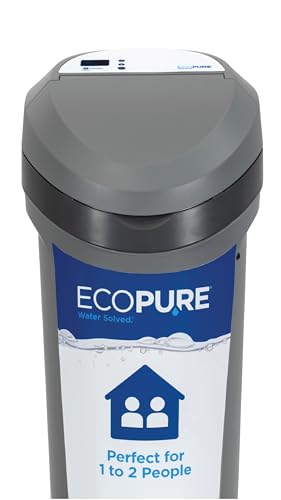
- Designed for one to two people
- AutoSense AI helps reduce salt use
- Compact cabinet-style whole-house design
Best For: Small households with limited installation space
Best RV Brass-Fitting Model
On The Go 16,000-Grain Compact

- 16,000-grain portable capacity
- Drinking-water-safe brass fittings
- Compact 10 x 10 x 24-inch design
Best For: RV water connections where a compact fitting-equipped unit is needed
Compact Whole-Home Filtration
3-Stage Water Filter and Scale System

- Filters sediment, chlorine, odors, iron, lead, and scale
- Includes three sets of cartridges for up to two years
- Compact design with bypass and shut-off valves
Best For: Small homes needing filtration and scale reduction without TDS removal
Certified Salt-Saving Softening

- 40,000-grain capacity for up to five people and four bathrooms
- NSF/ANSI 44-certified ion-exchange hardness reduction
- Metered controls help reduce salt and water use
Best For: Families wanting certified whole-house softening with efficiency controls
High-Capacity Smart Softening
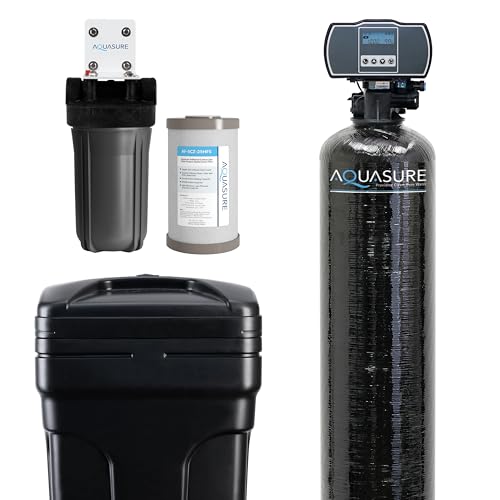
- 50,000-grain capacity for three- to four-bathroom homes
- Includes sediment, GAC, and zinc pre-filter
- Digital metered control enables programmable operation
Best For: Multi-bathroom small homes needing softening plus pre-filtration
Best Salt-Free Pick
iSpring ED2000 Electronic Descaler

- Compact, maintenance-free design
- No salt or plumbing modifications
- Helps reduce scale buildup
Best For: Small homes wanting salt-free scale control
Best for 1–4 People
Kenmore 350 32,000-Grain Softener

- Sized for 1–4-person homes
- Smart regeneration helps limit salt waste
- Compact footprint with 7.2-gpm flow
Best For: Small households needing conventional ion-exchange softening
Best High-Capacity Option
iSpring WCSTB45KG 45,000-Grain Softener
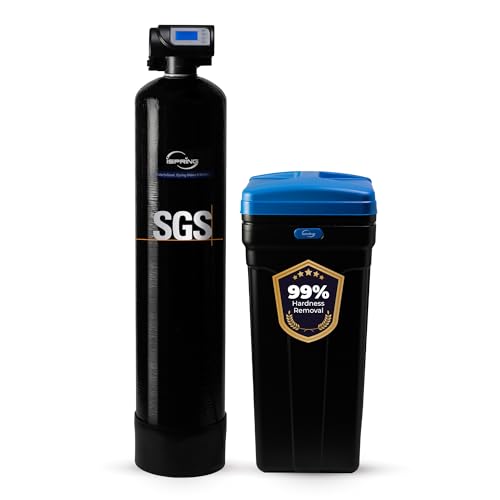
- 45,000-grain whole-house capacity
- Automatic regeneration and backwash
- Works with city or well water
Best For: Small homes needing extra capacity for hard water
Best Metered Softener – Aquasure Harmony 32,000-Grain
For households seeking water softeners for small homes, the Aquasure Harmony is sized for one to two bathrooms and treats up to 32,000 grains of hardness. Its metered controls help tailor regeneration to water use and incoming water quality.
Best For: Small homes with one or two bathrooms that want whole-house softening and programmable controls.
Pros:
- Designed specifically for one to two bathrooms.
- 32,000-grain capacity helps reduce hardness and scale buildup.
- Backlit digital meter supports customizable automatic flushing and maintenance monitoring.
- Includes a corrosion-resistant tank, bypass valve, and prefilled resin.
Cons:
- Requires corded electricity.
- At 52 inches tall and 67 pounds, it may need substantial installation space.
The Harmony is a practical whole-house option when you want a higher-capacity system without sizing for a large household. Its programmable metered head and included warranty and support add convenience, but confirm the installation area and electrical requirements first.
Best Portable RV Option – On The Go 16,000-Grain Double Standard
The On The Go Double Standard is a portable alternative for RV and marine owners rather than a conventional whole-house system. Among water softeners for small homes, it is relevant only for mobile setups because it connects through a standard garden hose and is not intended for household showers or under-sink installation.
Best For: RV or marine owners needing portable soft water without electricity or tools.
Pros:
- 16,000-grain capacity can provide up to approximately 1,600 gallons or 40 days, depending on water hardness and usage.
- Regenerates in under 30 minutes using two boxes of common table salt.
- Compact 22-inch design includes a carry handle, movable base, and travel cap and plug.
- Uses high-grade resin and a standard garden hose connection.
Cons:
- Not made for apartments, houses, showers, or under-kitchen-sink installation.
- Capacity varies substantially with source-water hardness and usage.
This unit makes sense when portability is the priority, especially in an RV storage bay or marine locker. It should not be treated as a substitute for a plumbed whole-house softener in a small home.
Best Space-Saving Efficiency – EcoPure EPS110
The EcoPure EPS110 is built specifically for small households of one to two people and one to two bathrooms. Its cabinet-style design and AutoSense AI demand-based regeneration make it a strong choice among water softeners for small homes where footprint and ongoing salt use matter.
Best For: One- or two-person households needing a compact whole-house softener for a closet, basement, or utility room.
Pros:
- Designed for one to two people and one to two bathrooms.
- AutoSense AI regeneration may use up to 40% less salt than comparable demand-based 32,000-grain systems.
- All-in-one cabinet design houses the resin tank inside the brine tank.
- Built-in sediment protection helps protect plumbing and appliances.
Cons:
- Requires corded electricity.
- Warranty coverage varies, with the standard full warranty listed as one year.
The EPS110 prioritizes efficient operation and a smaller footprint rather than a traditional exposed-tank layout. Its household sizing is straightforward, making it easier to match to a compact home without performing grain-capacity calculations.
Best RV Brass-Fitting Model – On The Go 16,000-Grain Compact
The On The Go OTG4-VM-DBLSOFT is a compact 16,000-grain portable softener with drinking-water-safe brass fittings. It can be useful for RV water connections, but it is not a residential whole-house solution despite its compact size.
Best For: RV owners who want a portable softener with brass fittings and a compact footprint.
Pros:
- 16,000-grain double-standard capacity.
- Compact 10-by-10-by-24-inch dimensions.
- Includes drinking-water-safe brass fittings.
Cons:
- Specifically not intended for apartments, condos, or house showers.
- Will not fit under a kitchen sink.
- Supplied notes do not specify regeneration time, gallon yield, or power details.
This model is best evaluated as an RV accessory rather than one of the water softeners for small homes. Its compact dimensions and brass fittings suit mobile water connections, while the stated installation limitations rule out typical household applications.
Compact Whole-Home Filtration – 3-Stage Water Filter and Scale System
For shoppers comparing water softeners for small homes, this compact three-stage system is better understood as a whole-house filter with scale-reduction support rather than a traditional salt-based softener. It targets sediment, chlorine, odors, iron, lead, and scale while retaining natural minerals, and its 3/4-inch connections suit many standard installations.
Best For: Small households seeking broad filtration in a compact under-sink, utility-room, or whole-house setup.
Pros:
- Three-stage filtration addresses sediment, chlorine, odors, iron, lead, and scale.
- Includes three complete filter sets, providing approximately 1.5–2 years of replacements.
- Built-in bypass and two shut-off valves simplify installation and cartridge changes.
- Compact 14-by-13-by-10-inch housing and a rated flow of up to 15 GPM.
Cons:
- It does not lower TDS or remove naturally occurring minerals.
- Cartridges require replacement about every six months, depending on use.
- It is not a conventional ion-exchange water softener for fully softened water.
This is a practical choice when your priority is cleaner-tasting water and reduced scale without committing to a large brine-tank system. Confirm the plumbing size and remember to remove each cartridge’s protective plastic wrap before installation.
Certified Salt-Saving Softening – Aquasana SimplySoft 40K Grain
Among water softeners for small homes, the Aquasana SimplySoft 40,000-grain system is a strong fit for households that want traditional ion-exchange softening with metered regeneration. It is sized for homes of up to five people and four bathrooms and is certified to NSF/ANSI 44 for reducing water hardness.
Best For: Families wanting certified, whole-house softening with programmable salt- and water-saving operation.
Pros:
- 40,000-grain capacity is designed for homes with up to five people and four bathrooms.
- Ion exchange reduces hard-water minerals, scale, and spotting throughout the home.
- Metered operation can use 50% less salt and 28% less water than standard time-based regeneration, according to the supplied specifications.
- Includes a user-friendly LCD and a 5/10-year limited warranty.
Cons:
- The 43-inch-tall, 92-pound tank-and-cabinet system needs dedicated installation space.
- An optional pre-filter is recommended but sold separately.
- It requires corded electricity and a suitable operating pressure of 20–125 psi.
SimplySoft offers the most conventional softening approach in this group, with useful efficiency controls and recognized certification. Measure carefully before buying, especially in a small utility area, and plan for the separate pre-filter if your water contains substantial sediment.
High-Capacity Smart Softening – Aquasure Harmony 50K Grain
For water softeners for small homes with three or four bathrooms, the Aquasure Harmony Series combines 50,000-grain capacity with automatic metered controls and a pre-filter. It is designed to reduce calcium and magnesium hardness while the sediment, GAC, and zinc pre-filter targets chlorine, odors, taste, VOCs, PFAs, rust, and other incoming contaminants.
Best For: Three- to four-bathroom homes that want higher-capacity softening plus pre-filtration and programmable regeneration.
Pros:
- 50,000-grain rating is sized for homes with three to four bathrooms.
- Triple-purpose pre-filter addresses sediment, chlorine, odors, taste, rust, and other listed contaminants.
- Backlit digital metered control supports programmable auto-flush intervals and maintenance monitoring.
- Includes a corrosion-resistant stainless-steel bypass valve, prefilled resin, and a five-year extended warranty when activated as specified.
Cons:
- The 48-inch-tall tank may be difficult to place in a compact installation area.
- Supplied specifications list reverse osmosis as the purification method, although the product description centers on water softening and pre-filtration; verify the installation documentation.
- Installation requires whole-house tank plumbing and appropriate space for the system components.
This system makes sense when a small home has relatively high water demand or multiple bathrooms and you want filtration before the softener. Its taller 50,000-grain configuration may be more capacity than a very small household needs, so compare available space and water use before choosing it.
Best Salt-Free Pick – iSpring ED2000 Electronic Descaler
For shoppers comparing water softeners for small homes, the iSpring ED2000 is a compact salt-free alternative focused on reducing scale rather than removing hardness minerals. It installs around existing pipes without plumbing modifications, uses no salt or chemicals, and requires no routine maintenance.
Best For: Small homes seeking a low-maintenance, salt-free way to help reduce limescale while retaining minerals in the water.
Pros:
- Compact 7-by-3.5-by-2-inch design that can fit in tight spaces.
- Works with PEX, PVC, and other pipe types without plumbing modifications.
- Uses no salt or chemicals and requires no maintenance.
- Includes a one-year money-back guarantee and lifetime technical support.
Cons:
- It is a descaler, not a conventional water softener, so it does not remove calcium or magnesium.
- Requires a corded electrical connection.
The ED2000 is best viewed as a simple scale-control device for smaller households, particularly where salt use, maintenance, or plumbing work is undesirable. Choose a conventional ion-exchange softener if you specifically want hardness minerals removed.
Best for 1–4 People – Kenmore 350 32,000-Grain Softener
The Kenmore 350 is a conventional whole-house water softener sized for households of one to four people. Its ion-exchange system addresses hard minerals and offers smart regeneration, a compact footprint, and a 7.2-gpm maximum flow rate for practical small-home use.
Best For: Households of one to four people that want a traditional, programmable water softener in a relatively compact installation footprint.
Pros:
- 32,000-grain capacity is specified for 1–4-person households.
- IntelliSoft technology adapts regeneration to household water use to help reduce salt waste.
- Reduces calcium, magnesium, and some clear-water iron, helping limit scale and soap scum.
- Includes a sediment shield, digital display, installation kit, and long tank warranty.
Cons:
- At 80 pounds and 48 inches tall, it requires more space than a salt-free descaler.
- Ion-exchange operation requires salt and regeneration.
- Installation is freestanding and may require suitable plumbing and drainage space.
Among water softeners for small homes, the Kenmore 350 is a strong fit when actual hardness reduction matters. Its household-size rating and adaptive regeneration make it more targeted than a larger commercial-style system, though it still needs room for a traditional softener setup.
Best High-Capacity Option – iSpring WCSTB45KG 45,000-Grain Softener
The iSpring WCSTB45KG is a 45,000-grain whole-house ion-exchange softener with a separate brine tank and automatic regeneration. Although its capacity may exceed the needs of some small homes, it is worth considering when higher demand, well-water compatibility, or extra softening headroom is a priority.
Best For: Small homes with especially hard water or higher usage that can accommodate a full brine-tank system.
Pros:
- 45,000-grain capacity provides more softening headroom than the Kenmore 350.
- Third-party testing reports a 99.71% reduction in water hardness.
- Automatic regeneration and backwash use water quality and usage data to manage cycles.
- Compatible with city and well water and includes lifetime free technical support.
Cons:
- Its 75.6-pound system and brine tank require more installation space than a compact descaler.
- Automatic operation requires a corded electrical connection.
- The larger capacity may be unnecessary for a lightly used small household.
This iSpring is a practical choice when a small home has demanding hardness conditions and enough room for a conventional brine-tank installation. For limited space or minimal maintenance, a smaller softener or salt-free descaler may be easier to live with.
How We Picked the Best Water Softeners for Small Homes
We focused on systems suited to modest household water demand, including units designed for one to four people and compact portable models. We considered grain capacity, control type, regeneration efficiency, installation footprint, maintenance requirements, and whether each product is a true salt-based softener or a salt-free conditioner. We also included different price and installation profiles so shoppers can compare practical alternatives rather than choosing by capacity alone.
Because local water hardness varies, capacity should be treated as a starting point. Check your municipal report or use a hardness test before buying, then confirm that the model supports your plumbing size and available drain, power, and brine-tank locations.
Quick Comparison
| Best For | Recommended Type | What to Prioritize |
|---|---|---|
| One to four residents | 32,000–45,000-grain metered softener | Demand-based regeneration and efficient salt use |
| Very limited installation space | Compact or portable softener | Footprint, hose connections, and regeneration convenience |
| RVs, cabins, and temporary setups | Portable 16,000-grain unit | Easy hookup, transport, and drinking-water-safe fittings |
| No-salt preference | Electronic descaler or salt-free conditioner | Scale-control expectations and compatibility with water conditions |
| Whole-home filtration needs | Softener or combination filter system | Contaminants addressed, replacement media, and flow rate |
Key Buying Factors for Water Softeners for Small Homes
Capacity and Household Size
A 16,000-grain portable unit may work for occasional use or a small water supply, while a 32,000- to 45,000-grain system generally offers more reserve capacity for a small family. Oversizing is not automatically better: a unit that regenerates too infrequently can waste capacity, while one that is too small may regenerate often.
Metered Controls and Efficiency
Demand-initiated systems regenerate based on actual water use instead of a fixed calendar schedule. This can reduce wasted salt and water, making metered controls particularly useful in homes with changing occupancy.
Salt-Based Versus Salt-Free
Salt-based softeners exchange hardness minerals and produce genuinely softened water. Salt-free conditioners and electronic descalers do not remove hardness; they aim to reduce how readily scale forms. Choose based on whether you need softer-feeling water or primarily want scale control with less routine maintenance.
Installation and Maintenance
Confirm that you have a suitable water-line location, drain, electrical outlet, bypass arrangement, and space for the resin and brine tanks. Salt-based systems require regular salt additions and periodic cleaning. Portable models simplify installation but may require manual regeneration.
Who Should Buy Which Water Softeners for Small Homes?
Choose the Kenmore 350 or a 32,000-grain Aquasure system if you need a conventional whole-house softener for a small household. Consider the EcoPure EPS110 when compact household-focused sizing is the priority. The Aquasure 50,000-grain, Aquasana SimplySoft 40K, or iSpring 45,000-grain models make more sense when water is particularly hard or usage is higher.
For RVs, cabins, or homes without a permanent installation, choose one of the On The Go 16,000-grain portable systems. If you want to avoid salt and routine brine-tank maintenance, the iSpring ED2000 is the relevant alternative—but remember that it conditions rather than softens water. Finally, select a combination filtration system only after confirming which contaminants it targets and how its flow rate fits your household.