Cleaning large, high, or hard-to-reach windows can be time-consuming and risky. The best window cleaning robots under $500 combine strong suction, automated navigation, spray systems, and safety backups to reduce hands-on work.
This roundup compares 10 affordable models across compact designs, edge-cleaning performance, spray coverage, and protection features so you can choose a robot that fits your windows and cleaning routine.
Best 10 Window Cleaning Robots Under 500 Picks for 2026
Test-Winning Edge Specialist
HUTT 10 Premium Round-Square Robot

- Dual-stage round wet-lift and square dry-polish cleaning
- 6500Pa suction with constant 55N pressure
- 220kg safety rope and 30-minute UPS protection
Best For: Edge-focused cleaning on windows, mirrors, and glass doors
High-Rise Round Performer

- 6400Pa variable suction and dual-spray cleaning
- AI navigation with edge detection
- 30-minute UPS and heavy-duty safety cable
Best For: High windows, skylights, mirrors, and tile walls
Large-Surface Coverage Pick

- Square edge-cleaning design for corners and frames
- Triple spray system with a 200ml tank
- AI routes plus fast, intensive, and spot modes
Best For: Large windows and users needing targeted stain cleaning
Mode-Flexible Budget Option

- Four-nozzle dual-spray system
- Six cleaning modes with remote control
- Pressure monitoring, drop sensor, and 25-minute backup
Best For: Routine glass cleaning with adjustable paths and spray
Best Simple Setup
Tosima W5 Window Cleaning Robot
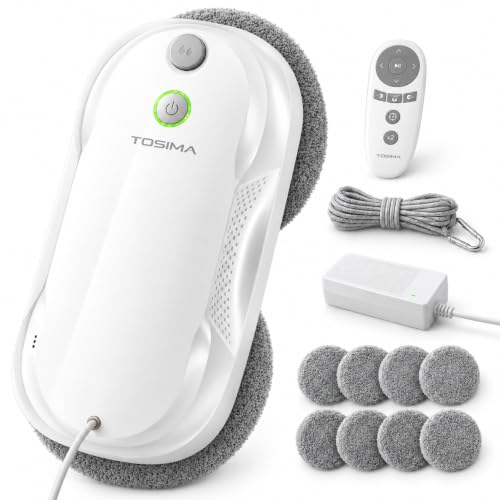
- Compact 4-pound design for apartments and smaller homes
- Adaptive suction up to 6,400Pa
- Dual spray and triple safety system
Best For: Simple remote-controlled cleaning on smooth glass
Best Budget-Friendly Option

- Dual-direction auto-spray for smooth surfaces
- Automatic and manual cleaning modes with remote control
- Replaceable nozzles, cloths, and tank covers
Best For: Light to moderate dirt on suitable high-rise windows and smooth surfaces
High-Reach Feature Pick

- 6400Pa suction for indoor or outdoor glass
- Triple safety system with backup battery and rope
- Dual spray, edge detection, and remote control
Best For: High-rise or hard-to-reach glass cleaning
Guided Glass-Cleaning Value

- 3000Pa suction with edge detection
- Dual spray and intelligent path planning
- Rope and 20-minute UPS backup protection
Best For: Smooth glass windows, doors, mirrors, and angled skylights
Test-Winning Edge Specialist – HUTT 10 Premium Round-Square Robot
For shoppers comparing window cleaning robots under 500, the HUTT 10 Premium stands out for its certified round-square, dual-stage cleaning system. It combines wet lifting, dry wiping, and polishing with strong suction and smart mapping for glass surfaces as small as 30×30 cm.
Best For: Homeowners who want strong edge coverage, dual-stage cleaning, and added safety for elevated windows.
Pros:
- Round wet-lift and square dry-polish pads help improve edge, corner, and frame-line coverage.
- 6500Pa suction and constant 55N pressure support stable, more forceful cleaning.
- Includes NAVI 7.0 mapping, 14 sensors, a 220kg safety rope, and up to 30 minutes of UPS adhesion.
- Supports windows, mirrors, shower doors, and sliding doors, with an 80ml tank.
Cons:
- Spray performance requires purified water, and cleaning liquid is not included.
- Tracks and pads must be kept appropriately clean and dry to prevent slipping or navigation issues.
- The 80ml tank may require refilling on larger cleaning jobs.
The HUTT is a feature-rich choice in this category, particularly if corners and frame edges matter. Its dual-pad workflow adds versatility, but careful pad preparation and water choice are important for reliable operation.
High-Rise Round Performer – X6 Window Cleaning Robot
The X6 is a practical contender among window cleaning robots under 500, using variable 6400Pa suction, dual spray nozzles, and AI navigation for interior or exterior glass. Its slim round design is also intended for windows, skylights, mirrors, and tile walls.
Best For: Apartment and office users who need a round robot for high windows, large glass areas, and mixed surfaces.
Pros:
- 6400Pa variable suction adjusts to help maintain adhesion while cleaning grime and dust.
- Dual-spray nozzles and AI route planning support more even coverage.
- Includes edge detection, a 30-minute UPS function, and a safety cable rated for at least 150 pounds.
- Works on glass, tile walls, mirrors, skylights, and floor-to-ceiling windows.
Cons:
- Its round form may not reach corners as directly as a square-shaped design.
- For heavily soiled glass, the supplied guidance recommends two cleaning passes.
- Water amount and pad cleanliness need attention to avoid smears.
With a slim profile, broad surface compatibility, and substantial safety features, the X6 is well suited to routine maintenance. Plan on replacing dirty pads and using controlled moisture for the clearest finish.
Large-Surface Coverage Pick – WISEBOT AI Square Robot
WISEBOT brings square-edge coverage and AI navigation to the window cleaning robots under 500 category. Its triple-spray system, 200ml tank, spot-cleaning function, and multiple routes are designed for large windows, balcony glass, mirrors, and other vertical surfaces.
Best For: Users prioritizing larger water capacity, targeted stain cleaning, and improved corner and frame access.
Pros:
- Square body with four round corner pads and a dedicated edge-cleaning mode targets corners and frame areas.
- AI navigation includes route planning, edge and frameless-glass detection, obstacle recognition, and tilt sensing.
- Triple-spray wet cleaning and a 200ml tank support broader, longer cleaning sessions.
- Offers fast, intensive, and spot-cleaning modes with reusable microfiber cloths.
Cons:
- The supplied notes do not specify suction strength, tank runtime, or noise level.
- Wet cleaning requires managing a larger water supply and microfiber cloths.
- As with other exterior glass robots, the safety rope and backup protection still require proper use.
WISEBOT is a compelling option when corner coverage and wet-cleaning capacity matter more than a compact round form. Its route choices and spot mode make it adaptable for both routine cleaning and localized stains.
Mode-Flexible Budget Option – WA9C Pro Window Robot
The WA9C Pro is a compact choice among window cleaning robots under 500, pairing four spray nozzles with remote-controlled cleaning modes. Its N-shaped, Z-shaped, and manual paths are designed to cover glass windows while maintaining contact through pressure monitoring and drop sensors.
Best For: Buyers who want remote control, adjustable spray volume, and multiple path options for routine glass cleaning.
Pros:
- Four-nozzle dual-spray system is designed to distribute moisture evenly across the glass.
- Six intelligent cleaning modes include N-shape, Z-shape, and manual control for targeted areas.
- Pressure monitoring, a drop sensor, power-failure protection, and a safety rope add operational safeguards.
- Includes cleaning mops, replacement nozzles, an unclogging needle kit, water bottle, and remote.
Cons:
- Its listed 2600–3200Pa suction is lower than the stronger-suction models in this roundup.
- Power-failure battery protection is rated for up to 25 minutes.
- The supplied specifications identify glass windows as the surface recommendation, with fewer stated surface applications.
The WA9C Pro makes sense for shoppers who value control and included maintenance accessories. Its lower listed suction and shorter backup duration make it better suited to straightforward glass-cleaning tasks than demanding high-rise use.
Best Compact Pick – ECOVACS WINBOT MINI 2
For shoppers comparing window cleaning robots under 500, the ECOVACS WINBOT MINI 2 stands out for its compact design and edge-focused cleaning. It is built for framed or frameless windows, mirrors, glass doors, and floor-to-ceiling glass, provided the surface meets the minimum size requirement.
Best For: Narrow windows, mirrors, glass doors, and routine cleaning of light dirt and fingerprints.
Pros:
- Compact 8.46-inch square design fits tighter glass areas.
- Four corner brushes and thin side wings bring the pad within 1 mm of edges.
- Offers ultrasonic misting, 8,000Pa suction, five cleaning modes, and route planning.
- Backup protection keeps the robot attached for over 30 minutes during a power interruption.
Cons:
- The minimum applicable window size is 8.66 x 9.84 inches.
- Heavily soiled glass may require multiple cycles or pad cleaning.
- At 65 dB, it is not silent during operation.
The MINI 2 is a strong choice when edge coverage and access to narrow glass matter more than maximum cleaning speed. Its safety systems and app-based controls add convenience, but users should still anchor the safety rope before every use.
Best Simple Setup – Tosima W5 Window Cleaning Robot
Among window cleaning robots under 500, the Tosima W5 is a practical option for apartments, condos, and smaller homes. It starts with a simple plug-in-and-place setup, then uses adaptive suction, dual spraying, and remote control to handle smooth glass surfaces.
Best For: Apartment residents and shoppers wanting compact, remote-controlled cleaning for smooth glass windows.
Pros:
- Compact, lightweight 4-pound design is easy to handle and store.
- Adaptive suction reaches up to 6,400Pa and adjusts to the surface.
- Dual-spray cleaning helps loosen dust, fingerprints, and stubborn stains.
- Triple safety system includes suction, a 220kg-rated safety rope, and up to 25 minutes of backup power.
Cons:
- The 25-minute emergency battery is intended for outages rather than cordless operation.
- Remote control is the primary listed control method, rather than app control.
- Its 6-inch cleaning path may require more passes on larger windows.
The W5 balances straightforward operation with useful safety features and replaceable parts. It is especially appealing for everyday maintenance in smaller homes, though users should expect a relatively narrow cleaning path.
Best Budget-Friendly Option – KKI X2 Window Cleaning Robot
For buyers seeking window cleaning robots under 500, the KKI X2 focuses on high-rise windows and broad smooth-surface compatibility. Its dual-direction spray, remote control, and automatic or manual cleaning modes can reduce the need for ladders when cleaning suitable glass.
Best For: Light to moderate dirt on smooth windows, mirrors, tiles, wooden doors, and marble surfaces.
Pros:
- Dual-direction auto-spray helps cover the cleaning area.
- AI path planning can scan frames and support automatic or manual modes.
- Works on a range of smooth surfaces, including glass, mirrors, ceramic tiles, and marble.
- Replaceable nozzles, microfiber cloths, and water tank covers simplify maintenance.
Cons:
- Requires corded power and lists up to 25 minutes of battery backup.
- Not designed for curved, textured, or very uneven glass.
- Heavily soiled windows may need a pre-wipe, and concentrated solutions can clog the sprayer.
The X2 is best viewed as a maintenance tool for appropriate smooth surfaces rather than a substitute for deep cleaning. Its replaceable parts and multiple control modes add flexibility, but surface compatibility and cleaning-solution limits require attention.
Compact Everyday Pick – ECOVACS WINBOT MINI
For shoppers comparing window cleaning robots under 500, the ECOVACS WINBOT MINI is a compact option focused on routine indoor glass maintenance. Its lightweight design, app control, intelligent path planning, and three cleaning modes make it suited to quick touch-ups and smaller windows.
Best For: Apartments, narrow or hard-to-reach indoor windows, and light everyday dust or fingerprints.
Pros:
- Compact, lightweight body that is easy to handle and store.
- Strong suction and a 9-stage protection system help it stay attached during cleaning.
- Quiet operation and simple setup support frequent household use.
- App control, dual ultrasonic spray nozzles, and three cleaning modes add convenience.
Cons:
- Designed primarily for light dirt and routine maintenance; heavily soiled glass may require multiple cycles.
- Indoor use is specified, and the robot must remain connected to corded power.
The WINBOT MINI is a practical choice when compact handling and straightforward daily cleaning matter more than tackling severe buildup. For stubborn stains, plan on cleaning the pad or repeating the cycle.
High-Reach Feature Pick – Curalk 6400Pa Window Robot
Among window cleaning robots under 500, this updated model stands out for high-reach glass cleaning features. It combines variable-frequency suction up to 6400Pa, triple safety protection, dual-direction spray, edge detection, and remote control for indoor or outdoor glass surfaces.
Best For: High or hard-to-reach indoor and outdoor glass where extra suction, a safety rope, and remote operation are useful.
Pros:
- 6400Pa variable-frequency suction adapts to different dirt levels and glass surfaces.
- Triple safety system includes a backup battery, air-pressure anti-drop protection, and a 178-inch safety rope.
- Dual-direction ultrasonic spray, edge and corner detection, and three cleaning modes support thorough coverage.
- Includes 10 microfiber mop replacements and an 85ml water tank.
Cons:
- Requires careful pad preparation; pads should be dampened to 50–70%, and cleaning solution should not be poured into the machine.
- As a corded robot, it is not a fully cordless cleaning solution despite its backup battery.
This model is compelling for users prioritizing reach and safety features on larger or elevated glass. Its remote control and navigation system add convenience, while correct pad and solution preparation remain important for streak-free results.
Guided Glass-Cleaning Value – Dual-Spray Window Robot
This dual-spray model is a focused option among window cleaning robots under 500 for smooth glass surfaces. It offers 3000Pa suction, edge detection, intelligent path planning, a 50ml tank, and a remote control, with safety support from a rope and UPS backup battery.
Best For: Suitable glass windows, glass doors, mirrors, and skylights angled at least 30 degrees from horizontal.
Pros:
- Dual atomizing nozzles provide even water coverage, with three cleaning paths.
- Edge detection and intelligent path planning support cleaning on frameless windows.
- Triple safety protection combines 3000Pa suction, a 4m safety rope, and 20-minute UPS backup.
- Includes 10 microfiber cloths, two cleaning rings, a remote, and power accessories.
Cons:
- It must stay plugged in; the UPS battery provides emergency holding rather than cordless operation.
- Not recommended for curved glass, thick trim, raised decorative elements, or horizontal surfaces.
- Heavy stains such as bird droppings, dried mud, paint, or oil need manual pre-cleaning.
The robot offers useful coverage and safety features for compatible glass, but preparation is central to reliable performance. A dry first pass followed by a wet second pass, with fresh cloths, is the recommended approach.
How We Picked the Best Window Cleaning Robots Under 500
We focused on the features that matter most in real-world window cleaning: suction strength, navigation, edge detection, spray delivery, safety systems, and ease of setup. We also considered whether each robot is suited to interior glass, exterior windows, high-rise use, framed surfaces, and different window sizes.
Specifications such as advertised suction pressure and cleaning modes can vary by manufacturer, so treat them as comparison points rather than guarantees. Surface condition, window framing, moisture, and pad maintenance all affect results.
Quick Comparison
| Feature | What to look for | Why it matters |
|---|---|---|
| Suction | About 3,000Pa or higher | Helps maintain contact on smooth glass |
| Navigation | Intelligent path planning or AI guidance | Improves coverage and reduces missed areas |
| Spray system | Dual, triple, or multi-nozzle delivery | Spreads cleaning solution more evenly |
| Safety | Backup battery, tether, and alarms | Adds protection if power or suction changes |
| Design | Compact body and edge detection | Helps with narrow panes and framed windows |
Key Buying Factors for Window Cleaning Robots Under 500
Suction and Surface Compatibility
Higher advertised suction can help a robot stay attached, but it does not make every model suitable for every surface. Check whether the manufacturer specifies compatibility with framed, frameless, tinted, frosted, or textured glass. Most robots work best on clean, smooth panes.
Navigation and Edge Cleaning
Look for intelligent path planning, edge detection, and corner coverage if your windows have frames or large uninterrupted surfaces. Compact robots may be easier to position, while square-edge designs can potentially reach closer to corners.
Spray Delivery and Cleaning Pads
Dual- or triple-spray systems can improve coverage, but the robot still depends on clean, properly attached microfiber pads. Confirm how replacement pads are sourced and whether the robot requires a specific cleaning solution or limited liquid volume.
Safety Features
For exterior or high windows, prioritize a safety tether, backup power, automatic alarms, and stable suction monitoring. Never rely on the robot alone: attach the tether correctly, keep the area below clear, and follow the operating instructions.
Who Should Buy Which Window Cleaning Robots Under 500?
- For small panes and tight spaces: Choose a compact WINBOT Mini-style model that is easier to handle and store.
- For high or exterior windows: Prioritize strong suction, a robust tether, backup protection, and clear safety alerts.
- For better edge coverage: Look for square designs, edge detection, and corner-focused navigation.
- For heavier cleaning workloads: Consider models with stronger suction, multiple spray nozzles, and several cleaning modes.
- For occasional maintenance: A simpler dual-spray robot may offer the best balance of cost, setup time, and useful automation.
Before buying, measure your smallest window, check the surface requirements, and verify the included tether, pads, power cable, and remote or app controls. The right choice is the model whose safety features and operating limits match your windows—not necessarily the one with the highest headline suction rating.