Low flow at showers, faucets, or appliances can make everyday water use frustrating. The best water pressure booster pumps for homes can improve pressure and maintain more consistent performance when municipal supply, elevation, or long pipe runs are limiting flow.
This roundup compares 10 home-focused booster pumps across automatic controls, variable-speed operation, pressure ratings, flow capacity, and self-priming designs. Use the buying guide below to match pump performance and installation requirements to your household.
Best 10 Water Pressure Booster Pumps for Homes Picks for 2026
Best Smart Constant-Pressure Pick

- Automatic variable-speed constant pressure
- Quiet 55 dB operation
- 22–80 PSI adjustable range
Best For: Homes needing quiet, automatically regulated pressure
Best High-Capacity Smart Pick

- Up to 53 GPM flow
- 22–92 PSI adjustable pressure
- Smart Life app control
Best For: Larger homes with multiple floors and faucets
Best Mid-Size Smart Whole-House Pick
- 26.5 GPM residential flow
- 22–92 PSI adjustable range
- Wireless app monitoring
Best For: Medium-size homes needing smart constant pressure
Whole-Home Comfort Pick
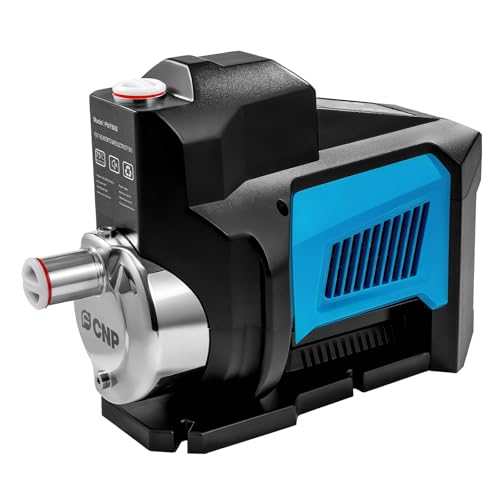
- Variable-speed pressure control for up to 10 faucets
- 22–80 PSI setting range and 164-foot maximum head
- Quiet operation with dry-run and power-failure protection
Best For: Larger homes and multi-fixture water systems
Quiet Adjustable Pick
Hanchen Variable-Speed Booster

- Adjustable pressure with variable-speed control
- Built-in check valves and dry-run status display
- Quiet operation rated at 45 dB or less
Best For: Apartments and homes needing quiet, adjustable boosting
Best High-Capacity Pick
CrestWave 1HP Variable-Speed Booster Pump

- 180-foot maximum head and 1,800 GPH flow
- 15–80 PSI adjustable pressure range
- Quiet motor with diagnostics and timed water-tower mode
Best For: Larger homes and higher water-demand applications
Best Automatic Stainless-Steel Option

- Automatic start/standby operation
- Water-shortage protection and pressure gauge
- Stainless-steel body with 1-inch connections
Best For: Hands-off household pressure boosting from wells or municipal supplies
Best Balanced Variable-Speed Pick
CrestWave Whole-House Booster Pump
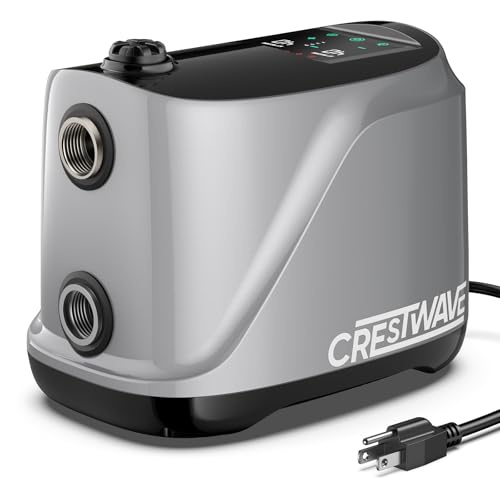
- 550W variable-speed motor with 15–80 PSI adjustment
- 150-foot maximum head and 1,500 GPH flow
- Quiet operation with pressure tank and fault diagnostics
Best For: Typical whole-house pressure boosting with energy-conscious control
Best Smart Constant-Pressure Pick – Aquastrong Smart 45
For homeowners comparing water pressure booster pumps for homes, the Aquastrong Smart 45 stands out as an integrated option with automatic variable-speed control. It adjusts output to demand, supports pressure settings from 22 to 80 PSI, and is designed for domestic water systems, apartments, showers, tanks, and shallow wells.
Best For: Homes needing quiet, automatically regulated pressure across multiple faucets.
Pros:
- Maintains constant pressure while adjusting performance to water demand.
- Quiet 55 dB operation with a permanent-magnet motor and inverter technology.
- Includes dry-run, overheating, blockage, leakage, and pressure-sensor protections.
- Self-priming design supports city mains, tanks, irrigation, and shallow wells up to 26 feet.
Cons:
- Maximum flow is 1,500 GPH, lower than the higher-capacity EVO BOOST8.
- Its integrated design may require more careful installation planning than a basic utility pump.
The Smart 45 is a strong fit when consistent household pressure, quiet operation, and built-in safeguards matter more than maximum flow capacity. Its adjustable 22–80 PSI range also gives homeowners useful control over the system.
Best High-Capacity Smart Pick – AIDPATH EVO BOOST8
The AIDPATH EVO BOOST8 is one of the more powerful water pressure booster pumps for homes, combining a 1.5 HP permanent-magnet motor with up to 53 GPM flow. Its variable-speed system automatically responds to demand and is rated for steady pressure across as many as 12 faucets on three floors.
Best For: Larger homes requiring high flow, multi-floor coverage, and app-based monitoring.
Pros:
- Delivers up to 53 GPM and a stated 197-foot head.
- Adjustable 22–92 PSI pressure range with automatic demand response.
- Smart Life app enables remote monitoring and parameter adjustments.
- Includes dry-run, overcurrent, and voltage-fault protections, plus a three-year full warranty.
Cons:
- Its larger 20.7-inch-long housing needs adequate installation space.
- The 1¼-inch MNPT ports may require adapters in systems using smaller connections.
With its high flow rating and app controls, the EVO BOOST8 is suited to demanding whole-house installations. It is a particularly practical choice for larger homes, although buyers should verify connection sizes and available space before installation.
Best Simple Mechanical-Control Pick – 1.5HP Automatic Booster Pump
For shoppers who want straightforward water pressure booster pumps for homes without complex electronics, this 1.5 HP automatic booster pump uses a mechanical pressure switch. It self-primes, starts and stops automatically, and can also handle irrigation, drainage, circulation, and emergency water transfer.
Best For: Buyers who prefer simple automatic operation for household and utility water tasks.
Pros:
- Mechanical pressure switch provides automatic start and stop control.
- 1.5 HP motor offers up to 1,600 GPH flow and a 120-foot maximum head.
- Self-priming design helps simplify startup.
- Built-in overheat and dry-run protection support safer operation.
Cons:
- Pressure cannot be custom-adjusted.
- It lacks the variable-speed control and app monitoring found on the EVO models.
- The notes list a 100-foot maximum head in one performance description and 120 feet in the product details.
This pump makes sense when reliability and uncomplicated controls are priorities. Its mechanical switch is easy to understand, but the lack of custom pressure adjustment makes it less flexible for users seeking precise constant-pressure management.
Best Mid-Size Smart Whole-House Pick – AIDPATH EVO BOOST5
The AIDPATH EVO BOOST5 offers a balanced option among water pressure booster pumps for homes, with a 1.2 HP variable-frequency motor and up to 26.5 GPM flow. It automatically adjusts to demand, supports up to eight faucets across three floors, and adds wireless monitoring through the Smart Life app.
Best For: Medium-size homes seeking smart constant pressure without the EVO BOOST8’s higher capacity.
Pros:
- Provides adjustable 22–92 PSI pressure and automatic demand control.
- Supports up to eight faucets across three floors.
- Smart Life app offers remote status, pressure, energy, and temperature monitoring.
- Quiet 50 dB operation with dry-run, overcurrent, and voltage-fault protection.
Cons:
- Its 26.5 GPM flow rating is lower than the EVO BOOST8’s 53 GPM capacity.
- The 1-inch MNPT ports may require plumbing adapters depending on the existing system.
The EVO BOOST5 is a sensible middle ground for homes that want variable-speed constant pressure and connected controls. It provides substantial capacity for typical residential demand while remaining more moderate than the larger EVO BOOST8.
High-Output Pick – 3/4 HP Automatic Booster Pump
For homeowners comparing water pressure booster pumps for homes, this 3/4 HP model combines strong flow with automatic operation. It delivers up to 17 GPM, reaches a stated maximum head of 130 feet, and includes adjustable pressure control for household plumbing, garden watering, or sprinkler use.
Best For: Homeowners who need a versatile, high-flow pump for low-pressure water supply, lawn irrigation, or shallow-well applications.
Pros:
- 17 GPM flow rate and up to 130 feet of maximum head.
- Automatic start when flow is detected and dry-run shutoff protection.
- Adjustable output pressure and standard 110V plug with a 6.5-foot cord.
- 1-inch inlet and outlet ports support household plumbing and watering setups.
Cons:
- The inlet requires a dedicated reinforced suction hose; a standard soft garden hose may collapse.
- At 24 pounds, it is heavier than the smaller pump options in this roundup.
This is a practical choice when flow capacity and application flexibility matter most. Confirm your plumbing connections and plan for the required reinforced intake hose before installation.
Whole-Home Comfort Pick – PM750S Constant-Pressure Pump
This whole-house model is designed for homeowners who want water pressure booster pumps for homes with automatic, consistent performance. Its variable-speed system adjusts to demand, supports a pressure range of 22–80 PSI, and is rated to supply up to 10 faucets across three floors.
Best For: Whole-house residential or light-commercial systems where quiet operation, constant pressure, and multi-fixture performance are priorities.
Pros:
- Automatic variable-speed control maintains consistent pressure as demand changes.
- Pressure setting range of 22–80 PSI and maximum head of 164 feet.
- Permanent-magnet motor is designed for quiet operation, with stated noise as low as 25–40 dB.
- Includes dry-run and power-failure protection, plus a stainless-steel pump head.
Cons:
- The larger 16.93-by-9.06-by-13.39-inch housing requires adequate installation space.
- Its advanced whole-house design may be more capability than a small, single-fixture setup needs.
Among these water pressure booster pumps for homes, the PM750S is the strongest fit for larger residential layouts and variable demand. Its integrated controls reduce the need for manual adjustment, while the quiet motor is better suited to occupied living spaces.
Quiet Adjustable Pick – Hanchen Variable-Speed Booster
The Hanchen HT-95-MYF offers a compact approach to water pressure booster pumps for homes, with variable-speed control, automatic start/stop, and user-adjustable pressure. Its 0.7 HP permanent-magnet motor supplies up to 18.5 GPM and is rated at no more than 45 dB.
Best For: Homes or apartments needing adjustable, quiet pressure boosting for showers, taps, shallow wells, or garden watering.
Pros:
- Variable-frequency control adjusts motor speed to maintain stable pressure.
- LED controls show operating, dry-run, and power-failure status.
- Built-in inlet and outlet check valves help prevent backflow and short cycling.
- Automatic on/off operation and stated noise level of 45 dB or less.
Cons:
- The stated maximum lifting height is 26 feet, limiting suitability for deeper lifts.
- Its 0.7 HP motor has less power than the larger whole-house pump in this roundup.
This pump stands out for compact residential installations where quiet operation and simple pressure adjustment are important. The built-in check valves and status display also make routine operation easier, but buyers should verify that the 26-foot lift rating matches their water source.
Best High-Capacity Pick – CrestWave 1HP Variable-Speed Booster Pump
If you need one of the more powerful water pressure booster pumps for homes, this CrestWave model combines a 1HP-class, 750W permanent-magnet variable-speed motor with adjustable pressure from 15 to 80 PSI. Its automatic speed adjustment is designed to maintain smoother household water flow while reducing unnecessary energy use.
Best For: Larger household water-demand needs, multi-outlet use, and homeowners who want variable-speed pressure control with diagnostic features.
Pros:
- Offers up to 180 feet of head and 1,800 GPH maximum flow.
- Adjustable 15–80 PSI range supports flexible household settings.
- Quiet 45 dB operation, pressure tank, check valve, and fault-code indicators add convenience.
- Water tower mode supports timed replenishment at 1-, 3-, 6-, or 12-hour intervals.
Cons:
- Initial setup requires filling the pump body and purging air from the system.
- The control panel displays head in meters rather than pressure, so settings may require consultation of the manual.
Choose this CrestWave when maximum capacity and adjustable constant-pressure operation matter most. Its built-in protections and quiet variable-speed design make it a feature-rich option, though installation and setup deserve careful attention.
Best Automatic Stainless-Steel Option – 2/3HP Home Booster Pump
This automatic stainless-steel pump is a practical choice among water pressure booster pumps for homes when you want hands-off operation. It starts when a faucet opens, switches to standby when demand stops, and includes water-shortage protection to help prevent dry running.
Best For: Homes needing automatic pressure assistance from municipal, well, or surface-water sources, including water heaters and multiple household outlets.
Pros:
- Automatic switch control starts and stops the pump based on water demand.
- Water-shortage protection helps stop operation when supply is insufficient.
- Stainless-steel construction, a pressure gauge, and control panel support monitoring and durability.
- Maximum lifting height is listed at 130 feet, with a 1-inch connection for household systems and garden hoses.
Cons:
- The supplied specifications contain inconsistent flow-rate wording, so buyers should verify the exact performance rating before installation.
- Two exterior appearances may be dispatched randomly.
- Installation still requires matching the 1-inch connections to the existing plumbing.
This model stands out for straightforward automatic control and visible pressure monitoring. Confirm the flow specifications and connection requirements for your system before buying, especially if you plan to supply several outlets simultaneously.
Best Balanced Variable-Speed Pick – CrestWave Whole-House Booster Pump
For homeowners comparing water pressure booster pumps for homes, this CrestWave model offers a balance of adjustable pressure, quiet operation, and moderate capacity. Its 550W permanent-magnet variable-speed motor automatically adapts to household demand, with a selectable 15–80 PSI pressure range and a factory default of 36 PSI.
Best For: Typical whole-house applications where steady pressure, lower operating noise, and energy-conscious variable-speed performance are priorities.
Pros:
- Provides up to 150 feet of head and 1,500 GPH maximum flow.
- Variable-speed control and a 15–80 PSI adjustment range support consistent water delivery.
- 45 dB operating noise is suitable for residential settings.
- Includes a pressure-stabilizing tank, outlet check valve, timed water-tower mode, and fault indicators.
Cons:
- Its maximum head and flow are lower than the 1HP CrestWave model.
- First use requires manual priming and thorough air removal from the pump and piping.
- The panel shows head in meters, not pressure, which may make adjustment less intuitive.
This is a sensible middle-ground option for whole-house boosting when you want smart pressure control without stepping up to the higher-capacity CrestWave. Compare its 150-foot head and 1,500 GPH rating with your household’s elevation and simultaneous-flow needs.
How We Picked the Best Water Pressure Booster Pumps for Homes
We evaluated these pumps by comparing the specifications that matter most in residential installations: maximum pressure, flow rate, horsepower, voltage, control method, priming capability, and intended use. Automatic and variable-speed models received attention for whole-house applications because they can respond to demand more conveniently than basic utility pumps.
Specifications such as 80 or 85 PSI describe maximum capability, not necessarily the pressure available at every fixture. Actual results depend on incoming supply, pipe size, elevation, fittings, and the number of outlets operating at once.
Quick Comparison
| Best For | What to Prioritize |
|---|---|
| One shower or fixture | Compact pump, automatic switch, moderate flow |
| Small or average home | Whole-house design, roughly 20–30 GPM, dependable controls |
| Large household or simultaneous use | Higher flow capacity, stronger motor, constant-pressure control |
| Variable incoming pressure | Adjustable or variable-speed operation |
| Shallow-well or utility application | Self-priming construction and suitable suction limitations |
Key Buying Factors for Water Pressure Booster Pumps for Homes
Pressure and Flow
Pressure determines how forcefully water reaches fixtures, while flow determines how much water the pump can deliver at the same time. A high PSI rating alone does not guarantee strong performance under multiple loads. Match the pump to your home’s peak demand and avoid selecting a model solely by horsepower.
Controls and Activation
Automatic pressure switches are convenient for ordinary on-demand use. Variable-speed pumps can provide steadier pressure and may adjust output as demand changes, but they are typically more complex and can cost more. Check whether the pump includes a pressure sensor, controller, check valve, or other required components.
Installation and Compatibility
Confirm the voltage, inlet and outlet sizes, flow direction, pump placement, and whether the unit is designed for potable-water systems. Some models are better suited to shallow wells, gardens, or individual fixtures than permanent whole-house plumbing. Electrical work and plumbing modifications should follow local codes and, when necessary, be completed by qualified professionals.
Noise, Protection, and Maintenance
Look for dry-run protection, thermal overload protection, corrosion-resistant materials, and accessible service parts. A pump should be installed where it remains dry, ventilated, and protected from freezing. A strainer or suitable filtration may also help protect the pump from debris.
Who Should Buy Which Water Pressure Booster Pumps for Homes?
Choose a variable-speed or adjustable-pressure whole-house model if you want more consistent pressure across changing demand. Higher-flow 1.2- to 1.5-horsepower options make more sense for larger homes, multiple bathrooms, or simultaneous fixtures, provided the plumbing and incoming supply can support them.
For a smaller home, a single bathroom, or a targeted shower-pressure problem, a lower-horsepower automatic pump may be sufficient and easier to install. Self-priming models are useful where the setup requires that feature, but verify their rated lift and application before purchase. If your home already has acceptable supply pressure but suffers from occasional fluctuations, prioritize automatic controls and pressure regulation over the highest advertised PSI.